Feeders
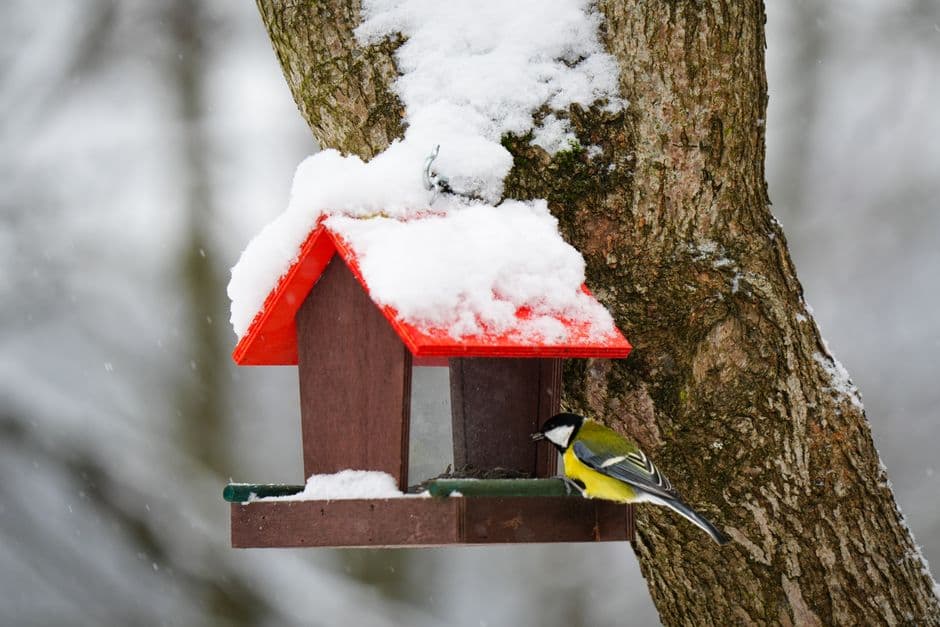
Heated hummingbird feeders and feeder heaters for winter
You cannot buy a good heated feeder. You can buy a good heater and put it under a feeder you already trust - and you should know its limit before you rely on it.
We earn a commission on purchases made through our links, at no extra cost to you. We don’t accept free products or paid placements. Full disclosure.
Buy a heater, not a heated feeder. The Hummer Hearth sits under a feeder you already own and is the only product in this category we found that publishes its wattage, a named electrical standard and an actual temperature limit: about 10 F with the 15 W bulb, wind depending. Almost every “heated hummingbird feeder” on the market is an unbranded listing with none of those figures, which is a poor trade for a mains-powered device that lives outside in the wet.
What we recommend here
| # | Product | Best for | Score | Price |
|---|---|---|---|---|
| 1 |  Hummer Hearth Feeder Heater Published wattage, UL/CAS wet-location cord, stated limit | The heater to buy | 8.3 out of 10 | |
| 2 |  Aspects HummZinger HighView 12 oz Flat-bottomed saucer - the shape a heater needs | The feeder to put over it | 9.2 out of 10 | |
| 3 |  Birds Choice Weatherguard Dome, 13 in Keeps snow off the ports the heater cannot reach | For snow, not just cold | 8.3 out of 10 |
Scores are our own editorial ratings from the criteria on our methodology page. They are not customer ratings and they are not test results.
The honest state of this category
We went looking for heated hummingbird feeders expecting to compare four or five and rank them. What we actually found was one verifiable product and a great many listings we could not responsibly recommend.
The heated-feeder listings are overwhelmingly unbranded — seller names that exist nowhere except an Amazon storefront, no manufacturer website, no spec sheet, no model number that resolves to anything. Several advertise a “constant temperature” without saying what wattage produces it or what outside temperature it holds against.
On a plastic feeder that would earn a shrug and a place in our skip list. On a device that plugs into your house and hangs outdoors through a winter, we think it earns something stronger. So this page recommends the other approach.
What a feeder heater actually is
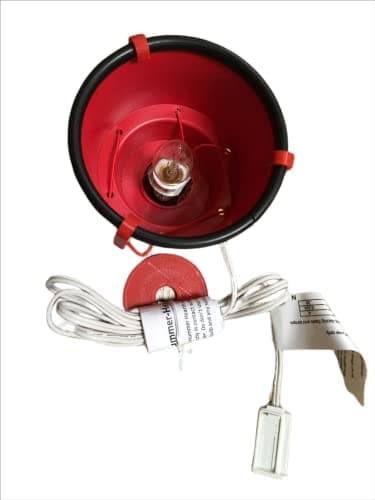
A low-wattage bulb inside a shielded housing that sits underneath your existing feeder and warms the nectar through the base. It does not touch the nectar and it is not part of the feeder, which means you can keep using the feeder you already chose on cleaning access and port design, and add heat only for the months you need it.
The Hummer Hearth is the one we could verify in detail. It ships with a 7 W bulb and accepts a 15 W, on a 6-foot cord and lamp holder that the maker states complies with UL / CAS specifications for outdoor wet conditions, with a fuse-protected plug, polarized contacts and cord strain protection. A rubber grip ring holds it against the bottom of the feeder and seals warm air in. It is made in the USA, and the feeder is not included.
Those are ordinary-sounding details. The reason they matter is that they are the exact details the rest of the category does not publish.
The honest limit: about 10 degrees
The specification we most want you to take away. Hummer Hearth states that, depending on wind, the 15 W bulb keeps a feeder thawed down to roughly 10 F (−12 C). Smaller feeders do better than large ones, because there is less nectar to keep warm.
So this is not a device that makes winter a solved problem. It extends the range in which a feeder stays usable, by a meaningful amount, and then it runs out. Below that, or in hard wind, nectar will freeze anyway. A maker that tells you where its product stops is being more useful than one that implies it never does.
It also needs mains power at the feeder, which quietly rules out most yards. Before buying, work out where the feeder hangs relative to an exterior outlet rated for outdoor use.
At what temperature does nectar freeze?
We cannot give you a number, and we would rather say so than invent one.
What is true and uncontroversial is the direction: dissolved sugar lowers the freezing point of water, so a 4:1 nectar solution freezes somewhere below 32 F rather than at it. What we could not find, in any manufacturer documentation or extension-service publication, is a published figure for the exact temperature at which standard 4:1 hummingbird nectar freezes. Numbers do circulate for this, confidently and inconsistently, and we are not going to add another one.
The practical version needs no number anyway: if the nectar in your feeder has visible ice crystals or slush in it, the birds cannot drink it, and that is the only reading you actually need.
The answer that costs nothing
If there is no outdoor power where your feeder hangs — which will be most readers — the standard approach needs no equipment at all: keep two feeders and rotate them.
One hangs out, one sits indoors at room temperature. When the outdoor one starts to freeze, you swap them. Hummingbirds feed heavily at first light after a cold night, so the one that matters most is the feeder that goes out at dawn, not the one that hung there overnight. Bring the outdoor one in after dusk when nothing is feeding anyway, and put the warm one out before sunrise.
It is more work than plugging something in, and it is free, reliable and has no failure mode. You need two feeders for it, which you may well want anyway for the reasons in how many feeders you need.
Wrapping a feeder in insulation is the other commonly suggested trick. It slows heat loss from nectar that is already warm; it does not add any heat, so on a cold day it delays the problem rather than preventing it.
Snow is a separate problem from cold
A heater warms nectar through the base. It does nothing about snow settling on top of the feeder and packing into the ports, which stops birds feeding just as effectively as ice in the reservoir does.
That is what a dome is for, and it is why a dome is a pick on a page about heat. Thirteen inches of cover over the top keeps snow off the ports and off the perch. Sizing and alternatives are in weather domes and rain guards.
Should you be feeding in winter at all?
Worth settling before you spend anything, because the most common reason people ask about heated feeders is a worry that turns out to be misplaced.
Leaving a feeder up does not delay migration. Hummingbirds migrate on day length and their own internal cues, not on whether your feeder is full, and a feeder left out will not trap a bird that would otherwise have left. That myth is dealt with properly in leaving a feeder up in winter, alongside the more useful question of when to take one down, which is in when to take feeders down.
Winter feeding genuinely matters in the parts of the country where some hummingbirds overwinter or where late stragglers pass through. If that is you, a heater is a reasonable purchase. If you are in a region where every bird has gone by November, the honest answer is that you do not need one.
Check the outlet before you check the heater
The specification that will actually decide whether you can use one of these is not on the heater. It is on your house.
The Hummer Hearth comes with a 6-foot cord. Six feet is not very far. Measure the real distance from where the feeder hangs to the nearest exterior outlet before you order anything, and remember that the run is rarely a straight line — it goes down the post, along the rail and around a corner. If the answer is more than six feet, you are also buying an outdoor-rated extension cord, and that is a second thing living in the weather all winter.
The heater itself is specified for this: the maker states the cord and lamp holder comply with UL / CAS specifications for outdoor wet conditions, with a fuse-protected plug, polarized contacts and cord strain protection. Those are the words you want to see, and their absence is precisely what disqualified the rest of the category from this page. An exterior outlet on a GFCI circuit with a weatherproof cover is the right place to plug it in.
Cleaning does not stop in winter
Easy to assume that cold weather suspends the cleaning schedule. It does not, and a heater makes that more true rather than less, because the entire point of it is to keep the nectar above freezing — which is to say, in the temperature range where it spoils.
A warmed feeder in January is closer to a shaded feeder in May than to a frozen one. Keep washing it, keep changing the nectar, and expect the interval to look more like the cool-weather schedule than like nothing at all. The cadence is in how often to clean a feeder.
This is another quiet argument for the saucer shape: in cold hands, with cold water, a two-part feeder you can open and rinse in a minute is very different from unscrewing a bottle base on a January morning.
What we would actually do
If you have outdoor power at the feeder and you are in overwintering territory: the Hummer Hearth under a flat-bottomed saucer feeder, with a dome over the top if you get real snow. A saucer is the right shape because the heater seals against a flat or gently rounded base with no air gap, and because it is the easiest thing to wash — and you are still washing it weekly in January.
If you do not have outdoor power: two feeders, rotated at dawn and dusk. Spend the money you saved on the second feeder.
Recommended for this
What we’d buy
1. The heater to buy
Hummer Hearth Feeder Heater
A bulb in a shielded housing that sits under the feeder you already own — the only feeder heater we could find with a published wattage, a named electrical standard and a stated temperature limit.
- Type
- Feeder heater (feeder not included)
- Bulb
- 7 W included; accepts 15 W
- Cord
- 6 ft power cord / lamp holder
- Electrical
- Complies with UL / CAS specifications for outdoor wet conditions
- Safety
- Fuse-protected plug, polarized contacts, cord strain protection
- Rated to
- Keeps feeders thawed to about 10 F (-12 C) with the 15 W bulb, wind depending
- Fitting
- Rubber grip ring holds it against the feeder base and seals in warm air
- Made in
- USA
Our score: 8.3/10 — an editorial rating, not a customer rating or a test result.
Cleaning access
Nothing to clean — it never touches nectar. It comes off the feeder in one movement, which does matter, because you are still washing the feeder weekly in winter and you do not want a heater that has to be unbolted first.
What works
- Published wattage, cord length and electrical standard — close to unique in this category
- Fuse-protected plug and strain relief rather than an unlabeled cord
- Works with a feeder you already trust instead of replacing it
- States a real temperature limit rather than claiming to work in any cold
What doesn’t
- About 10 F is the honest floor — a deep freeze will beat it
- Needs mains power at the feeder, which rules out most yards
- Works best on flat or rounded feeder bottoms with no air gap
- Costs more than most of the feeders it warms
Price as of October 16, 2026. #ad How we’re funded
Specifications from Hummer Hearth — Hummingbird Feeder Warmer. We have not handled this feeder — here is what we did instead.
2. The feeder to put over it
Aspects HummZinger HighView 12 oz
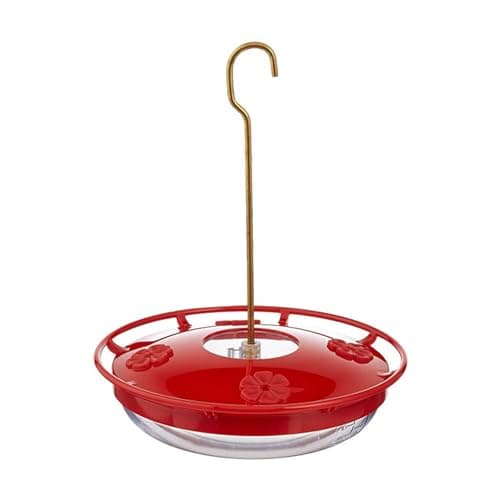
A four-port saucer feeder with the ant moat built into the lid and a cover that lifts straight off — the shortest path from hanging it up to washing it out.
- Type
- Saucer (dish)
- Capacity
- 12 oz
- Feeding ports
- 4
- Material
- Polycarbonate, metal hanger
- Dimensions
- 7.75" x 7.75" x 1.75"
- Ant moat
- Built in
- Perch
- Raised wraparound perch
- Mounting
- Hang or post mount
Our score: 9.2/10 — an editorial rating, not a customer rating or a test result.
Cleaning access
Two parts. The cover lifts off the base with no tools and no threads to cross, and the whole dish is one open bowl — a two-minute wash with a brush and hot water, which is exactly the cadence a nectar feeder needs. The moat is part of the lid, so there is no separate accessory to lose or forget to refill.
What works
- Saucer design puts nectar below the ports, so it does not drip as the air inside warms
- Ant moat is integral to the lid rather than a separate hanging accessory
- Opens to a single shallow bowl — the easiest shape in the category to scrub
- Raised ports shed rain, which keeps the nectar from being diluted
What doesn’t
- 12 oz is small for a busy yard
- Polycarbonate clouds over several seasons in a way glass does not
- No bee-excluding port tips fitted — that is the Ultra's feature, not the HighView's
Specifications from Duncraft — Aspects High View HummZinger and Amazon — Aspects HummZinger HighView 12 oz. We have not handled this feeder — here is what we did instead.
3. For snow, not just cold
Birds Choice Weatherguard Dome, 13 in
Thirteen inches of acrylic with brass hanging hardware in the box, from the one maker in this category that prints what its dome will not do.
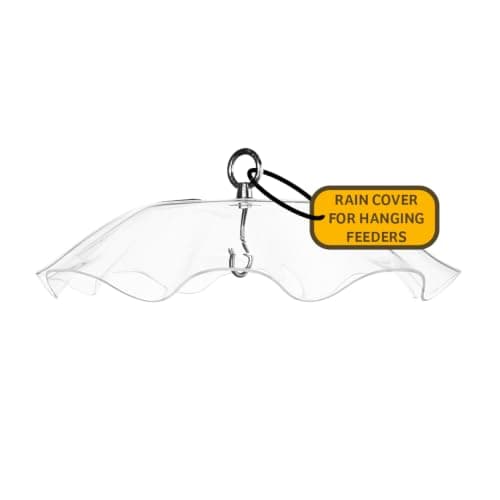
- Type
- Weather dome / rain guard
- Diameter
- 13 in
- Height
- About 3-4 in (retailer listings vary)
- Material
- Acrylic, 1/8 in thick
- Hardware
- Brass hanging hardware included
- Fits
- Small nectar, tube and seed feeders
- Protects against
- Rain and snow
- Not a baffle
- Maker states it is not intended as a squirrel or pest deterrent
- Color
- Clear on the current listing; the line is also sold in red, orange and yellow
Our score: 8.3/10 — an editorial rating, not a customer rating or a test result.
Cleaning access
Unhook it and wash it; nothing comes apart and no nectar touches it. Acrylic scratches more readily than polycarbonate, so use a cloth rather than the brush you use on feeder ports — a scratched dome hazes and you lose the view through it.
What works
- 13 in is the right size class for a standard hummingbird feeder, with margin for angled rain
- Brass hanging hardware is in the box rather than sold separately
- Maker states plainly that it is not a squirrel deterrent
- Clear body keeps the view of the feeder
What doesn’t
- Acrylic at 1/8 in scratches and hazes sooner than polycarbonate
- No tint, so it shades by blocking direct sun rather than filtering it
- Birds Choice publishes no warranty term for it
- Costs a real fraction of the feeder hanging underneath
Specifications from Birds Choice - Weatherguard acrylic bird feeder dome, 13 in round, 1/8 in acrylic, brass hanging hardware included, not intended as a squirrel deterrent. We have not handled this feeder — here is what we did instead.
What we’d skip
“2-in-1 heated hummingbird feeders” from unbranded sellers
This is the largest part of the category and we featured none of it. Search heated hummingbird feeders and you get a wall of listings from sellers with no presence outside Amazon, priced between about fifteen and forty dollars, most claiming a constant temperature. What almost none of them publish is the wattage, the electrical safety standard the cord and plug are built to, or the outside temperature the thing actually works down to. We hold that line on feeders because unverifiable specs make a recommendation dishonest. We hold it much harder here, because this is a mains-powered electrical device that hangs outdoors in rain, snow and ice all winter, and "who made this and to what electrical standard" stops being a question about product quality and becomes a question about your house.
Common questions
Frequently asked
Do hummingbirds need a heated feeder in winter?
Only where hummingbirds overwinter or where late birds are still passing through. In most of the country they have gone by late autumn, and a heater is solving a problem you do not have. Leaving a feeder up does not delay migration either way — see winter feeding.
At what temperature does hummingbird nectar freeze?
We could not find a published figure and will not guess one. Dissolved sugar lowers the freezing point, so 4:1 nectar freezes somewhere below 32 F rather than at it, but the exact temperature is not something we found documented by a manufacturer or an extension service. In practice, slush or ice crystals in the reservoir is the only reading you need.
How much electricity does a feeder heater use?
Very little. The Hummer Hearth ships with a 7 W bulb and accepts a 15 W one — less than a typical LED floodlight, running only through the cold months.
Can I just put a light bulb under my feeder?
That is essentially what a commercial feeder heater is — but the part you are buying is the rest of it: a housing that shields the bulb, a grip ring that seals against the feeder base, and a cord and plug built for outdoor wet conditions with a fuse and strain relief. An improvised bulb outdoors in the rain has none of that.
Is it better to bring the feeder in at night?
It is the free alternative and it works well. Keep two feeders, bring one in after dusk when nothing is feeding, and put the warm one out before sunrise — first light after a cold night is when it matters most.
Sources
Where this came from
Read next
Related reading
By Scooter M.
an enthusiast who's genuinely into this. I read the manuals, compile the published specs, and do the math. No lab coat.
Published September 21, 2026