Feeders
Hummingbird feeders that don't leak
A dripping feeder is almost never faulty. It is an inverted bottle behaving exactly as an inverted bottle does when the sun comes round.
We earn a commission on purchases made through our links, at no extra cost to you. We don’t accept free products or paid placements. Full disclosure.
Buy a saucer feeder — that is the entire fix. An inverted bottle leaks because the air trapped above the nectar expands as it warms and pushes liquid out of the ports; no seal prevents thermodynamics. A saucer holds nectar in a bowl below the ports, so there is nothing to push. The Aspects HummZinger HighView is our pick, and every other feeder on this page is a saucer for the same reason.
Quick picks
| # | Product | Best for | Score | Price |
|---|---|---|---|---|
| 1 |  Aspects HummZinger HighView 12 oz Saucer with raised ports that also shed rain | Best no-leak overall | 9.2 out of 10 | |
| 2 |  Aspects HummZinger Excel 16 oz Same physics, 16 oz and six ports | Best large no-leak | 8.7 out of 10 | |
| 3 |  Aspects HummZinger Ultra 12 oz Adds Nectar-Guard tips to the same body | No-leak plus bee guards | 8.9 out of 10 | |
| 4 | No product photo yet Aspects Jewel Box Window Feeder 8 oz A saucer stuck to the glass, with a hinged lid | Best no-leak window feeder | 8.5 out of 10 |
Scores are our own editorial ratings from the criteria on our methodology page. They are not customer ratings and they are not test results.
Why inverted bottles drip
Fill a bottle, invert it over a base and the nectar stays up there because of a pressure balance: atmospheric pressure pushing up against the weight of the liquid and a partial vacuum in the air above it. It is a stable arrangement, right up until the temperature changes.
Hang that bottle in a yard. The sun comes around, the trapped air warms and expands, and because it cannot escape upward it pushes the nectar down. The nectar leaves the only way it can — through the feeding ports. That is your leak. It has nothing to do with manufacturing quality, and it happens on a $60 glass feeder exactly as it happens on a $9 one.
Which means the whole category of “leak-proof bottle feeder” is fiction.
Why saucers cannot do it
A saucer feeder puts nectar in a shallow dish and the ports in the lid above it. The nectar level is below the openings. Warm the air and nothing happens, because the air is not sealed above a column of liquid — it is just air, in a room, above a bowl. Tip the feeder and it will spill; leave it hanging and it will not.
That single property drags three other benefits along with it, which is why we recommend saucers so consistently across the site:
- Bees lose interest. Bees feed mostly on spilled nectar, not at the port. No spill, no draw. See bee-proof feeders.
- Ants lose the trail. A sticky feeder base is an ant highway. A clean one is not — and the moat then does the rest.
- Cleaning gets faster. An open dish washes in a fraction of the time a reservoir does, which is the criterion we weight most heavily. Why we score it that way.
The other kind of leak: rain
Not every leak is nectar going out. Rain going in is the other half, and it dilutes the nectar, which both weakens it and speeds spoilage. A design that helps here is the raised port — the HummZinger HighView’s ports sit proud of the lid specifically to divert rain. Combined with hanging the feeder somewhere with a bit of overhead cover, that largely solves it.
If your feeder has been rained into, do not top it up. Empty it, wash it and refill with fresh 4:1 nectar. Dilute nectar spoils faster and gives the birds less than they came for.
If you are keeping the bottle feeder you own
You can reduce, though not eliminate, dripping from a bottle design:
- Hang it in shade. The mechanism is thermal. Less sun on the reservoir means less expansion. Shade also slows spoilage, so this is free on both counts.
- Fill it completely. Less trapped air means less air to expand. A half-full bottle is the worst case.
- Check the base is seated square. A cross-threaded base leaks in the ordinary way as well as the thermal way.
- Do not overtighten. Cracking the base creates a real leak on top of the physical one.
None of that beats simply owning a saucer. See saucer vs bottle for the full comparison.
The picks in full
Every pick, in detail
1. Best no-leak overall
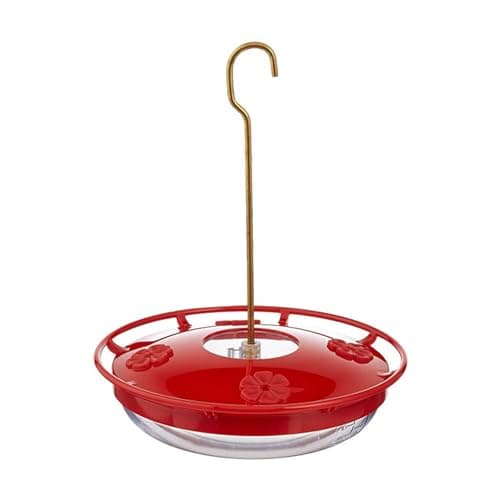
Aspects HummZinger HighView 12 oz
A four-port saucer feeder with the ant moat built into the lid and a cover that lifts straight off — the shortest path from hanging it up to washing it out.
- Type
- Saucer (dish)
- Capacity
- 12 oz
- Feeding ports
- 4
- Material
- Polycarbonate, metal hanger
- Dimensions
- 7.75" x 7.75" x 1.75"
- Ant moat
- Built in
- Perch
- Raised wraparound perch
- Mounting
- Hang or post mount
Our score: 9.2/10 — an editorial rating, not a customer rating or a test result.
Cleaning access
Two parts. The cover lifts off the base with no tools and no threads to cross, and the whole dish is one open bowl — a two-minute wash with a brush and hot water, which is exactly the cadence a nectar feeder needs. The moat is part of the lid, so there is no separate accessory to lose or forget to refill.
What works
- Saucer design puts nectar below the ports, so it does not drip as the air inside warms
- Ant moat is integral to the lid rather than a separate hanging accessory
- Opens to a single shallow bowl — the easiest shape in the category to scrub
- Raised ports shed rain, which keeps the nectar from being diluted
What doesn’t
- 12 oz is small for a busy yard
- Polycarbonate clouds over several seasons in a way glass does not
- No bee-excluding port tips fitted — that is the Ultra's feature, not the HighView's
Specifications from Duncraft — Aspects High View HummZinger and Amazon — Aspects HummZinger HighView 12 oz. We have not handled this feeder — here is what we did instead.
2. Best large no-leak
Aspects HummZinger Excel 16 oz
The saucer design scaled up to 16 oz and six ports, for the yard where a 12 oz feeder is empty by Tuesday and birds are queuing.
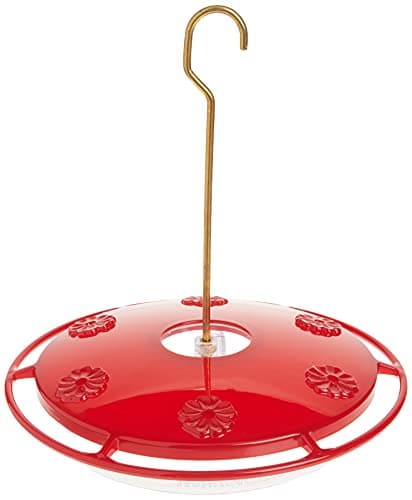
- Type
- Saucer (dish)
- Capacity
- 16 oz
- Feeding ports
- 6
- Material
- Polycarbonate
- Ant moat
- Built in
- Guarantee
- Lifetime guarantee (Aspects)
Our score: 8.7/10 — an editorial rating, not a customer rating or a test result.
Cleaning access
Identical two-part saucer routine to the rest of the HummZinger line — cover off, wash the bowl, done. The larger dish is if anything easier to get a brush around than the 12 oz.
What works
- Six ports genuinely reduces the fighting at a busy feeder
- Still a two-part saucer, so the extra capacity costs nothing in cleaning time
- Aspects' lifetime guarantee covers defects in material and workmanship
What doesn’t
- 16 oz of nectar spoils just as fast as 12 oz — capacity is not permission to clean less often
- Physically wider, which matters under a narrow eave
- No Nectar-Guard tips fitted as standard
Price as of October 16, 2026. #ad How we’re funded
Specifications from Greenhouse Megastore — Aspects HummZinger Excel and Amazon — Aspects HummZinger Excel. We have not handled this feeder — here is what we did instead.
3. No-leak plus bee guards
Aspects HummZinger Ultra 12 oz
The same saucer body as the HighView with Nectar-Guard tips fitted to every port — the one design change that physically keeps a bee's tongue out of the nectar instead of merely discouraging it.
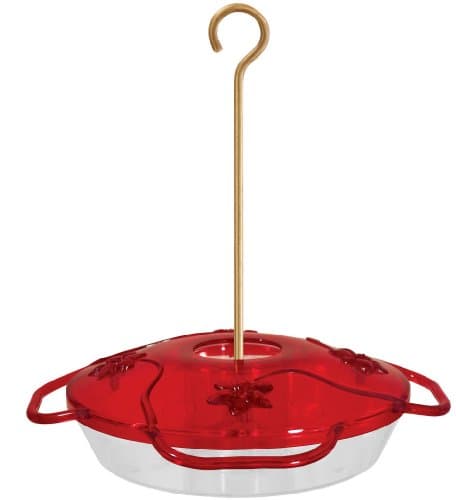
- Type
- Saucer (dish)
- Capacity
- 12 oz
- Feeding ports
- 4, with Nectar-Guard tips
- Material
- Polycarbonate, brass hanger
- Dimensions
- 8.25" x 2"
- Ant moat
- Built into the brass hanger
- Cover
- Twist-off
Our score: 8.9/10 — an editorial rating, not a customer rating or a test result.
Cleaning access
Twist-off cover, same open-dish base as the HighView. The one extra step is the Nectar-Guard tips: they are small flexible collars in each port, and sugar residue collects exactly where the tip narrows. Budget an extra thirty seconds and buy a port brush alongside the feeder.
What works
- Nectar-Guard tips are a physical barrier, not a deterrent — the mechanism that actually works on bees
- Brass hanger doubles as the ant moat, so ants and bees are both handled by the stock feeder
- Saucer body means no drip, and drips are what draw insects in the first place
What doesn’t
- The port tips need their own small brush; skip that and they clog
- Same 12 oz capacity as the HighView, so not the answer for a high-traffic yard
- Costs more than the HighView for a feature you only need if you have a bee problem
Price as of October 16, 2026. #ad How we’re funded
Specifications from Duncraft — Aspects HummZinger Ultra and Amazon — Aspects 367 HummZinger Ultra. We have not handled this feeder — here is what we did instead.
4. Best no-leak window feeder
Aspects Jewel Box Window Feeder 8 oz
The saucer logic applied to a window: 8 oz, three ports, a hinged lid you flip open to fill, a detachable ant moat, and a lifetime guarantee behind it.
photo yet
- Type
- Window mount, saucer
- Capacity
- 8 oz
- Feeding ports
- 3
- Material
- Polycarbonate
- Dimensions
- 8.5"L x 6"W x 2.2"H
- Mounting
- Suction-cup bracket; deck-mount hardware included
- Ant moat
- Detachable
- Ports
- Accepts optional Nectar-Guard tips
- Guarantee
- Lifetime guarantee (Aspects)
Our score: 8.5/10 — an editorial rating, not a customer rating or a test result.
Cleaning access
The best cleaning story of any window feeder here. The hinged lid opens for filling without unmounting anything, and the body is a shallow dish rather than a bottle — so the weekly wash is one bowl and three ports, not a reservoir you cannot see into.
What works
- Hinged lid means refilling does not involve taking it off the window
- Shallow dish shape is the easiest thing in the category to actually clean
- Accepts optional Nectar-Guard tips, so the bee fix is available if you need it
- Deck-mount hardware included if the suction cups disappoint you
What doesn’t
- 8 oz, and only three ports
- Nectar-Guard tips are an optional extra, not fitted
- Suction cups on a hot south-facing window are still suction cups
Specifications from Duncraft — Aspects Jewel Box Window Hummingbird Feeder. We have not handled this feeder — here is what we did instead.
What we’d skip
Bottle feeders sold with a “leak-proof” claim and a rubber gasket
The gasket is not the problem and cannot be the solution. Nectar leaves an inverted bottle through the feeding ports, not past the seal, because expanding air above the nectar has to push something somewhere. A tighter gasket makes the pressure build and the drip more sudden. Every listing promising a leak-proof bottle is promising to beat physics with a rubber ring. If you want a feeder that cannot drip, you want a different shape, not a better seal.
Common questions
Frequently asked
Why is my hummingbird feeder leaking?
Almost certainly because it is an inverted bottle and the air trapped above the nectar is warming and expanding, pushing liquid out through the ports. It is physics rather than a fault. Move it into shade, fill it completely, or switch to a saucer design.
Will a tighter seal stop my feeder leaking?
No. The nectar is not escaping past the seal, it is being pushed out through the feeding ports. A tighter seal can make the pressure build and the eventual drip more abrupt.
Do saucer feeders ever leak?
Only if you tip them, or overfill them so the nectar reaches the ports. In normal use, hanging level, they cannot — the nectar sits below the openings.
Does a leaking feeder attract bees and ants?
Yes, and it is the main reason to care. Bees feed on spilled nectar rather than at the port, and a sticky base is exactly what an ant trail follows. Fixing the drip fixes most of both problems.
Sources
Where this came from
Read next
Related reading
By Scooter M.
an enthusiast who's genuinely into this. I read the manuals, compile the published specs, and do the math. No lab coat.
Published September 1, 2026