Feeders
The best bee-proof hummingbird feeders
A bee guard is not a repellent. It is a shape that a hummingbird's bill fits through and a bee's tongue does not — which is why some work completely and others do nothing.
We earn a commission on purchases made through our links, at no extra cost to you. We don’t accept free products or paid placements. Full disclosure.
The Aspects HummZinger Ultra is the pick. It is a saucer feeder — so the nectar already sits below the ports, out of a bee’s reach — with Nectar-Guard tips fitted to all four ports, which are flexible collars that close behind a hummingbird’s bill. That is a physical barrier rather than a deterrent, which is the difference between a bee-proof feeder and a feeder that says “bee-proof” on the box.

Quick picks
| # | Product | Best for | Score | Price |
|---|---|---|---|---|
| 1 | 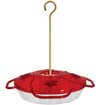 Aspects HummZinger Ultra 12 oz Fitted Nectar-Guard tips on a no-drip saucer body | Best bee guards | 9.3 out of 10 | |
| 2 |  Aspects HummZinger HighView 12 oz Saucer geometry alone puts nectar out of a bee's reach | Best without fitted guards | 8.7 out of 10 | |
| 3 |  More Birds Ruby 10 oz Glass Four bee-guard ports on glass, with the moat included | Best bee-guard bottle | 8.2 out of 10 | $16.99 on Amazon $22.48 24% off |
| 4 | No product photo yet Aspects Jewel Box Window Feeder 8 oz Shallow dish that accepts optional Nectar-Guard tips | Best bee-proof window feeder | 8.4 out of 10 |
Scores are our own editorial ratings from the criteria on our methodology page. They are not customer ratings and they are not test results.
Why bee guards work, when they work
A hummingbird has a long bill and a tongue that extends well beyond it. A honeybee has a proboscis measured in a few millimeters. Every genuine bee-proof design exploits exactly that gap: it puts the nectar somewhere a bird can reach and an insect cannot.
There are two ways to do it, and they are worth telling apart.
If you already own a feeder and would rather retrofit than replace it, read add-on bee guards first — the two that work are each locked to one brand, and your feeder may not be on either list.
- Distance. A saucer feeder holds nectar in a bowl below the port. Even with the port wide open, the nectar surface is out of a bee’s reach until the dish is nearly full. This is why saucers are bee-resistant without any special part.
- A fitted guard. Nectar-Guard tips are flexible collars in each port that a hummingbird’s bill parts and that close behind it. Nothing is open for an insect to land on.
The Ultra does both. That is the whole reason it wins this category rather than the HighView, which does only the first. There is a full write-up in the HummZinger Ultra review, and if you are weighing the two against each other, HighView vs Ultra is the direct comparison.
The thing that matters more than the feeder
You can buy the best-guarded feeder on the market and still have bees, because bees are not primarily feeding at the port. They are feeding on spilled nectar — on the base, on the outside of the reservoir, on the ground underneath. Audubon’s guidance leads with exactly this: the easiest way to deal with these pests is to keep your feeders tidy, and if the feeder is covered in sugar water, barring bees from the drinking hole won’t do much good.
So the order of operations is:
- Stop the drips. That means a saucer, or a bottle whose seals are genuinely tight.
- Wash the outside of the feeder, not just the inside, every time you refill it.
- Move the feeder a few feet. Insects lose track of a feeder that has moved; birds do not.
- Only then worry about port guards.
The full sequence, including what to do about an established swarm, is in how to keep bees off a hummingbird feeder. Wasps behave differently enough to need their own page.
What never works
Insecticide. Audubon is explicit — pesticides can injure, kill and reduce population numbers of birds, bees and other animals. Do not spray anything near a feeder.
Oil or petroleum jelly smeared around the ports. It is widely repeated and it is a genuinely bad idea: oils and petroleum products can damage feathers if a hummingbird contacts them, and a hummingbird will contact them, because they are smeared around the thing it puts its face into.
An ant moat. Not because it is harmful, but because it is the wrong tool. A moat stops crawling insects and does nothing whatever for anything with wings. If you have both problems you need both solutions — see keeping ants out.
Retrofitting a feeder you already own
Aspects sells Nectar-Guard tips separately, and several of their feeders — including the Jewel Box window feeder — accept them as an optional part. If you already own a HummZinger, that is a cheap upgrade rather than a new feeder. It is worth checking whether your model takes them before buying anything.
The picks in full
Every pick, in detail
1. Best bee guards
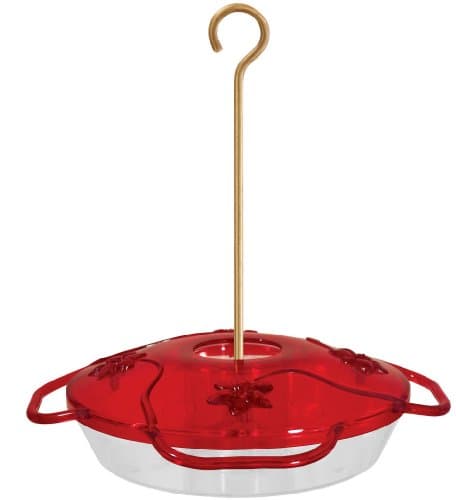
Aspects HummZinger Ultra 12 oz
The same saucer body as the HighView with Nectar-Guard tips fitted to every port — the one design change that physically keeps a bee's tongue out of the nectar instead of merely discouraging it.
- Type
- Saucer (dish)
- Capacity
- 12 oz
- Feeding ports
- 4, with Nectar-Guard tips
- Material
- Polycarbonate, brass hanger
- Dimensions
- 8.25" x 2"
- Ant moat
- Built into the brass hanger
- Cover
- Twist-off
Our score: 9.3/10 — an editorial rating, not a customer rating or a test result.
Cleaning access
Twist-off cover, same open-dish base as the HighView. The one extra step is the Nectar-Guard tips: they are small flexible collars in each port, and sugar residue collects exactly where the tip narrows. Budget an extra thirty seconds and buy a port brush alongside the feeder.
What works
- Nectar-Guard tips are a physical barrier, not a deterrent — the mechanism that actually works on bees
- Brass hanger doubles as the ant moat, so ants and bees are both handled by the stock feeder
- Saucer body means no drip, and drips are what draw insects in the first place
What doesn’t
- The port tips need their own small brush; skip that and they clog
- Same 12 oz capacity as the HighView, so not the answer for a high-traffic yard
- Costs more than the HighView for a feature you only need if you have a bee problem
Price as of October 16, 2026. #ad How we’re funded
Specifications from Duncraft — Aspects HummZinger Ultra and Amazon — Aspects 367 HummZinger Ultra. We have not handled this feeder — here is what we did instead.
2. Best without fitted guards
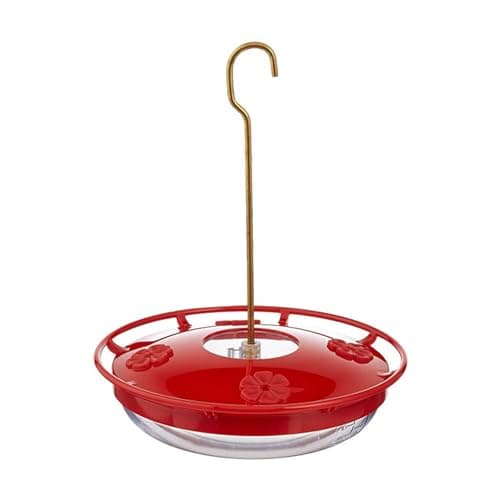
Aspects HummZinger HighView 12 oz
A four-port saucer feeder with the ant moat built into the lid and a cover that lifts straight off — the shortest path from hanging it up to washing it out.
- Type
- Saucer (dish)
- Capacity
- 12 oz
- Feeding ports
- 4
- Material
- Polycarbonate, metal hanger
- Dimensions
- 7.75" x 7.75" x 1.75"
- Ant moat
- Built in
- Perch
- Raised wraparound perch
- Mounting
- Hang or post mount
Our score: 8.7/10 — an editorial rating, not a customer rating or a test result.
Cleaning access
Two parts. The cover lifts off the base with no tools and no threads to cross, and the whole dish is one open bowl — a two-minute wash with a brush and hot water, which is exactly the cadence a nectar feeder needs. The moat is part of the lid, so there is no separate accessory to lose or forget to refill.
What works
- Saucer design puts nectar below the ports, so it does not drip as the air inside warms
- Ant moat is integral to the lid rather than a separate hanging accessory
- Opens to a single shallow bowl — the easiest shape in the category to scrub
- Raised ports shed rain, which keeps the nectar from being diluted
What doesn’t
- 12 oz is small for a busy yard
- Polycarbonate clouds over several seasons in a way glass does not
- No bee-excluding port tips fitted — that is the Ultra's feature, not the HighView's
Specifications from Duncraft — Aspects High View HummZinger and Amazon — Aspects HummZinger HighView 12 oz. We have not handled this feeder — here is what we did instead.
3. Best bee-guard bottle
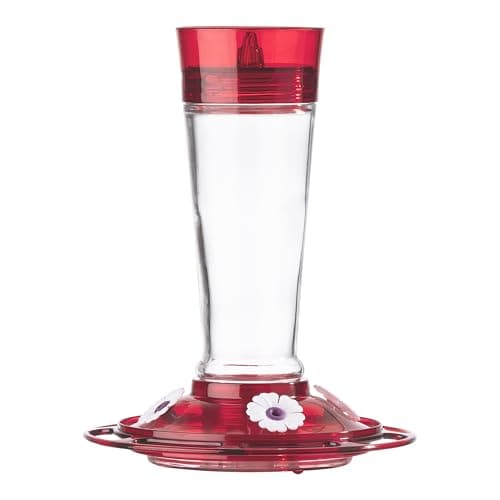
More Birds Ruby 10 oz Glass
A 10 oz glass bottle with four bee-guard ports, five perches and the ant moat built into the top — the cheapest way to get glass without giving up either insect defense.
- Type
- Glass bottle
- Capacity
- 10 oz
- Feeding ports
- 4, bee-guard style
- Perches
- 5 integrated
- Material
- Glass, plastic and metal
- Dimensions
- 8.75"H x 6.5"W x 6.5"D
- Ant moat
- Built in, on top
- Base
- Detachable flat base
Our score: 8.2/10 — an editorial rating, not a customer rating or a test result.
Cleaning access
The flat base detaches and the bottle opening is wide, so you can reach every surface. Glass is the real advantage: it does not hold the cloudy film polycarbonate develops after a couple of seasons of sugar water, so 'clean' and 'looks clean' stay the same thing.
What works
- Glass reservoir does not stain or cloud the way polycarbonate does
- Four bee-guard ports and a built-in ant moat, both included rather than sold as extras
- Five perches on a 10 oz feeder is generous — perched birds drink longer and fight less
What doesn’t
- Glass breaks; a pole-mounted feeder in a windy spot is a bad match
- 10 oz is modest, so this is a second feeder in a busy yard rather than the only one
- Still an inverted bottle, so it shares the bottle-design drip risk
Specifications from Perky-Pet — More Birds Bird Health+ Ruby Hummingbird Feeder and Amazon — More Birds Bird Health+ Ruby Hummingbird Feeder. We have not handled this feeder — here is what we did instead.
4. Best bee-proof window feeder
Aspects Jewel Box Window Feeder 8 oz
The saucer logic applied to a window: 8 oz, three ports, a hinged lid you flip open to fill, a detachable ant moat, and a lifetime guarantee behind it.
photo yet
- Type
- Window mount, saucer
- Capacity
- 8 oz
- Feeding ports
- 3
- Material
- Polycarbonate
- Dimensions
- 8.5"L x 6"W x 2.2"H
- Mounting
- Suction-cup bracket; deck-mount hardware included
- Ant moat
- Detachable
- Ports
- Accepts optional Nectar-Guard tips
- Guarantee
- Lifetime guarantee (Aspects)
Our score: 8.4/10 — an editorial rating, not a customer rating or a test result.
Cleaning access
The best cleaning story of any window feeder here. The hinged lid opens for filling without unmounting anything, and the body is a shallow dish rather than a bottle — so the weekly wash is one bowl and three ports, not a reservoir you cannot see into.
What works
- Hinged lid means refilling does not involve taking it off the window
- Shallow dish shape is the easiest thing in the category to actually clean
- Accepts optional Nectar-Guard tips, so the bee fix is available if you need it
- Deck-mount hardware included if the suction cups disappoint you
What doesn’t
- 8 oz, and only three ports
- Nectar-Guard tips are an optional extra, not fitted
- Suction cups on a hot south-facing window are still suction cups
Specifications from Duncraft — Aspects Jewel Box Window Hummingbird Feeder. We have not handled this feeder — here is what we did instead.
What we’d skip
Anything sold as a bee-proof bottle feeder with yellow flower ports
Two problems stacked. An inverted bottle drips as the trapped air warms, and drips on the outside of a feeder are what bees actually feed on — Audubon puts it plainly: if the feeder is covered in sugar water, barring bees from the drinking hole will not do much good. Then the yellow: Audubon specifically advises avoiding feeders with yellow decor because bees are attracted to the color. A yellow-ported bottle marketed as bee-proof is two known attractants with a bee guard bolted on top.
Common questions
Frequently asked
How do I keep bees away from my hummingbird feeder?
Stop the drips first — switch to a saucer feeder or tighten the seals on a bottle — then wash the outside of the feeder every refill, then move it a few feet. Fitted bee guards help after that. Never use insecticide, and never smear oil around the ports.
Do bee guards stop hummingbirds feeding too?
No. Nectar-Guard tips are flexible and part around a hummingbird’s bill, then close behind it. Birds work them out within a day or two of the feeder going up.
Does an ant moat keep bees away?
No, and this is the single most common mix-up in the category. A moat is a cup of water that crawling insects will not cross. Bees fly. They are different problems with unrelated solutions.
Should I move the feeder if bees find it?
Yes — moving it three or four feet is one of the cheapest fixes available. Insects lose track of a relocated feeder while hummingbirds find it again easily.
Are yellow feeder parts really a problem?
Audubon advises avoiding feeders with yellow decor because bees are attracted to the color. Some feeders let you replace yellow flower inserts with red ones, which is worth doing if yours does.
Sources
Where this came from
Read next
Related reading
By Scooter M.
an enthusiast who's genuinely into this. I read the manuals, compile the published specs, and do the math. No lab coat.
Published September 1, 2026