Migration
When to take hummingbird feeders down
Later than most people do, and the reason people take them down early is a myth worth killing properly.
We earn a commission on purchases made through our links, at no extra cost to you. We don’t accept free products or paid placements. Full disclosure.
Leave it up until about two weeks after your last sighting. In northern states that usually means late September into early October; in southern states, through October and sometimes November. Leaving a feeder up does not delay or prevent migration — hummingbirds leave on day length and instinct, not on whether your feeder is full. That myth is the reason people take feeders down too early, and it costs late stragglers a meal.
What we recommend here
| # | Product | Best for | Score | Price |
|---|---|---|---|---|
| 1 |  Aspects HummZinger HighView 12 oz Two parts, so a cold-weather wash is still quick | Easiest to keep going late | 9.0 out of 10 | |
| 2 | No product photo yet Aspects Jewel Box Window Feeder 8 oz 8 oz, right-sized for a fading season | Best late-season feeder | 8.5 out of 10 | |
| 3 | No product photo yet Hummingbird Feeder Brush Kit (3-piece) Store it dirty and you start next spring with the problem | For the wash before storage | 8.4 out of 10 |
Scores are our own editorial ratings from the criteria on our methodology page. They are not customer ratings and they are not test results.
The myth, stated and dismissed
A very persistent belief holds that leaving a feeder up in fall will convince hummingbirds to stay put and get them caught by winter. It is not true, and it is worth being clear about because it causes real harm.
Hummingbird migration is triggered by day length and hormonal changes, not by local food supply. A bird whose internal clock says go, goes. What your feeder actually does for a migrating hummingbird is provide fuel for a journey that may span thousands of miles — some Ruby-throated Hummingbirds cross the Gulf of Mexico non-stop.
So the risk of leaving a feeder up is nil, and the benefit is real. If you see a hummingbird at your feeder in late October, it needs the calories more than any bird you have fed all year.
The timing
| Region | Typical last birds | Take it down |
|---|---|---|
| Northern states and Canada | September | Late September to early October |
| Mid-Atlantic and Midwest | Late September to October | Mid October |
| Southeast and Gulf Coast | October into November | Through October or November |
| Southwest | Varies by species | Watch, then two weeks after the last bird |
| Coastal California and Pacific Northwest | Anna’s are resident | Consider keeping one up year round |
The universal rule underneath the table: two weeks after your last sighting. Migration is staggered — the birds that bred in your yard leave before the ones that bred further north pass through it, and those late travelers arrive to find most feeders already gone.
Late-season maintenance still applies
Fall is cooler, so the nectar change interval stretches toward the longer end — every four to five days rather than daily. It does not stop. The cadence.
Two cold-weather points. If nectar freezes and thaws repeatedly it separates and a glass reservoir can crack, so bring it in overnight during a hard frost and put it back at first light. And fill shallower as traffic drops, so you are not pouring away most of a feeder every few days. Sizing.
Storing it properly
Whatever the date, the routine at the end is the same, and skipping it means starting next spring with a problem.
- Empty it completely.
- Take it fully apart and wash every surface — including inside each port with a port brush.
- Deep clean with a four-to-one vinegar and water solution. Vinegar vs bleach.
- Rinse thoroughly and air dry completely — every part, not just the reservoir.
- Store the parts loose rather than assembled, somewhere dry and indoors. Never leave nectar in a glass feeder over a freeze.
Then check when to put it back out, which in the Southeast is only about four months later.
If a hummingbird shows up in winter
It happens, particularly in the South and along the coasts, and it is not necessarily a bird in trouble — some species winter further north than they used to, and Anna’s hummingbirds are year-round residents on the West Coast.
If one appears, keeping a feeder available is the right response. Keep it thawed and keep it clean. Do not make the nectar stronger; the ratio stays at four to one. The ratio. The full method — which species overwinter, how to stop the nectar freezing, and why a feeder does not delay migration — is on leaving a hummingbird feeder up in winter.
Recommended for this
What we’d buy
1. Easiest to keep going late
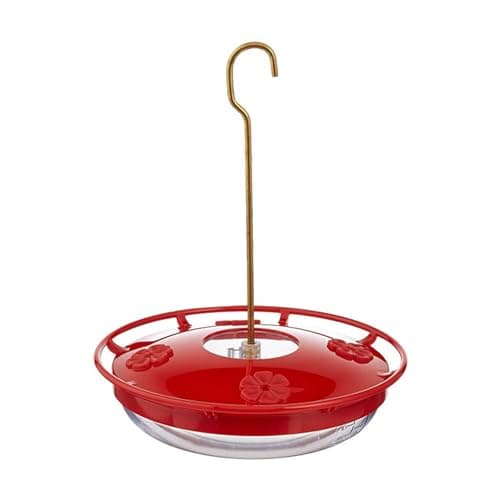
Aspects HummZinger HighView 12 oz
A four-port saucer feeder with the ant moat built into the lid and a cover that lifts straight off — the shortest path from hanging it up to washing it out.
- Type
- Saucer (dish)
- Capacity
- 12 oz
- Feeding ports
- 4
- Material
- Polycarbonate, metal hanger
- Dimensions
- 7.75" x 7.75" x 1.75"
- Ant moat
- Built in
- Perch
- Raised wraparound perch
- Mounting
- Hang or post mount
Our score: 9.0/10 — an editorial rating, not a customer rating or a test result.
Cleaning access
Two parts. The cover lifts off the base with no tools and no threads to cross, and the whole dish is one open bowl — a two-minute wash with a brush and hot water, which is exactly the cadence a nectar feeder needs. The moat is part of the lid, so there is no separate accessory to lose or forget to refill.
What works
- Saucer design puts nectar below the ports, so it does not drip as the air inside warms
- Ant moat is integral to the lid rather than a separate hanging accessory
- Opens to a single shallow bowl — the easiest shape in the category to scrub
- Raised ports shed rain, which keeps the nectar from being diluted
What doesn’t
- 12 oz is small for a busy yard
- Polycarbonate clouds over several seasons in a way glass does not
- No bee-excluding port tips fitted — that is the Ultra's feature, not the HighView's
Specifications from Duncraft — Aspects High View HummZinger and Amazon — Aspects HummZinger HighView 12 oz. We have not handled this feeder — here is what we did instead.
2. Best late-season feeder
Aspects Jewel Box Window Feeder 8 oz
The saucer logic applied to a window: 8 oz, three ports, a hinged lid you flip open to fill, a detachable ant moat, and a lifetime guarantee behind it.
photo yet
- Type
- Window mount, saucer
- Capacity
- 8 oz
- Feeding ports
- 3
- Material
- Polycarbonate
- Dimensions
- 8.5"L x 6"W x 2.2"H
- Mounting
- Suction-cup bracket; deck-mount hardware included
- Ant moat
- Detachable
- Ports
- Accepts optional Nectar-Guard tips
- Guarantee
- Lifetime guarantee (Aspects)
Our score: 8.5/10 — an editorial rating, not a customer rating or a test result.
Cleaning access
The best cleaning story of any window feeder here. The hinged lid opens for filling without unmounting anything, and the body is a shallow dish rather than a bottle — so the weekly wash is one bowl and three ports, not a reservoir you cannot see into.
What works
- Hinged lid means refilling does not involve taking it off the window
- Shallow dish shape is the easiest thing in the category to actually clean
- Accepts optional Nectar-Guard tips, so the bee fix is available if you need it
- Deck-mount hardware included if the suction cups disappoint you
What doesn’t
- 8 oz, and only three ports
- Nectar-Guard tips are an optional extra, not fitted
- Suction cups on a hot south-facing window are still suction cups
Specifications from Duncraft — Aspects Jewel Box Window Hummingbird Feeder. We have not handled this feeder — here is what we did instead.
3. For the wash before storage
Hummingbird Feeder Brush Kit (3-piece)
A bottle brush, a socket brush and a thin port brush. The port brush is the one that matters — it is the only thing that reaches inside a flower port, and a flower port is where mold starts.
photo yet
- Bottle brush
- Typically 13.5" long, 1.5" bristle diameter
- Socket brush
- Typically 8" long, 1" bristle diameter
- Port brush
- Typically 8.25" long, sized for feeding ports
- Bristles
- Nylon — non-scratching on glass and plastic
Our score: 8.4/10 — an editorial rating, not a customer rating or a test result.
Cleaning access
Rinse the brushes when you rinse the feeder and stand them up to dry. A brush stored wet in a drawer grows its own problem.
What works
- The port brush reaches the one surface a sponge and a stream of water never will
- Nylon bristles will not scratch polycarbonate, which is what makes it cloud
- Cheap enough that there is no argument for not owning one
What doesn’t
- Kit contents vary by seller — check the port brush is actually included
- A 13.5" bottle brush will not reach the bottom of a tall 32 oz reservoir
- Bristles wear out; a splayed brush stops reaching into ports
Specifications from Duncraft — Nectar Brush Set and Blue Bird Landing — Hummingbird Feeder Cleaning Brush 3-Piece Kit. We have not handled this feeder — here is what we did instead.
Common questions
Frequently asked
When should I take my hummingbird feeder down?
About two weeks after your last sighting. In northern states that is usually late September into early October; in southern states, through October or November.
Will leaving a feeder up stop hummingbirds from migrating?
No. Migration is triggered by day length and instinct rather than food supply. A feeder left up provides fuel for a long journey — it does not persuade a bird to stay.
What if I still see hummingbirds in late October?
Keep the feeder up and keep it clean. Late birds are often traveling from further north and need the calories more than anything you have fed all season.
How do I store a hummingbird feeder over winter?
Empty it, take it fully apart, wash every part including inside the ports, deep clean with 4:1 vinegar and water, rinse, air dry completely, and store the parts loose and indoors.
Sources
Where this came from
Read next
Related reading
By Scooter M.
an enthusiast who's genuinely into this. I read the manuals, compile the published specs, and do the math. No lab coat.
Published September 1, 2026