Hummingbird feeders
The best hummingbird feeders
Trusted picks built from published specifications, live prices, and how easily each one comes apart to clean.
We earn a commission on purchases made through our links, at no extra cost to you. We don’t accept free products or paid placements. Full disclosure.
The Aspects HummZinger HighView is our pick for most yards. It is a 12 oz saucer feeder with four ports, a wraparound perch and the ant moat built into the lid, and the cover lifts straight off — which means the every-few-days wash that nectar actually requires takes about two minutes instead of ten. If you want it cheaper, the First Nature 3051 gets the same two-part logic for a fraction of the price.
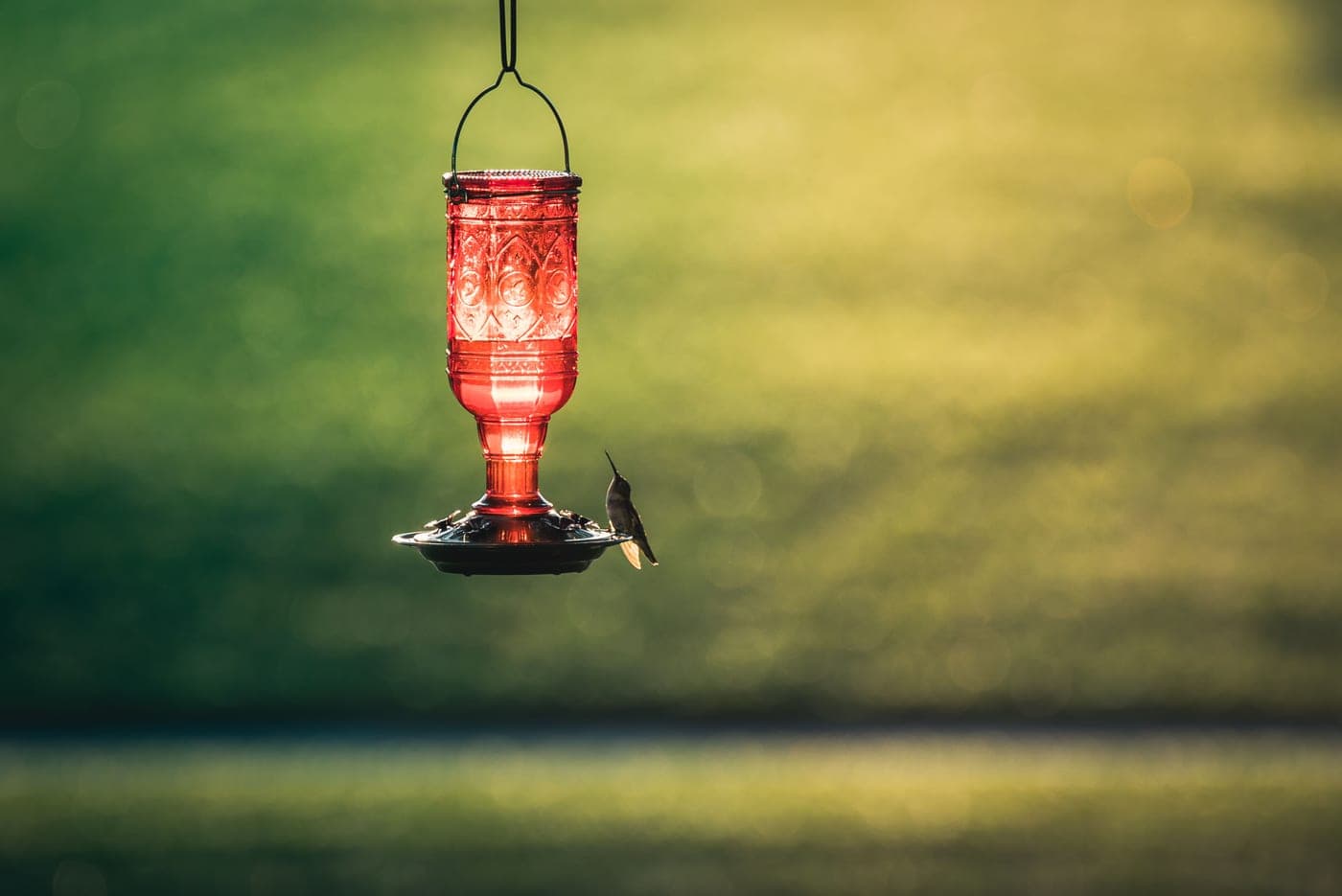
Quick picks
| # | Product | Best for | Score | Price |
|---|---|---|---|---|
| 1 |  Aspects HummZinger HighView 12 oz Two-part saucer, built-in moat, fastest to clean | Best overall | 9.2 out of 10 | |
| 2 | No product photo yet First Nature 3051 16 oz Wide mouth and a twist-apart base at the bottom of the price range | Best budget | 8.6 out of 10 | |
| 3 |  Aspects HummZinger Ultra 12 oz Nectar-Guard tips physically block a bee's tongue | Best for bees | 8.9 out of 10 | |
| 4 |  Kingsyard 16 oz Glass Feeder Six ports, glass reservoir, ant moat in the box | Best glass | 8.4 out of 10 | $19.99 on Amazon $22.99 13% off |
| 5 |  Aspects HummZinger Excel 16 oz 16 oz and six ports with no extra cleaning cost | Best for a busy yard | 8.7 out of 10 | |
| 6 | No product photo yet Aspects Jewel Box Window Feeder 8 oz Hinged lid, shallow dish, refills without unmounting | Best window feeder | 8.5 out of 10 | |
| 7 | No product photo yet Bird Buddy Smart Hummingbird Feeder Pro 2K, HDR, five ports — the best camera hardware here | Best camera feeder | 8.0 out of 10 |
Scores are our own editorial ratings from the criteria on our methodology page. They are not customer ratings and they are not test results.
How we chose
We have not tested these feeders, and the way we picked them is the whole argument for reading this rather than the twenty pages that claim they did. We compiled published specifications from manufacturers and major retailers, read what each maker says about disassembly and cleaning, compared port geometry and capacity against how much a real backyard actually drinks, and pulled live pricing. The full criteria — including the weighting — are on our methodology page.
One criterion does more work here than any other, and it is the one most roundups skip entirely: how fast the feeder comes apart. That is not a tidiness preference. Nectar needs changing every three to five days in moderate weather and daily in very hot weather, and a feeder that takes ten minutes to disassemble is a feeder that quietly slips to fortnightly. Fermented nectar and black mold in the ports are what actually harms hummingbirds. We treat cleaning access as a safety spec, and we score it on every pick. There is more on the cadence in how often to clean a hummingbird feeder.
One filter worth knowing about before the picks, because it narrows this list sharply: two of the brands here publish where they manufacture. Aspects states it builds every item in its Rhode Island facility and backs them with a lifetime guarantee, and First Nature states its feeder is made in America. If that matters to you, the verified shortlist is on the best American-made hummingbird feeders.
Saucer or bottle: the decision that comes first
Almost every feeder on sale is one of two designs, and the choice between them predicts most of what you will experience.
A saucer (or dish) feeder holds nectar in a shallow bowl below the feeding ports. The birds reach down through the port to drink. Because the nectar sits below the openings, it has nowhere to go when the trapped air warms, so a saucer does not drip. It is also, physically, an open bowl — which is why it washes in a fraction of the time.
An inverted bottle feeder holds nectar in a reservoir above the ports and relies on a vacuum to hold it there. That vacuum is temperature-dependent. Warm the air in the top of the bottle and it expands, pushes nectar down, and the feeder drips. The drips land on the base and the ground, and they are the single biggest reason bees and ants show up. The trade-off is capacity: bottles hold more.
We break the full comparison down in saucer vs bottle feeders. The short version: buy a saucer unless you have a specific reason not to. For the choice most readers actually face — our top pick against our budget pick — see HummZinger HighView vs First Nature 3051.
Glass or plastic
Glass does not cloud. Polycarbonate does — after a couple of seasons of sugar water and UV, a plastic reservoir develops a permanent haze that makes it genuinely hard to tell clean from dirty. That matters more than it sounds, because the visual check is how most people decide whether it is time to wash the thing.
Against that: glass breaks, glass is heavy, and a full 24 oz glass reservoir on a shepherd’s hook in a windy yard is a genuine risk. Plastic is lighter, cheaper and survives being dropped. We go through the whole thing in glass vs plastic hummingbird feeders, and if you’ve already decided on glass, the glass feeder roundup is the shorter read.
How much capacity you actually need
This is where most people buy the wrong feeder, and the mistake is always in the same direction: too big.
Capacity is not storage. Nectar spoils on a schedule set by the weather, not by how much you poured — so a 32 oz feeder in a quiet yard means you throw away 28 oz of sugar water every three days. The right size is the one your birds empty just about as fast as the nectar would go off anyway. For most yards that is 8 to 16 oz. Buy the 32 oz model only if you are genuinely refilling a 16 oz feeder daily. We work through the arithmetic in what size hummingbird feeder to get.
A related trick: two small feeders beat one large one, and not only for spoilage. Hummingbirds are territorial, and a single dominant bird will sit and guard one feeder against all comers. Put a second feeder out of sight of the first — around a corner, on the other side of a shrub — and it cannot be defended from one perch.
Ports, perches and the bee question
Port count matters less than port design. Six ports on a feeder no bird can defend beats ten ports on one it can. What port design does decide is whether bees can feed.
A hummingbird has a long bill and a longer tongue. A honeybee has neither. A port that is deep and narrow lets a hummingbird reach nectar that a bee physically cannot, which is why saucer designs are inherently more bee-resistant than bottles: on a saucer the nectar level sits below the port. Fitted bee guards like the Nectar-Guard tips on the HummZinger Ultra take that further with a flexible collar that closes behind the bill. Both of those are mechanisms. Yellow decoration on the feeder, meanwhile, works in the wrong direction — the National Audubon Society specifically advises avoiding feeders with yellow decor because bees are drawn to the color. The whole subject gets its own page: how to keep bees off a hummingbird feeder.
Perches are a genuine plus and a slightly contested one. A perched hummingbird burns far less energy than a hovering one and tends to drink longer, so perches are good for the birds. The old argument against them — that perching leaves a bird exposed — has largely faded. Buy the perch. We rank feeders on perch design alone, and take the guarding argument apart properly, in the best hummingbird feeders with perches.
Ant moats: get one built in
Ants are a water problem, not a port problem. A moat is a small cup of plain water hanging between the hook and the feeder; ants will not cross it. That is the entire mechanism, and it works completely as long as the moat has water in it.
Prefer a feeder with the moat built in — the HummZinger line, the First Nature bases, the More Birds Ruby and both Kingsyard models all include one. A built-in moat is one you cannot forget to buy, and topping it up becomes part of the same visit as refilling. If your feeder does not have one, the add-on moats are a few dollars. Full detail in keeping ants out of a hummingbird feeder.
Camera feeders: worth it, with one honest caveat
Smart feeders are the most expensive thing in this category by a wide margin, and they deliver something no other feeder can: close-up footage of a bird that is otherwise a blur. The Bird Buddy Pro shoots 2K video and 5MP stills on a 1/2.7-inch HDR sensor with a 122-degree field of view. The Birdfy Hum Feeder Duo runs two 2K cameras so the far side of the feeder is not a blind spot.
The caveat is not about the cameras. It is that a camera feeder is electronics attached to something that must be washed every few days, and the washing gets slower and more careful — which is exactly the friction that makes people do it less often. If a two-day change cycle already sounds like a chore, a camera feeder will make it a bigger one. Buy one because you want the footage, and go in knowing the maintenance is the price. Full comparison in the camera feeder roundup.
What we would actually buy
If someone handed us thirty dollars and a hook: the HummZinger HighView, a three-piece brush kit, and a bag of plain white sugar. That combination covers the feeder, the thing that makes cleaning it survivable, and the recipe, which is four parts water to one part sugar and nothing else. Everything past that is refinement.
The picks in full
Every pick, in detail
1. Best overall
Aspects HummZinger HighView 12 oz
A four-port saucer feeder with the ant moat built into the lid and a cover that lifts straight off — the shortest path from hanging it up to washing it out.
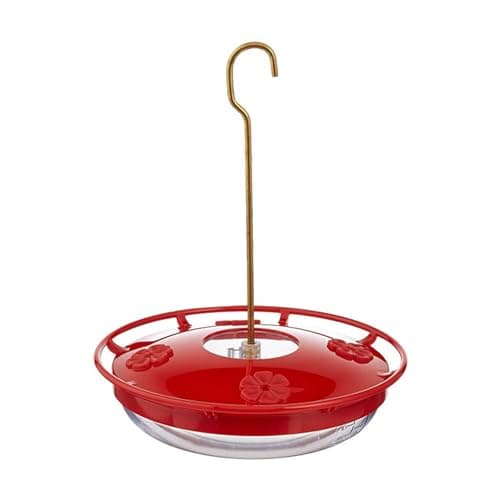
- Type
- Saucer (dish)
- Capacity
- 12 oz
- Feeding ports
- 4
- Material
- Polycarbonate, metal hanger
- Dimensions
- 7.75" x 7.75" x 1.75"
- Ant moat
- Built in
- Perch
- Raised wraparound perch
- Mounting
- Hang or post mount
Our score: 9.2/10 — an editorial rating, not a customer rating or a test result.
Cleaning access
Two parts. The cover lifts off the base with no tools and no threads to cross, and the whole dish is one open bowl — a two-minute wash with a brush and hot water, which is exactly the cadence a nectar feeder needs. The moat is part of the lid, so there is no separate accessory to lose or forget to refill.
What works
- Saucer design puts nectar below the ports, so it does not drip as the air inside warms
- Ant moat is integral to the lid rather than a separate hanging accessory
- Opens to a single shallow bowl — the easiest shape in the category to scrub
- Raised ports shed rain, which keeps the nectar from being diluted
What doesn’t
- 12 oz is small for a busy yard
- Polycarbonate clouds over several seasons in a way glass does not
- No bee-excluding port tips fitted — that is the Ultra's feature, not the HighView's
Specifications from Duncraft — Aspects High View HummZinger and Amazon — Aspects HummZinger HighView 12 oz. We have not handled this feeder — here is what we did instead.
2. Best budget
First Nature 3051 16 oz
Ten ports, a wide-mouth reservoir and a base that twists into two pieces — the cheapest feeder in the category that is genuinely easy to clean, which is the only reason it is here.
photo yet
- Type
- Inverted bottle
- Capacity
- 16 oz
- Feeding ports
- 10
- Material
- Plastic
- Base
- Patented two-part base, twists apart
- Reservoir
- Wide-mouth
- Ant moat
- Built into the base
- Dishwasher
- Not dishwasher safe — warm soapy water
Our score: 8.6/10 — an editorial rating, not a customer rating or a test result.
Cleaning access
Better than the price suggests. The reservoir mouth is wide enough to take a bottle brush without contortions, and the base twists into two pieces so you can reach the underside of the ports — the spot that grows mold first on a cheap bottle feeder. First Nature specifies warm soapy water, not the dishwasher.
What works
- Wide-mouth reservoir takes a standard bottle brush, unlike most budget bottle feeders
- Two-part base opens up the port undersides, which is where mold starts
- Ten ports and an integrated ant moat at the bottom of the category's price range
What doesn’t
- It is an inverted bottle, so it can drip as trapped air warms and pushes nectar out
- Not dishwasher safe, and the thin plastic would not enjoy a hot wash anyway
- Fill all 16 oz in a quiet yard and you will pour most of it away
Specifications from Oak Ridge Stores — First Nature FN3051. We have not handled this feeder — here is what we did instead.
3. Best for bees
Aspects HummZinger Ultra 12 oz
The same saucer body as the HighView with Nectar-Guard tips fitted to every port — the one design change that physically keeps a bee's tongue out of the nectar instead of merely discouraging it.
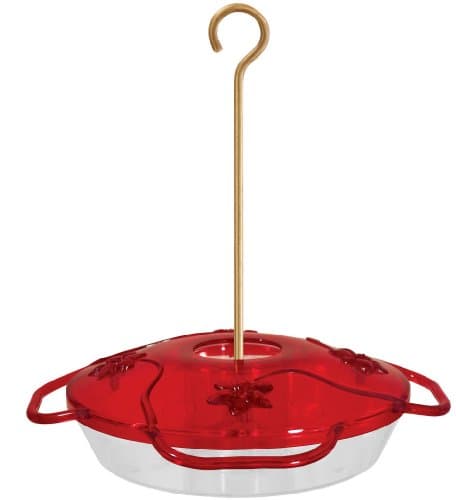
- Type
- Saucer (dish)
- Capacity
- 12 oz
- Feeding ports
- 4, with Nectar-Guard tips
- Material
- Polycarbonate, brass hanger
- Dimensions
- 8.25" x 2"
- Ant moat
- Built into the brass hanger
- Cover
- Twist-off
Our score: 8.9/10 — an editorial rating, not a customer rating or a test result.
Cleaning access
Twist-off cover, same open-dish base as the HighView. The one extra step is the Nectar-Guard tips: they are small flexible collars in each port, and sugar residue collects exactly where the tip narrows. Budget an extra thirty seconds and buy a port brush alongside the feeder.
What works
- Nectar-Guard tips are a physical barrier, not a deterrent — the mechanism that actually works on bees
- Brass hanger doubles as the ant moat, so ants and bees are both handled by the stock feeder
- Saucer body means no drip, and drips are what draw insects in the first place
What doesn’t
- The port tips need their own small brush; skip that and they clog
- Same 12 oz capacity as the HighView, so not the answer for a high-traffic yard
- Costs more than the HighView for a feature you only need if you have a bee problem
Price as of October 16, 2026. #ad How we’re funded
Specifications from Duncraft — Aspects HummZinger Ultra and Amazon — Aspects 367 HummZinger Ultra. We have not handled this feeder — here is what we did instead.
4. Best glass
Kingsyard 16 oz Glass Feeder
Six flower ports sized to admit a hummingbird bill and not much else, a thick glass reservoir, and an ant moat in the box — the glass feeder that does not make you buy accessories to finish it.
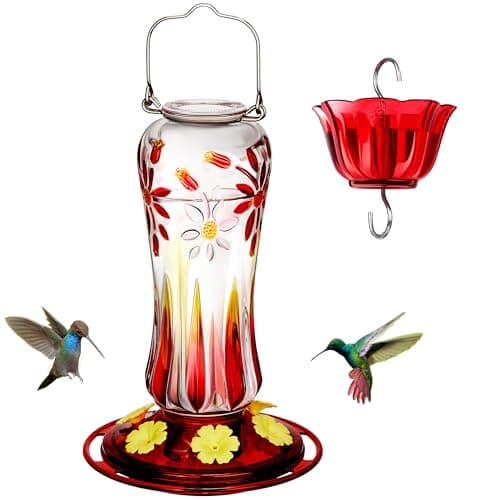
- Type
- Glass bottle
- Capacity
- 16 oz
- Feeding ports
- 6, flower-shaped
- Material
- Glass reservoir, plastic base
- Ant moat
- Included
- Bee guards
- Ports sized to exclude bees
Our score: 8.4/10 — an editorial rating, not a customer rating or a test result.
Cleaning access
Fully disassembles — reservoir, base and ports all come apart, which is what you want, because a six-port base has six places for residue to sit. The glass reservoir is the easy part; plan on a port brush for the flowers.
What works
- Six ports and a supplied ant moat at a mid-range price
- Glass stays visually clean, so the nectar level and its condition are readable at a glance
- Disassembles completely rather than to two pieces
What doesn’t
- More parts to wash than a saucer, every single time
- Glass and a full 16 oz make for a heavy hang
- Port sizing discourages bees but is not the same as a fitted Nectar-Guard tip
Specifications from Kingsyard — hummingbird feeder range and Amazon — Kingsyard Glass Hummingbird Feeders for Outdoors. We have not handled this feeder — here is what we did instead.
5. Best for a busy yard
Aspects HummZinger Excel 16 oz
The saucer design scaled up to 16 oz and six ports, for the yard where a 12 oz feeder is empty by Tuesday and birds are queuing.
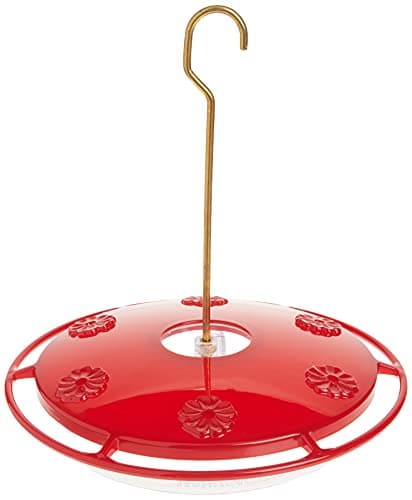
- Type
- Saucer (dish)
- Capacity
- 16 oz
- Feeding ports
- 6
- Material
- Polycarbonate
- Ant moat
- Built in
- Guarantee
- Lifetime guarantee (Aspects)
Our score: 8.7/10 — an editorial rating, not a customer rating or a test result.
Cleaning access
Identical two-part saucer routine to the rest of the HummZinger line — cover off, wash the bowl, done. The larger dish is if anything easier to get a brush around than the 12 oz.
What works
- Six ports genuinely reduces the fighting at a busy feeder
- Still a two-part saucer, so the extra capacity costs nothing in cleaning time
- Aspects' lifetime guarantee covers defects in material and workmanship
What doesn’t
- 16 oz of nectar spoils just as fast as 12 oz — capacity is not permission to clean less often
- Physically wider, which matters under a narrow eave
- No Nectar-Guard tips fitted as standard
Price as of October 16, 2026. #ad How we’re funded
Specifications from Greenhouse Megastore — Aspects HummZinger Excel and Amazon — Aspects HummZinger Excel. We have not handled this feeder — here is what we did instead.
6. Best window feeder
Aspects Jewel Box Window Feeder 8 oz
The saucer logic applied to a window: 8 oz, three ports, a hinged lid you flip open to fill, a detachable ant moat, and a lifetime guarantee behind it.
photo yet
- Type
- Window mount, saucer
- Capacity
- 8 oz
- Feeding ports
- 3
- Material
- Polycarbonate
- Dimensions
- 8.5"L x 6"W x 2.2"H
- Mounting
- Suction-cup bracket; deck-mount hardware included
- Ant moat
- Detachable
- Ports
- Accepts optional Nectar-Guard tips
- Guarantee
- Lifetime guarantee (Aspects)
Our score: 8.5/10 — an editorial rating, not a customer rating or a test result.
Cleaning access
The best cleaning story of any window feeder here. The hinged lid opens for filling without unmounting anything, and the body is a shallow dish rather than a bottle — so the weekly wash is one bowl and three ports, not a reservoir you cannot see into.
What works
- Hinged lid means refilling does not involve taking it off the window
- Shallow dish shape is the easiest thing in the category to actually clean
- Accepts optional Nectar-Guard tips, so the bee fix is available if you need it
- Deck-mount hardware included if the suction cups disappoint you
What doesn’t
- 8 oz, and only three ports
- Nectar-Guard tips are an optional extra, not fitted
- Suction cups on a hot south-facing window are still suction cups
Specifications from Duncraft — Aspects Jewel Box Window Hummingbird Feeder. We have not handled this feeder — here is what we did instead.
7. Best camera feeder
Bird Buddy Smart Hummingbird Feeder Pro
The best-specified camera in the category — 2K video, 5MP stills, a 1/2.7" sensor with HDR and a 122-degree field of view — on a 14 oz basin with five ports, three open and two closed.
photo yet
- Type
- Smart camera feeder
- Capacity
- 14 fl oz (1.75 cups)
- Camera
- 2K video, 5MP stills
- Sensor
- 1/2.7", HDR
- Field of view
- 122 degrees
- Feeding ports
- 3 open flower, 2 closed flower
- Power
- Solar roof variant available
Our score: 8.0/10 — an editorial rating, not a customer rating or a test result.
Cleaning access
A basin rather than a bottle, which helps — the nectar sits in an open reservoir you can reach into, and the camera module detaches. It is still the slowest wash of anything in this guide, and if a two-day change cycle already sounds like a chore, this is the feeder where it will become one.
What works
- Genuinely the best camera hardware here — HDR, a wide field of view and slow motion
- Five ports, three of them open, so it works as a feeder and not only as a camera
- Solar roof variant removes the recharging chore that kills enthusiasm for these
What doesn’t
- Premium price, and the solar roof is a separate variant
- 14 oz is modest for the money
- Every camera feeder trades cleaning speed for footage, and cleaning speed is what keeps nectar safe
Specifications from Bird Buddy — Smart Hummingbird Feeder Pro Solar. We have not handled this feeder — here is what we did instead.
What we’d skip
Decorative blown-glass bottle feeders with sealed bases
They are the prettiest thing in the aisle and the worst thing in the yard. A bottle feeder that does not separate from its base leaves you washing a reservoir you cannot reach into and ports you cannot get behind, on a two-to-five-day cycle, forever. The nectar ferments where you cannot see it. If you want glass, buy glass that comes apart — the More Birds Ruby detaches at the base and the Kingsyard disassembles completely. Pretty is fine. Sealed is not.
Common questions
Frequently asked
What kind of hummingbird feeder is best?
A saucer feeder, for most yards. Nectar sits below the ports so it cannot drip, bees struggle to reach it, and the feeder washes as a shallow open bowl instead of a reservoir you cannot get a hand into. Bottle feeders win on capacity and lose on almost everything else.
Are glass or plastic hummingbird feeders better?
Glass stays visually clear where polycarbonate develops a permanent haze after a couple of seasons, which makes it easier to see when the nectar has turned. Plastic is lighter, cheaper and does not shatter. If the feeder will hang somewhere windy or high, take the plastic. See the full comparison.
What size hummingbird feeder should I get?
Eight to sixteen ounces for most yards. Capacity is not storage: nectar spoils on the weather’s schedule rather than yours, so a large feeder in a quiet yard mostly produces sugar water you pour down the drain. Buy the size your birds empty in two or three days.
Should hummingbird feeders have perches?
Yes. A perched hummingbird uses far less energy than a hovering one and generally drinks longer. The old worry that perches leave birds exposed has not held up, and most of the better feeders now include them.
Do hummingbirds prefer certain feeder colors?
Red on the feeder itself helps hummingbirds find it. Red in the nectar does not, and should never be added — Audubon calls food coloring unnecessary and notes it could prove harmful. Avoid yellow decoration, which attracts bees. More in is red dye bad for hummingbirds.
Are hummingbird feeders with cameras worth it?
If you want the footage, yes — the current 2K models genuinely deliver it. Go in knowing that a camera feeder still has to be washed every few days, and washing around electronics is slower, which is the friction that makes people clean less often.
How many feeders should I put out?
Two small ones beat one large one. Hummingbirds are territorial and a dominant bird will guard a single feeder from one perch. Put the second feeder out of sight of the first and it cannot be defended.
Sources
Where this came from
Read next
Related reading
By Scooter M.
an enthusiast who's genuinely into this. I read the manuals, compile the published specs, and do the math. No lab coat.
Published September 1, 2026