Feeders
Saucer vs bottle hummingbird feeders
The single decision that determines whether your feeder drips, whether bees move in, and how long the every-other-day wash takes.
We earn a commission on purchases made through our links, at no extra cost to you. We don’t accept free products or paid placements. Full disclosure.
Buy a saucer. A dish feeder holds nectar below the ports, so it cannot be pushed out by warming air, bees cannot reach the surface, and the whole thing washes as an open bowl in about two minutes. A bottle feeder wins on one axis — capacity — and capacity is the least useful thing a hummingbird feeder can have, because nectar spoils on the weather’s schedule regardless of how much you poured.
What we recommend here
| # | Product | Best for | Score | Price |
|---|---|---|---|---|
| 1 |  Aspects HummZinger HighView 12 oz Two parts, built-in moat, does not drip | Best saucer | 9.2 out of 10 | |
| 2 | No product photo yet First Nature 3051 16 oz If you want a bottle, this is the one that opens properly | Best bottle | 8.6 out of 10 | |
| 3 |  Kingsyard 16 oz Glass Feeder Six ports and full disassembly, if looks matter | Best bottle in glass | 8.4 out of 10 | $19.99 on Amazon $22.99 13% off |
Scores are our own editorial ratings from the criteria on our methodology page. They are not customer ratings and they are not test results.
The two designs
A saucer — also sold as a dish or basin feeder — is a shallow bowl with the ports in the lid above the nectar. Birds reach down through the opening, exactly as they do into a flower.
A bottle — the classic inverted-reservoir feeder — holds nectar above the ports and relies on a pressure balance to keep it there. It is the shape most people picture when they think “hummingbird feeder.”
A top-fill feeder is a bottle feeder with the opening moved to the lid, so you never invert it to refill. Worth knowing that it changes only the filling, not the geometry below — the nectar still sits above the ports, so everything in this comparison still applies. Those are covered in the best top-fill feeders.
Where saucers win, and why
Leaking
The vacuum holding nectar up inside a bottle is temperature-dependent. Warm the trapped air and it expands, pushing liquid out through the ports. That is not a defect and no gasket fixes it. A saucer has no liquid above the openings and therefore nothing to push. Full detail on feeders that don’t leak.
Bees
Two mechanisms, both favoring the saucer. First, the nectar level sits below the port, out of reach of a bee’s short tongue while remaining within reach of a hummingbird’s long one. Second, and more importantly, saucers do not drip — and Audubon’s guidance makes the point that if the feeder is covered in sugar water, keeping bees out of the port will not achieve much. Most bees at a feeder are feeding on spilled nectar, not through the hole. See the bees page.
Cleaning
This is the one we weight most heavily. A saucer opens to a shallow bowl you can wipe out with a brush in about two minutes. A bottle is a reservoir you cannot see into and a base with ports molded into the underside. Given the wash has to happen every two to five days for six months, the difference compounds into whether the schedule survives at all.
Where bottles win
Capacity
Bottles go to 32 oz; saucers usually top out around 16. If you are genuinely refilling a 16 oz feeder daily in peak season, a bottle saves trips.
For everyone else this is a false win. Nectar spoils on a fixed schedule set by temperature, not by volume, so a 32 oz feeder in an average yard produces more sugar water down the drain rather than fewer refills. The arithmetic is on what size feeder to get, and we take the biggest bottle in the category apart in the First Nature 32 oz review — including the three yards where it genuinely is the right buy.
Looks
A glass bottle catching afternoon light is genuinely pretty, and a saucer is a disc. If the feeder is partly garden decoration for you, that is a legitimate reason — the glass roundup lists the bottles that at least come apart properly.
Port count
Bottles tend to have more ports — the First Nature 3051 has ten against the HummZinger HighView’s four. In a busy yard that reduces squabbling. Though a better answer to that problem is two feeders out of sight of each other, because a territorial hummingbird will guard one feeder no matter how many holes it has — see how many hummingbird feeders you need.
Choose a bottle if… choose a saucer if…
Choose a bottle if your yard genuinely empties 16 oz in a day, or you want the look of glass and are willing to do a slightly longer wash. Get one that disassembles: the First Nature’s two-part base and wide mouth are the reason it appears on this site at all.
Choose a saucer if you want the feeder to not drip, want fewer bees, and want the recurring chore to take two minutes rather than ten. That is most people, which is why saucers are our default recommendation across the whole site. The saucer roundup has the models.
Recommended for this
What we’d buy
1. Best saucer
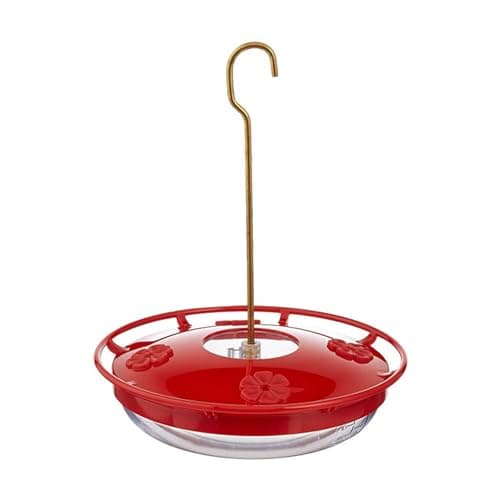
Aspects HummZinger HighView 12 oz
A four-port saucer feeder with the ant moat built into the lid and a cover that lifts straight off — the shortest path from hanging it up to washing it out.
- Type
- Saucer (dish)
- Capacity
- 12 oz
- Feeding ports
- 4
- Material
- Polycarbonate, metal hanger
- Dimensions
- 7.75" x 7.75" x 1.75"
- Ant moat
- Built in
- Perch
- Raised wraparound perch
- Mounting
- Hang or post mount
Our score: 9.2/10 — an editorial rating, not a customer rating or a test result.
Cleaning access
Two parts. The cover lifts off the base with no tools and no threads to cross, and the whole dish is one open bowl — a two-minute wash with a brush and hot water, which is exactly the cadence a nectar feeder needs. The moat is part of the lid, so there is no separate accessory to lose or forget to refill.
What works
- Saucer design puts nectar below the ports, so it does not drip as the air inside warms
- Ant moat is integral to the lid rather than a separate hanging accessory
- Opens to a single shallow bowl — the easiest shape in the category to scrub
- Raised ports shed rain, which keeps the nectar from being diluted
What doesn’t
- 12 oz is small for a busy yard
- Polycarbonate clouds over several seasons in a way glass does not
- No bee-excluding port tips fitted — that is the Ultra's feature, not the HighView's
Specifications from Duncraft — Aspects High View HummZinger and Amazon — Aspects HummZinger HighView 12 oz. We have not handled this feeder — here is what we did instead.
2. Best bottle
First Nature 3051 16 oz
Ten ports, a wide-mouth reservoir and a base that twists into two pieces — the cheapest feeder in the category that is genuinely easy to clean, which is the only reason it is here.
photo yet
- Type
- Inverted bottle
- Capacity
- 16 oz
- Feeding ports
- 10
- Material
- Plastic
- Base
- Patented two-part base, twists apart
- Reservoir
- Wide-mouth
- Ant moat
- Built into the base
- Dishwasher
- Not dishwasher safe — warm soapy water
Our score: 8.6/10 — an editorial rating, not a customer rating or a test result.
Cleaning access
Better than the price suggests. The reservoir mouth is wide enough to take a bottle brush without contortions, and the base twists into two pieces so you can reach the underside of the ports — the spot that grows mold first on a cheap bottle feeder. First Nature specifies warm soapy water, not the dishwasher.
What works
- Wide-mouth reservoir takes a standard bottle brush, unlike most budget bottle feeders
- Two-part base opens up the port undersides, which is where mold starts
- Ten ports and an integrated ant moat at the bottom of the category's price range
What doesn’t
- It is an inverted bottle, so it can drip as trapped air warms and pushes nectar out
- Not dishwasher safe, and the thin plastic would not enjoy a hot wash anyway
- Fill all 16 oz in a quiet yard and you will pour most of it away
Specifications from Oak Ridge Stores — First Nature FN3051. We have not handled this feeder — here is what we did instead.
3. Best bottle in glass
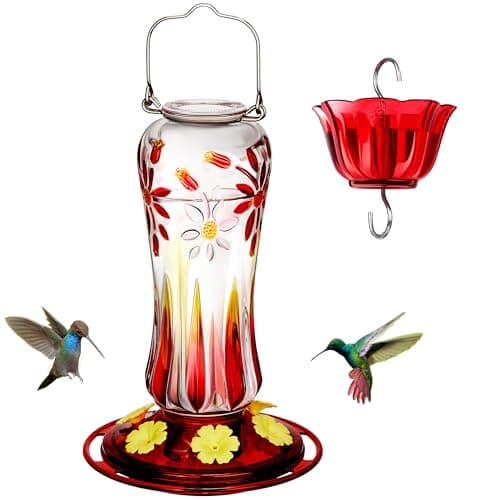
Kingsyard 16 oz Glass Feeder
Six flower ports sized to admit a hummingbird bill and not much else, a thick glass reservoir, and an ant moat in the box — the glass feeder that does not make you buy accessories to finish it.
- Type
- Glass bottle
- Capacity
- 16 oz
- Feeding ports
- 6, flower-shaped
- Material
- Glass reservoir, plastic base
- Ant moat
- Included
- Bee guards
- Ports sized to exclude bees
Our score: 8.4/10 — an editorial rating, not a customer rating or a test result.
Cleaning access
Fully disassembles — reservoir, base and ports all come apart, which is what you want, because a six-port base has six places for residue to sit. The glass reservoir is the easy part; plan on a port brush for the flowers.
What works
- Six ports and a supplied ant moat at a mid-range price
- Glass stays visually clean, so the nectar level and its condition are readable at a glance
- Disassembles completely rather than to two pieces
What doesn’t
- More parts to wash than a saucer, every single time
- Glass and a full 16 oz make for a heavy hang
- Port sizing discourages bees but is not the same as a fitted Nectar-Guard tip
Specifications from Kingsyard — hummingbird feeder range and Amazon — Kingsyard Glass Hummingbird Feeders for Outdoors. We have not handled this feeder — here is what we did instead.
Common questions
Frequently asked
Do saucer feeders work better than bottle feeders?
For most yards, clearly yes. They cannot drip, they are harder for bees to feed at, and they wash in a fraction of the time. Bottles win on capacity, which is the least useful advantage a nectar feeder can have.
What feeders do hummingbirds like best?
Hummingbirds will use either design readily. What they respond to is fresh nectar, a red feeder they can find, a perch, and a feeder they do not have to fight for — which argues for whichever design you will actually keep clean, plus a second feeder out of sight of the first.
Do saucer feeders hold less nectar?
Usually yes — 8 to 16 oz against up to 32 for a bottle. In practice that is rarely a limitation, because nectar has to be replaced every two to five days whether the birds drank it or not.
Can you convert a bottle feeder into a no-drip one?
Not really. You can reduce dripping by hanging it in shade and filling it completely so there is less trapped air to expand, but the mechanism is thermal and it does not go away. A saucer is the fix.
Sources
Where this came from
Read next
Related reading
By Scooter M.
an enthusiast who's genuinely into this. I read the manuals, compile the published specs, and do the math. No lab coat.
Published September 1, 2026