Feeders
What size hummingbird feeder should you get?
The most common buying mistake in the category, and it is always in the same direction.
We earn a commission on purchases made through our links, at no extra cost to you. We don’t accept free products or paid placements. Full disclosure.
Eight to sixteen ounces for almost every yard. Capacity is not storage. Nectar has to be replaced every three to five days in moderate weather and daily in very hot weather whether the birds drank it or not — so a 32 oz feeder in an average backyard produces sugar water down the drain, not fewer trips outside. Buy the size your birds empty in two or three days.
What we recommend here
| # | Product | Best for | Score | Price |
|---|---|---|---|---|
| 1 |  Aspects HummZinger HighView 12 oz 12 oz, four ports — the sweet spot | Right size for most yards | 9.2 out of 10 | |
| 2 | No product photo yet Aspects Jewel Box Window Feeder 8 oz 8 oz, which is honest rather than stingy | Right size for a quiet yard | 8.5 out of 10 | |
| 3 | 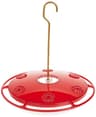 Aspects HummZinger Excel 16 oz 16 oz and six ports, without a longer wash | Right size for a genuinely busy yard | 8.7 out of 10 | |
| 4 |  First Nature 32 oz Hummingbird Feeder 32 oz — the size most people should not buy | Only if you are refilling daily | 7.4 out of 10 |
Scores are our own editorial ratings from the criteria on our methodology page. They are not customer ratings and they are not test results.
The arithmetic, shown
Here is the whole thing, using published figures and one assumption we will state openly.
The fixed input: nectar must be changed every three to five days in moderate weather, and daily in very hot weather. That is Cornell Lab guidance, and it is not negotiable, because what is being prevented is fermentation and mold.
The smallest sane answer: if your yard turns out to be quiet, a 4 oz dish wastes almost nothing — see our Aspects HummBlossom review.
The variable input: how much your yard actually drinks. This is the number nobody can tell you in advance, and anyone quoting you a precise figure for a yard they have never seen is guessing. It depends on how many hummingbirds visit, whether they are resident or passing through, what is flowering nearby, and the time of year.
The rule that falls out: the right capacity is whatever your birds finish in roughly the same time the nectar would spoil anyway. Anything above that is waste, because you are pouring it out on the same schedule regardless.
So the practical method is to start small. Buy 8 to 12 oz. Fill it. If it is empty in a day, buy a second one — or go up a size. If half of it is going down the drain every third day, fill it half full next time. The feeder tells you the answer within a week, and no article can.
Why the instinct to buy big is wrong
The mental model people bring is a dog’s water bowl or a seed feeder: bigger means longer between refills. Seed genuinely works that way — dry seed sits happily for weeks.
Sugar water does not. It is a warm, dilute sugar solution sitting outdoors, which is close to an ideal medium for yeast and mold. Its clock starts when you hang it and it does not care how much of it there is. Buying a bigger feeder buys you nothing except a bigger thing to wash.
Two feeders beat one big one
If your problem is genuinely “the feeder keeps running out,” the better fix is usually a second feeder rather than a larger one, and for a reason that has nothing to do with volume.
Hummingbirds are territorial. A dominant bird picks a perch with a view of the feeder and drives off everything that approaches, all season. It cannot do that to a feeder it cannot see. Two 8 oz feeders on opposite sides of the house will show you more birds than one 32 oz feeder ever will — and each one still gets washed as a small, quick job. More on this in where to hang a hummingbird feeder.
Fill level: you do not have to fill it
A slightly obvious point that people miss: capacity is a maximum, not an instruction. A 16 oz feeder filled to 6 oz works exactly as well as an 8 oz feeder, and you can adjust week by week as the season builds and fades.
There is a caveat for bottle feeders. A partly-full inverted bottle has more trapped air above the nectar, and more air means more expansion in the sun and more dripping. If you have a bottle feeder and want to run it half full, expect a bit more drip — or switch to a saucer, where fill level does not affect anything. See why feeders leak.
Seasonal sizing
Demand is not flat. Early spring, when the first arrivals show up, is quiet — a small feeder, filled shallow, is right. Mid-summer with fledglings around is the peak. Late summer and fall migration can be surprisingly busy again as birds fuel up to move.
The easiest way to handle that is not to buy for the peak. Own a 12 oz feeder and adjust the fill level, or own two small ones and hang the second only when you need it. Timing is on when to put feeders out and when to take them down.
Recommended for this
What we’d buy
1. Right size for most yards
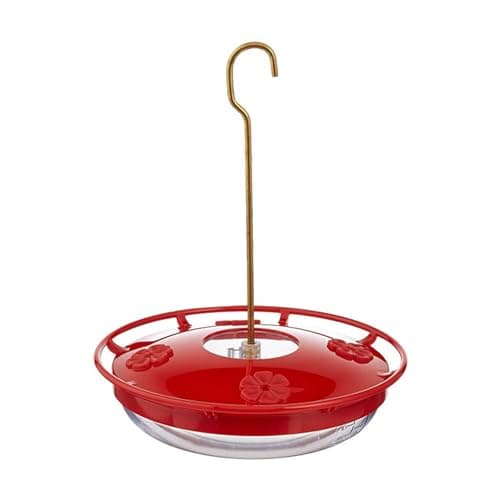
Aspects HummZinger HighView 12 oz
A four-port saucer feeder with the ant moat built into the lid and a cover that lifts straight off — the shortest path from hanging it up to washing it out.
- Type
- Saucer (dish)
- Capacity
- 12 oz
- Feeding ports
- 4
- Material
- Polycarbonate, metal hanger
- Dimensions
- 7.75" x 7.75" x 1.75"
- Ant moat
- Built in
- Perch
- Raised wraparound perch
- Mounting
- Hang or post mount
Our score: 9.2/10 — an editorial rating, not a customer rating or a test result.
Cleaning access
Two parts. The cover lifts off the base with no tools and no threads to cross, and the whole dish is one open bowl — a two-minute wash with a brush and hot water, which is exactly the cadence a nectar feeder needs. The moat is part of the lid, so there is no separate accessory to lose or forget to refill.
What works
- Saucer design puts nectar below the ports, so it does not drip as the air inside warms
- Ant moat is integral to the lid rather than a separate hanging accessory
- Opens to a single shallow bowl — the easiest shape in the category to scrub
- Raised ports shed rain, which keeps the nectar from being diluted
What doesn’t
- 12 oz is small for a busy yard
- Polycarbonate clouds over several seasons in a way glass does not
- No bee-excluding port tips fitted — that is the Ultra's feature, not the HighView's
Specifications from Duncraft — Aspects High View HummZinger and Amazon — Aspects HummZinger HighView 12 oz. We have not handled this feeder — here is what we did instead.
2. Right size for a quiet yard
Aspects Jewel Box Window Feeder 8 oz
The saucer logic applied to a window: 8 oz, three ports, a hinged lid you flip open to fill, a detachable ant moat, and a lifetime guarantee behind it.
photo yet
- Type
- Window mount, saucer
- Capacity
- 8 oz
- Feeding ports
- 3
- Material
- Polycarbonate
- Dimensions
- 8.5"L x 6"W x 2.2"H
- Mounting
- Suction-cup bracket; deck-mount hardware included
- Ant moat
- Detachable
- Ports
- Accepts optional Nectar-Guard tips
- Guarantee
- Lifetime guarantee (Aspects)
Our score: 8.5/10 — an editorial rating, not a customer rating or a test result.
Cleaning access
The best cleaning story of any window feeder here. The hinged lid opens for filling without unmounting anything, and the body is a shallow dish rather than a bottle — so the weekly wash is one bowl and three ports, not a reservoir you cannot see into.
What works
- Hinged lid means refilling does not involve taking it off the window
- Shallow dish shape is the easiest thing in the category to actually clean
- Accepts optional Nectar-Guard tips, so the bee fix is available if you need it
- Deck-mount hardware included if the suction cups disappoint you
What doesn’t
- 8 oz, and only three ports
- Nectar-Guard tips are an optional extra, not fitted
- Suction cups on a hot south-facing window are still suction cups
Specifications from Duncraft — Aspects Jewel Box Window Hummingbird Feeder. We have not handled this feeder — here is what we did instead.
3. Right size for a genuinely busy yard
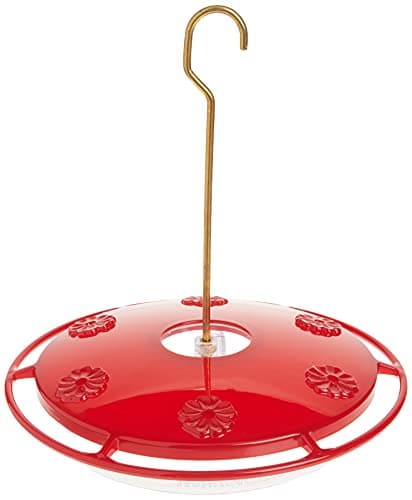
Aspects HummZinger Excel 16 oz
The saucer design scaled up to 16 oz and six ports, for the yard where a 12 oz feeder is empty by Tuesday and birds are queuing.
- Type
- Saucer (dish)
- Capacity
- 16 oz
- Feeding ports
- 6
- Material
- Polycarbonate
- Ant moat
- Built in
- Guarantee
- Lifetime guarantee (Aspects)
Our score: 8.7/10 — an editorial rating, not a customer rating or a test result.
Cleaning access
Identical two-part saucer routine to the rest of the HummZinger line — cover off, wash the bowl, done. The larger dish is if anything easier to get a brush around than the 12 oz.
What works
- Six ports genuinely reduces the fighting at a busy feeder
- Still a two-part saucer, so the extra capacity costs nothing in cleaning time
- Aspects' lifetime guarantee covers defects in material and workmanship
What doesn’t
- 16 oz of nectar spoils just as fast as 12 oz — capacity is not permission to clean less often
- Physically wider, which matters under a narrow eave
- No Nectar-Guard tips fitted as standard
Price as of October 16, 2026. #ad How we’re funded
Specifications from Greenhouse Megastore — Aspects HummZinger Excel and Amazon — Aspects HummZinger Excel. We have not handled this feeder — here is what we did instead.
4. Only if you are refilling daily
First Nature 32 oz Hummingbird Feeder
The same design at 32 oz. Right for a genuinely busy yard in peak season, wrong for almost everyone else — nectar spoils on a schedule that ignores how much you poured.
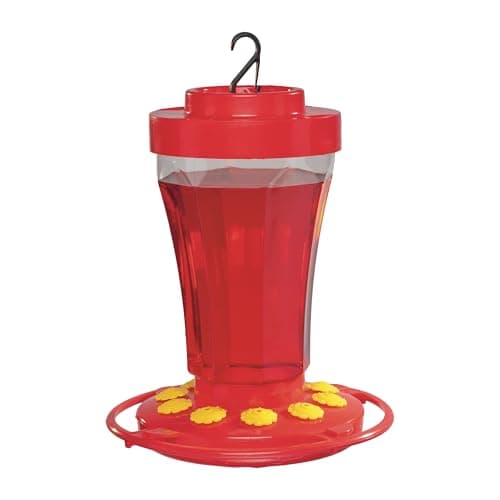
- Type
- Inverted bottle
- Capacity
- 32 oz
- Feeding ports
- 10
- Material
- Plastic
- Base
- Two-part base, twists apart
- Ant moat
- Built in
Our score: 7.4/10 — an editorial rating, not a customer rating or a test result.
Cleaning access
Same two-part twist base and wide-mouth reservoir as the 16 oz, so the method does not change — but you are washing a bigger bottle on the same two-to-five-day cycle, and the reservoir is tall enough that a short brush will not reach the bottom.
What works
- Genuinely useful where a yard empties a 16 oz feeder in a day
- Same easy-clean two-part base as the smaller model
- Ten ports spread out the traffic that justifies buying this size
What doesn’t
- Most yards will pour out more spoiled nectar than the birds drink
- Tall reservoir needs a long bottle brush, not the one in a standard kit
- A full 32 oz bottle is heavy — check what you are hanging it from
Price as of October 16, 2026. #ad How we’re funded
Specifications from Walmart — First Nature Hummingbird Feeder, 32 oz, 10 feeding ports and Amazon — First Nature Hummingbird Flower Feeder, 32 oz. We have not handled this feeder — here is what we did instead.
Common questions
Frequently asked
What size hummingbird feeder is best?
Eight to sixteen ounces for most yards. Buy the size your birds finish in two or three days, because nectar spoils on that schedule regardless of how much you poured.
Is a bigger hummingbird feeder better?
No, and it is the most common mistake in the category. A bigger feeder does not extend the interval between refills, because the interval is set by spoilage rather than volume. It just means more nectar poured away.
Can I fill a hummingbird feeder only part way?
Yes, and you often should. Capacity is a maximum, not an instruction. The one caveat is bottle feeders: a partly-full bottle has more trapped air, which means more thermal expansion and more dripping.
How much nectar do hummingbirds drink in a day?
It varies enormously by yard, season and how many birds you have, and anyone quoting you a precise figure for a yard they have not seen is guessing. Fill your feeder, see how far it drops in three days, and size from that.
Sources
Where this came from
Read next
Related reading
By Scooter M.
an enthusiast who's genuinely into this. I read the manuals, compile the published specs, and do the math. No lab coat.
Published September 1, 2026