Feeders
Hummingbird feeder parts
Six parts do all the work. Knowing which one has failed is usually the difference between a two-dollar fix and a new feeder.
We earn a commission on purchases made through our links, at no extra cost to you. We don’t accept free products or paid placements. Full disclosure.
Feeding ports and gaskets are what fail; everything else usually outlives the feeder. Ports go brittle and crack after a few seasons of UV, and a perished gasket turns a bottle feeder into a genuine leak on top of the thermal drip it already had. Both are cheap. What is not worth replacing is a hazed reservoir, because the haze is in the plastic itself.
What we recommend here
| # | Product | Best for | Score | Price |
|---|---|---|---|---|
| 1 | No product photo yet Trap-It Ant Moat Retrofits any hanging feeder that lacks a built-in moat | The part most feeders are missing | 8.3 out of 10 | |
| 2 | No product photo yet Hummingbird Feeder Brush Kit (3-piece) A port brush reaches the surface nothing else does | The part that keeps the others working | 8.4 out of 10 | |
| 3 |  Aspects HummZinger HighView 12 oz Two parts, so there is very little to fail | When replacing beats repairing | 9.0 out of 10 |
Scores are our own editorial ratings from the criteria on our methodology page. They are not customer ratings and they are not test results.
The six parts, and what each does
Feeding ports
The flower-shaped inserts the birds drink through. On better feeders they pull out for cleaning, which matters because the inside of a port is where mold takes hold and it is the one surface a stream of water does not reach. Ports are also the part most likely to fail: UV makes the plastic brittle and a cracked port both leaks and gives insects a way in.
The base
On a bottle feeder the base carries the ports and the seal. Look for one that separates from the reservoir — First Nature’s two-part base, which twists apart, is the reason a cheap feeder makes our list at all. On a saucer the base is the reservoir.
The gasket or seal
The rubber or silicone ring between reservoir and base on a bottle feeder. It perishes with age and UV. A failed gasket is a real leak — distinct from the ordinary thermal dripping every bottle feeder does, which no gasket can fix. See why feeders leak.
Perches
Worth having: a perched hummingbird uses far less energy than a hovering one. Some are detachable, which is good for cleaning — Perky-Pet’s 217 has three detachable perches. They rarely fail.
The ant moat
A small cup that holds water between the hook and the feeder. Built into the HummZinger line, both Kingsyard models, the More Birds Ruby and the First Nature bases. The failure mode is not breakage but evaporation — an empty moat is a bridge, and worse than no moat because you stop checking. More on ants.
The hanger
Wire, brass or stainless. The HummZinger Ultra’s brass hanger doubles as its ant moat; the Kingsyard 24 oz ships a stainless hook. Painted decorative hardware is what corrodes first, which is why we say to avoid it in the outdoor feeder roundup.
What fails first, in order
- Ports — brittle and cracked after two to four seasons of sun.
- Gaskets — perished, usually a season or two behind the ports.
- Reservoir clarity — permanent UV haze in polycarbonate. Not repairable.
- Hardware — corroded hangers and hooks, mostly on painted decorative parts.
When to replace the part, and when to replace the feeder
Replace the part when a port has cracked, a gasket has perished, or a moat has been lost — all cheap, all available from the maker or as a generic set, and all much less wasteful than a new feeder.
Replace the feeder when the reservoir has hazed to the point you can no longer see the nectar clearly, when the base has cross-threaded so it no longer seats square, or — the honest one — when it is a design you dread cleaning. That last case is not a failure of the object, it is a mismatch, and it ends the same way: with a feeder that quietly stops being washed. If that is where you are, a two-part saucer is the fix.
A note on retrofits
Two upgrades are worth knowing about because they cost far less than a new feeder. Aspects sells Nectar-Guard tips separately and several of their feeders accept them as an optional part, which turns a standard feeder into a bee-guarded one. And any hanging feeder without a moat can have one added for a few dollars. Check what your model takes before buying anything else.
Recommended for this
What we’d buy
1. The part most feeders are missing
Trap-It Ant Moat
A three-quarter-cup water moat that hangs above any feeder. It holds more water than most, which is the only spec that matters — a moat that dries out on a hot afternoon is a bridge.
photo yet
- Type
- Hanging water ant moat
- Water capacity
- 3/4 cup
- Dimensions
- Approx. 3" diameter x 3.5" tall including hooks
- Material
- One-piece weather-resistant plastic
- Hooks
- Open eye hooks top and bottom, 3/8 in diameter
- Colors
- Red, orange
Our score: 8.3/10 — an editorial rating, not a customer rating or a test result.
Cleaning access
One open cup. Tip it out, rinse it, refill with plain water when you refill the feeder — conveniently the same visit.
What works
- Larger water capacity than most moats, so it survives a hot day without going dry
- Open hooks top and bottom fit almost any hanging feeder
- One piece of plastic — nothing to break or lose
What doesn’t
- Does nothing whatsoever for bees or wasps; that is a port-size problem
- Needs topping up, and an empty moat is worse than none because you stop checking
- Only useful on a hanging feeder — a pole-mounted feeder needs a different answer
Specifications from Duncraft — Trap-It Ant Moat. We have not handled this feeder — here is what we did instead.
2. The part that keeps the others working
Hummingbird Feeder Brush Kit (3-piece)
A bottle brush, a socket brush and a thin port brush. The port brush is the one that matters — it is the only thing that reaches inside a flower port, and a flower port is where mold starts.
photo yet
- Bottle brush
- Typically 13.5" long, 1.5" bristle diameter
- Socket brush
- Typically 8" long, 1" bristle diameter
- Port brush
- Typically 8.25" long, sized for feeding ports
- Bristles
- Nylon — non-scratching on glass and plastic
Our score: 8.4/10 — an editorial rating, not a customer rating or a test result.
Cleaning access
Rinse the brushes when you rinse the feeder and stand them up to dry. A brush stored wet in a drawer grows its own problem.
What works
- The port brush reaches the one surface a sponge and a stream of water never will
- Nylon bristles will not scratch polycarbonate, which is what makes it cloud
- Cheap enough that there is no argument for not owning one
What doesn’t
- Kit contents vary by seller — check the port brush is actually included
- A 13.5" bottle brush will not reach the bottom of a tall 32 oz reservoir
- Bristles wear out; a splayed brush stops reaching into ports
Specifications from Duncraft — Nectar Brush Set and Blue Bird Landing — Hummingbird Feeder Cleaning Brush 3-Piece Kit. We have not handled this feeder — here is what we did instead.
3. When replacing beats repairing
Aspects HummZinger HighView 12 oz
A four-port saucer feeder with the ant moat built into the lid and a cover that lifts straight off — the shortest path from hanging it up to washing it out.
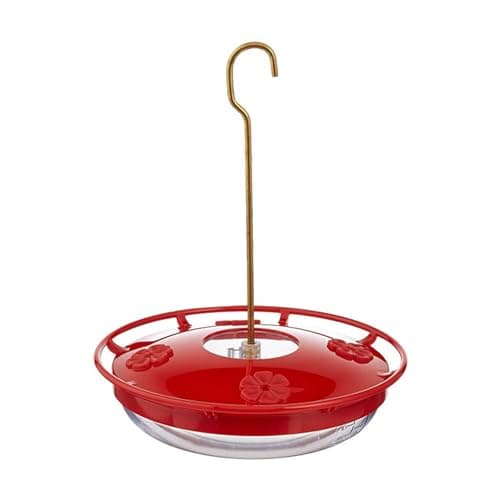
- Type
- Saucer (dish)
- Capacity
- 12 oz
- Feeding ports
- 4
- Material
- Polycarbonate, metal hanger
- Dimensions
- 7.75" x 7.75" x 1.75"
- Ant moat
- Built in
- Perch
- Raised wraparound perch
- Mounting
- Hang or post mount
Our score: 9.0/10 — an editorial rating, not a customer rating or a test result.
Cleaning access
Two parts. The cover lifts off the base with no tools and no threads to cross, and the whole dish is one open bowl — a two-minute wash with a brush and hot water, which is exactly the cadence a nectar feeder needs. The moat is part of the lid, so there is no separate accessory to lose or forget to refill.
What works
- Saucer design puts nectar below the ports, so it does not drip as the air inside warms
- Ant moat is integral to the lid rather than a separate hanging accessory
- Opens to a single shallow bowl — the easiest shape in the category to scrub
- Raised ports shed rain, which keeps the nectar from being diluted
What doesn’t
- 12 oz is small for a busy yard
- Polycarbonate clouds over several seasons in a way glass does not
- No bee-excluding port tips fitted — that is the Ultra's feature, not the HighView's
Specifications from Duncraft — Aspects High View HummZinger and Amazon — Aspects HummZinger HighView 12 oz. We have not handled this feeder — here is what we did instead.
Common questions
Frequently asked
Can you buy replacement parts for hummingbird feeders?
For the major brands, yes — ports, bases, perches and moats are commonly available, and Aspects sells Nectar-Guard tips as a separate part. Generic replacement port sets also exist and fit many feeders.
What part of a hummingbird feeder breaks first?
The feeding ports. UV makes the plastic brittle over two to four seasons, and a cracked port leaks and lets insects in. Gaskets are next.
Can you fix a cloudy hummingbird feeder?
No. Cloudiness in a plastic reservoir is UV damage to the polycarbonate itself rather than residue, and no cleaning removes it. It is the main practical argument for glass.
Do I need to replace my hummingbird feeder every year?
No. A well-made feeder that is washed regularly and stored dry over winter lasts many seasons — Aspects offers a lifetime guarantee on several models. Replace parts as they fail rather than the whole thing.
Sources
Where this came from
Read next
Related reading
By Scooter M.
an enthusiast who's genuinely into this. I read the manuals, compile the published specs, and do the math. No lab coat.
Published September 1, 2026