Feeders
Where to hang a hummingbird feeder
Height is the question everyone asks and the least important variable. Shade, cover and whether you can reach it are what actually decide whether this works.
We earn a commission on purchases made through our links, at no extra cost to you. We don’t accept free products or paid placements. Full disclosure.
Four to six feet off the ground is right for almost every yard — high enough to be out of a cat’s reach, low enough that you can service it without a ladder. Height is not really the deciding factor though. Partial shade matters more: a feeder in full afternoon sun spoils its nectar on the fast schedule, which means daily changes in hot weather rather than every three to five days.
What we recommend here
| # | Product | Best for | Score | Price |
|---|---|---|---|---|
| 1 |  Aspects HummZinger HighView 12 oz Hangs or post-mounts, and raised ports shed rain | Best for a hook or a post | 9.0 out of 10 | |
| 2 | No product photo yet Aspects Jewel Box Window Feeder 8 oz Suction bracket plus deck-mount hardware included | Best for a window | 8.5 out of 10 | |
| 3 | No product photo yet Trap-It Ant Moat Ants find a feeder anywhere; water is the only thing that stops them | Needed wherever it hangs | 8.3 out of 10 |
Scores are our own editorial ratings from the criteria on our methodology page. They are not customer ratings and they are not test results.
Height: the honest answer
Four to six feet. Hummingbirds are not fussy about elevation — they feed at flowers from ground level to the tree canopy — so height is mostly about you and about cats. Below four feet a feeder is reachable by a cat that has learned to wait. Above six feet you are fetching a stepladder twice a week, and a feeder that requires a stepladder is a feeder that gets cleaned less often. That second effect is the one that actually harms birds, so it decides the range.
The exception is a window feeder, which sits wherever your window is and is fine there. See the window feeder roundup.
Shade beats everything
Nectar in full afternoon sun gets hot, and hot sugar water ferments fast. Cornell’s guidance is to change nectar every three to five days and daily in very hot weather; direct sun effectively promotes your feeder to the daily schedule.
The ideal spot gets morning sun and afternoon shade. Morning light helps the birds find a red feeder; afternoon shade protects what is in it. Where no such spot exists — an open deck, a hook in the middle of a lawn — a weather dome shades the feeder where it hangs and keeps rain out of the ports at the same time. Dappled shade under a tree is close to perfect, as long as it is not directly beneath a branch ants will use as a bridge. In a genuinely hot climate this stops being a nicety — feeders for hot weather covers what changes when the change interval drops to daily.
Sun also does slow damage to the feeder itself — UV is what hazes polycarbonate permanently. Another reason shade is doing two jobs. See glass vs plastic.
Cover, and the ten-foot rule
Hummingbirds like a perch they can survey from and retreat to. A feeder within roughly ten feet of a shrub, a small tree or even a trellis will be adopted faster than one in the middle of an open lawn. Too close and a cat has an ambush point; ten feet or so is the usual compromise.
If you can, hang it where a bird sitting on that perch can see the feeder. Territorial hummingbirds pick a lookout and defend from it, and giving them one makes the feeder feel claimable. That lookout is a different job from the perch on the feeder itself, which is for drinking — the two are separated on the best feeders with perches.
Windows, and the counter-intuitive distance
Window strikes are a genuine risk and the safe distances are not the ones people guess. Very close is safe and middle distance is dangerous. A bird leaving a feeder mounted on the pane has no room to reach speed. A bird startled off a feeder five or ten feet from the glass can accelerate straight into a reflection of the sky.
So mount it on the window, or put it well away. Avoid the middle.
Two feeders, out of sight of each other
This is the single most effective placement decision available and it costs the price of a second cheap feeder. Hummingbirds are territorial: one dominant bird will sit on a lookout and drive everything else away from a single feeder, and it can do it all season.
It cannot defend what it cannot see. Put the second feeder around a corner of the house, on the other side of a hedge, or at the far end of the yard, and the monopoly breaks. You will see more birds at two 8 oz feeders than at one 32 oz one — which is also the reason buying a bigger feeder is usually the wrong upgrade.
Where not to hang it
- Directly over a patio, path or deck rail. Feeders drip, birds are messy, and glass over paving is a hazard.
- Directly beneath a branch or against a wall. Both are ant highways that bypass your moat entirely. A moat only works on a free-hanging feeder — that is worth knowing before you buy one. See the ants page.
- Anywhere very windy. Wind swings a feeder, which sloshes nectar out and deters birds from landing.
- Anywhere you need a ladder. Repeating this because it is the one people ignore, and it is the one that quietly ends the cleaning routine. Here is what that routine is.
Moving a feeder the birds already use
Move it in stages if you can — a few feet at a time over a week — rather than relocating it across the yard overnight. Hummingbirds remember feeder locations remarkably well and re-find a shifted feeder quickly, but an abrupt move can cost you a few days of traffic.
One deliberate exception: if bees have moved in, a sudden three-or-four-foot move is a recommended fix. Insects lose track of a relocated feeder while birds do not.
Recommended for this
What we’d buy
1. Best for a hook or a post
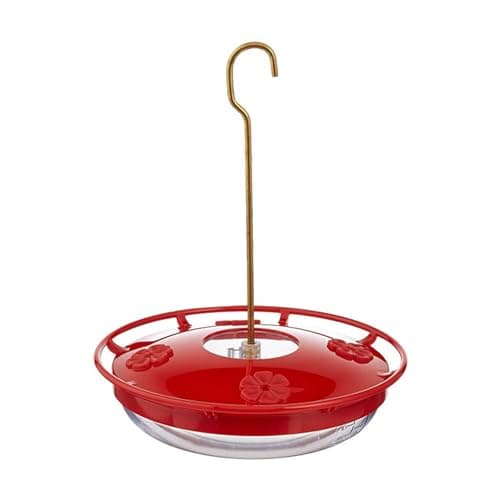
Aspects HummZinger HighView 12 oz
A four-port saucer feeder with the ant moat built into the lid and a cover that lifts straight off — the shortest path from hanging it up to washing it out.
- Type
- Saucer (dish)
- Capacity
- 12 oz
- Feeding ports
- 4
- Material
- Polycarbonate, metal hanger
- Dimensions
- 7.75" x 7.75" x 1.75"
- Ant moat
- Built in
- Perch
- Raised wraparound perch
- Mounting
- Hang or post mount
Our score: 9.0/10 — an editorial rating, not a customer rating or a test result.
Cleaning access
Two parts. The cover lifts off the base with no tools and no threads to cross, and the whole dish is one open bowl — a two-minute wash with a brush and hot water, which is exactly the cadence a nectar feeder needs. The moat is part of the lid, so there is no separate accessory to lose or forget to refill.
What works
- Saucer design puts nectar below the ports, so it does not drip as the air inside warms
- Ant moat is integral to the lid rather than a separate hanging accessory
- Opens to a single shallow bowl — the easiest shape in the category to scrub
- Raised ports shed rain, which keeps the nectar from being diluted
What doesn’t
- 12 oz is small for a busy yard
- Polycarbonate clouds over several seasons in a way glass does not
- No bee-excluding port tips fitted — that is the Ultra's feature, not the HighView's
Specifications from Duncraft — Aspects High View HummZinger and Amazon — Aspects HummZinger HighView 12 oz. We have not handled this feeder — here is what we did instead.
2. Best for a window
Aspects Jewel Box Window Feeder 8 oz
The saucer logic applied to a window: 8 oz, three ports, a hinged lid you flip open to fill, a detachable ant moat, and a lifetime guarantee behind it.
photo yet
- Type
- Window mount, saucer
- Capacity
- 8 oz
- Feeding ports
- 3
- Material
- Polycarbonate
- Dimensions
- 8.5"L x 6"W x 2.2"H
- Mounting
- Suction-cup bracket; deck-mount hardware included
- Ant moat
- Detachable
- Ports
- Accepts optional Nectar-Guard tips
- Guarantee
- Lifetime guarantee (Aspects)
Our score: 8.5/10 — an editorial rating, not a customer rating or a test result.
Cleaning access
The best cleaning story of any window feeder here. The hinged lid opens for filling without unmounting anything, and the body is a shallow dish rather than a bottle — so the weekly wash is one bowl and three ports, not a reservoir you cannot see into.
What works
- Hinged lid means refilling does not involve taking it off the window
- Shallow dish shape is the easiest thing in the category to actually clean
- Accepts optional Nectar-Guard tips, so the bee fix is available if you need it
- Deck-mount hardware included if the suction cups disappoint you
What doesn’t
- 8 oz, and only three ports
- Nectar-Guard tips are an optional extra, not fitted
- Suction cups on a hot south-facing window are still suction cups
Specifications from Duncraft — Aspects Jewel Box Window Hummingbird Feeder. We have not handled this feeder — here is what we did instead.
3. Needed wherever it hangs
Trap-It Ant Moat
A three-quarter-cup water moat that hangs above any feeder. It holds more water than most, which is the only spec that matters — a moat that dries out on a hot afternoon is a bridge.
photo yet
- Type
- Hanging water ant moat
- Water capacity
- 3/4 cup
- Dimensions
- Approx. 3" diameter x 3.5" tall including hooks
- Material
- One-piece weather-resistant plastic
- Hooks
- Open eye hooks top and bottom, 3/8 in diameter
- Colors
- Red, orange
Our score: 8.3/10 — an editorial rating, not a customer rating or a test result.
Cleaning access
One open cup. Tip it out, rinse it, refill with plain water when you refill the feeder — conveniently the same visit.
What works
- Larger water capacity than most moats, so it survives a hot day without going dry
- Open hooks top and bottom fit almost any hanging feeder
- One piece of plastic — nothing to break or lose
What doesn’t
- Does nothing whatsoever for bees or wasps; that is a port-size problem
- Needs topping up, and an empty moat is worse than none because you stop checking
- Only useful on a hanging feeder — a pole-mounted feeder needs a different answer
Specifications from Duncraft — Trap-It Ant Moat. We have not handled this feeder — here is what we did instead.
Common questions
Frequently asked
Should hummingbird feeders be high or low?
Four to six feet is right for almost every yard — above a cat’s reach, below the height where you need a ladder to service it. Hummingbirds themselves are not fussy about elevation, so the constraint is really about safety and access.
Should a hummingbird feeder be in sun or shade?
Partial shade — ideally morning sun and afternoon shade. Nectar in full sun ferments faster and needs changing daily rather than every three to five days, and UV also hazes a plastic reservoir permanently.
How far from a window should a hummingbird feeder be?
Either mounted on the glass, or well away from it. Very close is safe because a departing bird cannot build up speed; the risky distance is the middle, where a startled bird can accelerate into a reflection.
How many hummingbird feeders should I put out?
At least two, out of sight of each other. A dominant hummingbird will guard a single feeder from a lookout perch all season, and it cannot guard what it cannot see.
Can I hang a feeder from a tree branch?
You can, but a branch is an ant bridge that bypasses your moat — ants walk down the wire from above. A free-hanging hook or a shepherd’s pole works better with a moat. See keeping ants out.
Sources
Where this came from
Read next
Related reading
By Scooter M.
an enthusiast who's genuinely into this. I read the manuals, compile the published specs, and do the math. No lab coat.
Published September 1, 2026