Migration
Hummingbird migration by region
Arrival and departure windows for the parts of the country people actually ask about — and an honest note about what this page is not.
We earn a commission on purchases made through our links, at no extra cost to you. We don’t accept free products or paid placements. Full disclosure.
Ruby-throated Hummingbirds reach the Gulf Coast in numbers by early March and the northern states by late April or early May. In the Mountain West, Broad-tailed, Black-chinned and Calliope hummingbirds appear near the Mexican border from early March and reach the northern Rockies by early to mid May. On the West Coast, Rufous Hummingbirds are as far north as Oregon by the end of February, while Anna’s and Allen’s are year-round residents.
What we recommend here
| # | Product | Best for | Score | Price |
|---|---|---|---|---|
| 1 |  Aspects HummZinger HighView 12 oz Small, fast to clean, does not drip | Right feeder wherever you are | 9.0 out of 10 | |
| 2 | No product photo yet Aspects Jewel Box Window Feeder 8 oz 8 oz suits a resident population rather than a migration peak | Best for a year-round West Coast feeder | 8.5 out of 10 |
Scores are our own editorial ratings from the criteria on our methodology page. They are not customer ratings and they are not test results.
What this page is, and what it is not
This is a summary of typical regional windows, drawn from Audubon’s published guidance. It is useful for deciding when to hang and when to take down a feeder.
It is not live tracking data, and we are not going to present it as such. Real-time sighting maps exist and they are built from years of user-submitted reports — Hummingbird Central runs the best-known one. We have no sightings feed and no contributor network, so anything we published claiming to show where the birds are right now would be invented. If you want live sightings, go to a site that actually collects them.
What we can tell you accurately is the seasonal pattern, which is below.
East: Ruby-throated Hummingbird
One dominant species across the entire eastern half of the country, which makes the timing unusually clean.
- Gulf Coast: arrives in numbers by early March. Hang the feeder in late February.
- Southeast: March. Audubon suggests putting feeders out by early March here.
- Mid-Atlantic and Midwest: through April as the front moves north.
- Northeast and southern Canada: late April or early May. Audubon suggests hanging feeders by late April in the Northeast.
Departure runs in reverse through September and October, with the Gulf Coast latest — and with birds from further north passing through after your local breeders have gone. When to take feeders down.
Mountain West
More species and a longer window. Broad-tailed, Black-chinned and Calliope hummingbirds appear in yards near the Mexican border starting in early March, and are found in the northern Rockies by early to mid May.
Audubon notes a genuine conservation concern here: climate change and earlier wildflower blooming may be affecting these species, because they do not appear to be shifting their arrival times to match the earlier blossoming. A well-maintained feeder is a small buffer against that mismatch — which is an argument for hanging early and keeping it clean rather than for anything more elaborate.
West Coast
The most distinctive region, and the one where the usual advice does not apply.
- Rufous Hummingbird: moving north early — as far north as Oregon by the end of February, heading for Alaskan breeding grounds. If you are on the Pacific Northwest coast, hang your feeder in mid February.
- Anna’s and Allen’s Hummingbirds: year-round residents. There is no season to time — there is just a feeder that needs to stay clean and full all year.
For year-round feeding the cleaning discipline matters more, not less, because there is no off-season reset. A feeder that comes apart in two pieces is the difference between a sustainable routine and one that lapses in November. Easiest feeders to clean.
Southwest and Texas
Species-dependent and genuinely variable — several species overlap, some winter locally, and arrival can start as early as anywhere in the country near the Mexican border in early March. The practical rule here is to watch rather than to follow a calendar: hang the feeder in late February and take it down two weeks after your last bird, whenever that turns out to be.
The rule that works everywhere
If you only remember one thing: hang it a week or two before your region’s usual arrival, and take it down two weeks after your last sighting. Both errors are asymmetric — early and late cost you almost nothing, while being late in spring or early in fall costs a bird a meal at the two points in the year when it most needs one.
Recommended for this
What we’d buy
1. Right feeder wherever you are
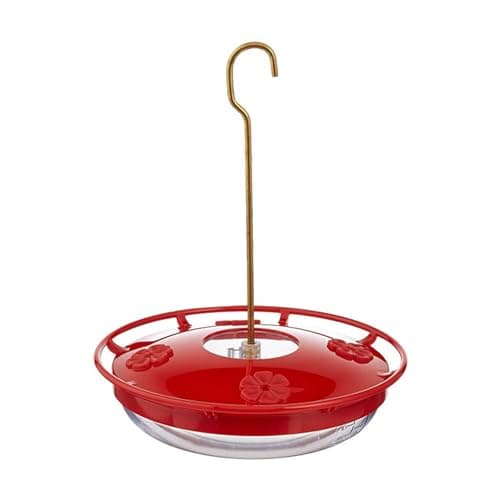
Aspects HummZinger HighView 12 oz
A four-port saucer feeder with the ant moat built into the lid and a cover that lifts straight off — the shortest path from hanging it up to washing it out.
- Type
- Saucer (dish)
- Capacity
- 12 oz
- Feeding ports
- 4
- Material
- Polycarbonate, metal hanger
- Dimensions
- 7.75" x 7.75" x 1.75"
- Ant moat
- Built in
- Perch
- Raised wraparound perch
- Mounting
- Hang or post mount
Our score: 9.0/10 — an editorial rating, not a customer rating or a test result.
Cleaning access
Two parts. The cover lifts off the base with no tools and no threads to cross, and the whole dish is one open bowl — a two-minute wash with a brush and hot water, which is exactly the cadence a nectar feeder needs. The moat is part of the lid, so there is no separate accessory to lose or forget to refill.
What works
- Saucer design puts nectar below the ports, so it does not drip as the air inside warms
- Ant moat is integral to the lid rather than a separate hanging accessory
- Opens to a single shallow bowl — the easiest shape in the category to scrub
- Raised ports shed rain, which keeps the nectar from being diluted
What doesn’t
- 12 oz is small for a busy yard
- Polycarbonate clouds over several seasons in a way glass does not
- No bee-excluding port tips fitted — that is the Ultra's feature, not the HighView's
Specifications from Duncraft — Aspects High View HummZinger and Amazon — Aspects HummZinger HighView 12 oz. We have not handled this feeder — here is what we did instead.
2. Best for a year-round West Coast feeder
Aspects Jewel Box Window Feeder 8 oz
The saucer logic applied to a window: 8 oz, three ports, a hinged lid you flip open to fill, a detachable ant moat, and a lifetime guarantee behind it.
photo yet
- Type
- Window mount, saucer
- Capacity
- 8 oz
- Feeding ports
- 3
- Material
- Polycarbonate
- Dimensions
- 8.5"L x 6"W x 2.2"H
- Mounting
- Suction-cup bracket; deck-mount hardware included
- Ant moat
- Detachable
- Ports
- Accepts optional Nectar-Guard tips
- Guarantee
- Lifetime guarantee (Aspects)
Our score: 8.5/10 — an editorial rating, not a customer rating or a test result.
Cleaning access
The best cleaning story of any window feeder here. The hinged lid opens for filling without unmounting anything, and the body is a shallow dish rather than a bottle — so the weekly wash is one bowl and three ports, not a reservoir you cannot see into.
What works
- Hinged lid means refilling does not involve taking it off the window
- Shallow dish shape is the easiest thing in the category to actually clean
- Accepts optional Nectar-Guard tips, so the bee fix is available if you need it
- Deck-mount hardware included if the suction cups disappoint you
What doesn’t
- 8 oz, and only three ports
- Nectar-Guard tips are an optional extra, not fitted
- Suction cups on a hot south-facing window are still suction cups
Specifications from Duncraft — Aspects Jewel Box Window Hummingbird Feeder. We have not handled this feeder — here is what we did instead.
Common questions
Frequently asked
When do hummingbirds arrive in my area?
Broadly: Gulf Coast and Southwest early March, Southeast through March, Mid-Atlantic and Midwest through April, Northeast late April to early May, northern Rockies early to mid May, Pacific Northwest as early as late February for Rufous.
Where are the hummingbirds right now?
We do not publish live sighting data and will not pretend to. Real-time maps are built from years of user-submitted reports by sites that collect them — Hummingbird Central runs the best-known one. What we can give you is the typical seasonal pattern above.
Do hummingbirds stay in California all year?
Anna’s and Allen’s hummingbirds are year-round residents on the West Coast, so a clean, filled feeder is useful in every month rather than seasonally.
Which hummingbird migrates earliest?
The Rufous Hummingbird moves north early on the West Coast — as far north as Oregon by the end of February, heading for Alaskan breeding grounds.
Sources
Where this came from
Read next
Related reading
By Scooter M.
an enthusiast who's genuinely into this. I read the manuals, compile the published specs, and do the math. No lab coat.
Published September 1, 2026