Nectar
Buying hummingbird nectar instead of making it
We would rather you mixed your own. If you are going to buy it, here is the one rule that matters and the kit that makes the alternative painless.
We earn a commission on purchases made through our links, at no extra cost to you. We don’t accept free products or paid placements. Full disclosure.
Buy clear concentrate, never a red ready-to-use bottle. Those are the only two rules. Concentrate is better value than shipping water, and clear avoids the dye that Audubon calls unnecessary and notes could prove harmful. Honestly though, four parts water to one part plain white sugar costs pennies — the recipe takes four minutes.

Quick picks
| # | Product | Best for | Score | Price |
|---|---|---|---|---|
| 1 | No product photo yet First Nature 3051 16 oz Wide-mouth reservoir is designed for mixing in the feeder | Best feeder for concentrate | 8.6 out of 10 | |
| 2 |  Aspects HummZinger HighView 12 oz Two-part saucer, so the refill is not the hard part | Best feeder for mixing your own | 9.0 out of 10 | |
| 3 | No product photo yet Hummingbird Feeder Brush Kit (3-piece) Cleaning is the recurring cost, not the sugar | Buy this before you buy nectar | 8.4 out of 10 |
Scores are our own editorial ratings from the criteria on our methodology page. They are not customer ratings and they are not test results.
What to look for on the label
- Clear, not red. The single most important thing. Why.
- Sucrose as the sugar. That is what flower nectar is, and what the standard recipe uses.
- Concentrate rather than ready-to-use. Better value, less packaging, and it stores smaller.
- A short ingredient list. Sugar and water is the target. Every additional line is something you did not need.
Mixing concentrate properly
Follow the maker’s dilution rather than eyeballing it — a concentrate is not necessarily formulated to end up at 4:1 by the same measure as raw sugar. Mix it in a jug rather than in the feeder if you can, so you can see that it is fully combined.
The one exception worth knowing: First Nature’s reservoir is designed for mixing their concentrate directly in the feeder, which removes a step and a washing-up item.
Storage
Concentrate follows its label. Mixed nectar, whether from concentrate or from sugar, goes in a covered container in the fridge and keeps about a week — see how long nectar lasts. Once it is in the feeder, the outdoor clock applies regardless of source: three to five days, daily in very hot weather.
The honest recommendation
We are not going to pad this page out. Commercial nectar is a convenience product for a liquid you can make from one ingredient you already own. If the reason you are buying it is that the boil-and-cool routine is a hassle, the better fix is usually a feeder that is quicker to service and a Sunday batch in the fridge — that combination removes far more friction than pre-mixed nectar does, and costs nothing per fill.
The picks in full
Every pick, in detail
1. Best feeder for concentrate
First Nature 3051 16 oz
Ten ports, a wide-mouth reservoir and a base that twists into two pieces — the cheapest feeder in the category that is genuinely easy to clean, which is the only reason it is here.
photo yet
- Type
- Inverted bottle
- Capacity
- 16 oz
- Feeding ports
- 10
- Material
- Plastic
- Base
- Patented two-part base, twists apart
- Reservoir
- Wide-mouth
- Ant moat
- Built into the base
- Dishwasher
- Not dishwasher safe — warm soapy water
Our score: 8.6/10 — an editorial rating, not a customer rating or a test result.
Cleaning access
Better than the price suggests. The reservoir mouth is wide enough to take a bottle brush without contortions, and the base twists into two pieces so you can reach the underside of the ports — the spot that grows mold first on a cheap bottle feeder. First Nature specifies warm soapy water, not the dishwasher.
What works
- Wide-mouth reservoir takes a standard bottle brush, unlike most budget bottle feeders
- Two-part base opens up the port undersides, which is where mold starts
- Ten ports and an integrated ant moat at the bottom of the category's price range
What doesn’t
- It is an inverted bottle, so it can drip as trapped air warms and pushes nectar out
- Not dishwasher safe, and the thin plastic would not enjoy a hot wash anyway
- Fill all 16 oz in a quiet yard and you will pour most of it away
Specifications from Oak Ridge Stores — First Nature FN3051. We have not handled this feeder — here is what we did instead.
2. Best feeder for mixing your own
Aspects HummZinger HighView 12 oz
A four-port saucer feeder with the ant moat built into the lid and a cover that lifts straight off — the shortest path from hanging it up to washing it out.
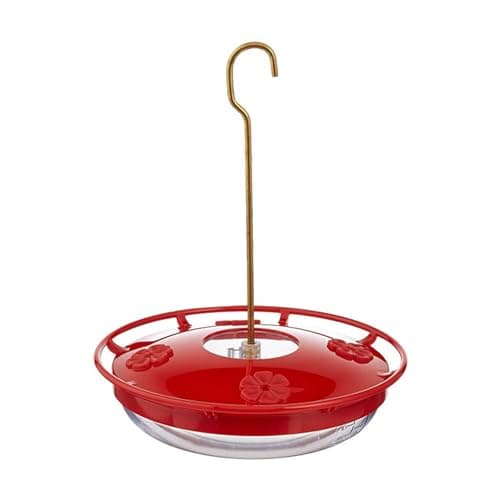
- Type
- Saucer (dish)
- Capacity
- 12 oz
- Feeding ports
- 4
- Material
- Polycarbonate, metal hanger
- Dimensions
- 7.75" x 7.75" x 1.75"
- Ant moat
- Built in
- Perch
- Raised wraparound perch
- Mounting
- Hang or post mount
Our score: 9.0/10 — an editorial rating, not a customer rating or a test result.
Cleaning access
Two parts. The cover lifts off the base with no tools and no threads to cross, and the whole dish is one open bowl — a two-minute wash with a brush and hot water, which is exactly the cadence a nectar feeder needs. The moat is part of the lid, so there is no separate accessory to lose or forget to refill.
What works
- Saucer design puts nectar below the ports, so it does not drip as the air inside warms
- Ant moat is integral to the lid rather than a separate hanging accessory
- Opens to a single shallow bowl — the easiest shape in the category to scrub
- Raised ports shed rain, which keeps the nectar from being diluted
What doesn’t
- 12 oz is small for a busy yard
- Polycarbonate clouds over several seasons in a way glass does not
- No bee-excluding port tips fitted — that is the Ultra's feature, not the HighView's
Specifications from Duncraft — Aspects High View HummZinger and Amazon — Aspects HummZinger HighView 12 oz. We have not handled this feeder — here is what we did instead.
3. Buy this before you buy nectar
Hummingbird Feeder Brush Kit (3-piece)
A bottle brush, a socket brush and a thin port brush. The port brush is the one that matters — it is the only thing that reaches inside a flower port, and a flower port is where mold starts.
photo yet
- Bottle brush
- Typically 13.5" long, 1.5" bristle diameter
- Socket brush
- Typically 8" long, 1" bristle diameter
- Port brush
- Typically 8.25" long, sized for feeding ports
- Bristles
- Nylon — non-scratching on glass and plastic
Our score: 8.4/10 — an editorial rating, not a customer rating or a test result.
Cleaning access
Rinse the brushes when you rinse the feeder and stand them up to dry. A brush stored wet in a drawer grows its own problem.
What works
- The port brush reaches the one surface a sponge and a stream of water never will
- Nylon bristles will not scratch polycarbonate, which is what makes it cloud
- Cheap enough that there is no argument for not owning one
What doesn’t
- Kit contents vary by seller — check the port brush is actually included
- A 13.5" bottle brush will not reach the bottom of a tall 32 oz reservoir
- Bristles wear out; a splayed brush stops reaching into ports
Specifications from Duncraft — Nectar Brush Set and Blue Bird Landing — Hummingbird Feeder Cleaning Brush 3-Piece Kit. We have not handled this feeder — here is what we did instead.
What we’d skip
Any bright red ready-to-use nectar
Two problems in one bottle. The dye is unnecessary — Audubon says so plainly, and adds it could also prove harmful — and it does not even do the job people think, because hummingbirds are drawn to red on the feeder rather than red in the liquid. And ready-to-use is mostly water you are paying to have shipped across the country. If you want to buy nectar, buy clear concentrate. If you want the cheapest safe option, it is a bag of plain white sugar.
Common questions
Frequently asked
What is the best hummingbird nectar to buy?
Clear concentrate from any reputable brand. Avoid red ready-to-use bottles: the dye is unnecessary and possibly harmful, and you are mostly paying to ship water.
Is it cheaper to make hummingbird nectar?
Substantially. A cup of plain white sugar makes roughly 32 oz of nectar, which is several feeder-fills for a few cents.
Can I mix concentrate directly in the feeder?
Some feeders are designed for it — First Nature’s wide-mouth reservoir is one. Otherwise mix in a jug so you can see it has fully combined.
Sources
Where this came from
Read next
Related reading
By Scooter M.
an enthusiast who's genuinely into this. I read the manuals, compile the published specs, and do the math. No lab coat.
Published September 1, 2026