Nectar
How long does hummingbird nectar last?
Two different questions with two different answers, and people usually ask the easy one.
We earn a commission on purchases made through our links, at no extra cost to you. We don’t accept free products or paid placements. Full disclosure.
In the fridge, covered: about a week. In the feeder: three to five days in moderate weather, and daily in very hot weather. Those are two separate clocks. Cornell’s guidance is to change sugar water every three to five days to prevent mold and deadly fermentation, and more frequently when it is hot — the feeder is the one that matters, because that is where the birds drink.
What we recommend here
| # | Product | Best for | Score | Price |
|---|---|---|---|---|
| 1 |  Aspects HummZinger HighView 12 oz Two-part saucer washes in about two minutes | Makes the schedule easy | 9.0 out of 10 | |
| 2 | No product photo yet Aspects Jewel Box Window Feeder 8 oz 8 oz, which suits the change cycle rather than fighting it | Small enough to finish before it turns | 8.5 out of 10 | |
| 3 | No product photo yet Hummingbird Feeder Brush Kit (3-piece) Rinsing is not changing; the port brush is the tool | What a change actually needs | 8.4 out of 10 |
Scores are our own editorial ratings from the criteria on our methodology page. They are not customer ratings and they are not test results.
The two clocks
In the fridge
Nectar you have mixed and not yet used, in a covered container in the refrigerator, keeps for roughly a week. Cold slows the yeast and mold that would otherwise get going, and a lid keeps out whatever else might. Make a batch on Sunday, refill from it during the week — it is the single easiest habit for keeping the feeder on schedule.
If a fridge batch goes cloudy, smells sour or has anything floating in it, pour it out. It costs a few cents to replace.
In the feeder
This is the question that matters and the answer is much shorter. Cornell recommends changing sugar water every three to five days to prevent mold and deadly fermentation, and more frequently in hot weather. Clemson’s extension guidance is to fill with new sugar water twice a week, with more frequent changes when it is warmer.
In very hot weather that becomes daily. There is no version of this where a feeder in a heatwave is fine for five days.
Temperature is the variable
Warm sugar water is close to an ideal culture medium. The hotter it is, the faster yeast ferments the sugar and the faster mold establishes in the ports. So the change interval is not really a number — it is a function of the weather, and it tightens as summer builds.
Two practical consequences. First, hang the feeder where it gets morning sun and afternoon shade; that alone buys you real time. See where to hang a feeder. Second, do not buy a feeder based on how long the nectar will last in it, because the answer is unaffected by capacity — the sizing page works through why.
How to tell it has gone
- Cloudiness. Fresh nectar is water-clear. Cloudy is fermenting.
- Strings or floaters. Visible growth. Empty it now.
- Black specks around the ports. Mold, and the ports are where it starts. See the mold page.
- A sour smell. Fermentation, unambiguously.
One important caveat: nectar can be unsafe before it looks wrong. The visual check is a backstop, not the schedule. Run the calendar and use your eyes as an early warning, not the other way round.
Do not top up — change
Pouring fresh nectar onto old nectar in an unwashed feeder does not reset the clock. It gives the existing yeast and mold a fresh supply of sugar. Every change means empty, wash, refill.
That is the whole reason we care so much about how a feeder comes apart. A wash that takes two minutes gets done; one that takes ten gets postponed, and postponed is where the harm is. The cleaning cadence · feeders that make it fast.
Recommended for this
What we’d buy
1. Makes the schedule easy
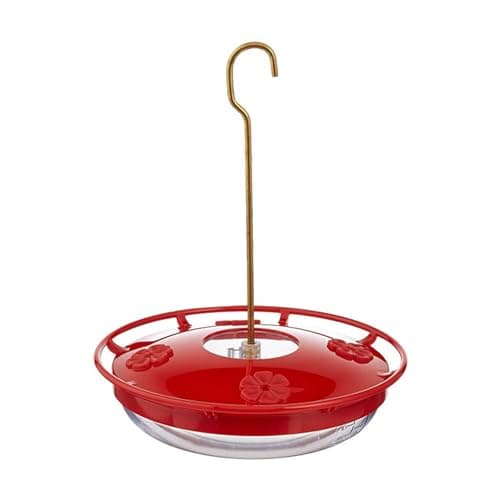
Aspects HummZinger HighView 12 oz
A four-port saucer feeder with the ant moat built into the lid and a cover that lifts straight off — the shortest path from hanging it up to washing it out.
- Type
- Saucer (dish)
- Capacity
- 12 oz
- Feeding ports
- 4
- Material
- Polycarbonate, metal hanger
- Dimensions
- 7.75" x 7.75" x 1.75"
- Ant moat
- Built in
- Perch
- Raised wraparound perch
- Mounting
- Hang or post mount
Our score: 9.0/10 — an editorial rating, not a customer rating or a test result.
Cleaning access
Two parts. The cover lifts off the base with no tools and no threads to cross, and the whole dish is one open bowl — a two-minute wash with a brush and hot water, which is exactly the cadence a nectar feeder needs. The moat is part of the lid, so there is no separate accessory to lose or forget to refill.
What works
- Saucer design puts nectar below the ports, so it does not drip as the air inside warms
- Ant moat is integral to the lid rather than a separate hanging accessory
- Opens to a single shallow bowl — the easiest shape in the category to scrub
- Raised ports shed rain, which keeps the nectar from being diluted
What doesn’t
- 12 oz is small for a busy yard
- Polycarbonate clouds over several seasons in a way glass does not
- No bee-excluding port tips fitted — that is the Ultra's feature, not the HighView's
Specifications from Duncraft — Aspects High View HummZinger and Amazon — Aspects HummZinger HighView 12 oz. We have not handled this feeder — here is what we did instead.
2. Small enough to finish before it turns
Aspects Jewel Box Window Feeder 8 oz
The saucer logic applied to a window: 8 oz, three ports, a hinged lid you flip open to fill, a detachable ant moat, and a lifetime guarantee behind it.
photo yet
- Type
- Window mount, saucer
- Capacity
- 8 oz
- Feeding ports
- 3
- Material
- Polycarbonate
- Dimensions
- 8.5"L x 6"W x 2.2"H
- Mounting
- Suction-cup bracket; deck-mount hardware included
- Ant moat
- Detachable
- Ports
- Accepts optional Nectar-Guard tips
- Guarantee
- Lifetime guarantee (Aspects)
Our score: 8.5/10 — an editorial rating, not a customer rating or a test result.
Cleaning access
The best cleaning story of any window feeder here. The hinged lid opens for filling without unmounting anything, and the body is a shallow dish rather than a bottle — so the weekly wash is one bowl and three ports, not a reservoir you cannot see into.
What works
- Hinged lid means refilling does not involve taking it off the window
- Shallow dish shape is the easiest thing in the category to actually clean
- Accepts optional Nectar-Guard tips, so the bee fix is available if you need it
- Deck-mount hardware included if the suction cups disappoint you
What doesn’t
- 8 oz, and only three ports
- Nectar-Guard tips are an optional extra, not fitted
- Suction cups on a hot south-facing window are still suction cups
Specifications from Duncraft — Aspects Jewel Box Window Hummingbird Feeder. We have not handled this feeder — here is what we did instead.
3. What a change actually needs
Hummingbird Feeder Brush Kit (3-piece)
A bottle brush, a socket brush and a thin port brush. The port brush is the one that matters — it is the only thing that reaches inside a flower port, and a flower port is where mold starts.
photo yet
- Bottle brush
- Typically 13.5" long, 1.5" bristle diameter
- Socket brush
- Typically 8" long, 1" bristle diameter
- Port brush
- Typically 8.25" long, sized for feeding ports
- Bristles
- Nylon — non-scratching on glass and plastic
Our score: 8.4/10 — an editorial rating, not a customer rating or a test result.
Cleaning access
Rinse the brushes when you rinse the feeder and stand them up to dry. A brush stored wet in a drawer grows its own problem.
What works
- The port brush reaches the one surface a sponge and a stream of water never will
- Nylon bristles will not scratch polycarbonate, which is what makes it cloud
- Cheap enough that there is no argument for not owning one
What doesn’t
- Kit contents vary by seller — check the port brush is actually included
- A 13.5" bottle brush will not reach the bottom of a tall 32 oz reservoir
- Bristles wear out; a splayed brush stops reaching into ports
Specifications from Duncraft — Nectar Brush Set and Blue Bird Landing — Hummingbird Feeder Cleaning Brush 3-Piece Kit. We have not handled this feeder — here is what we did instead.
Common questions
Frequently asked
How long does homemade hummingbird nectar last in the fridge?
About a week in a covered container. If it goes cloudy or smells sour before then, pour it out.
How often should I change hummingbird nectar in hot weather?
Daily. Cornell’s standard guidance is every three to five days, with more frequent changes in hot weather — and in a real heatwave that means every day.
Can I top up a hummingbird feeder instead of emptying it?
No. Adding fresh nectar to old nectar in an unwashed feeder feeds the yeast and mold already there. Every change means empty, wash, refill.
Can nectar be bad before it looks bad?
Yes, which is why the schedule matters more than the visual check. Treat cloudiness and black specks as a warning that you are already late, not as the trigger.
Sources
Where this came from
Read next
Related reading
By Scooter M.
an enthusiast who's genuinely into this. I read the manuals, compile the published specs, and do the math. No lab coat.
Published September 1, 2026