Reviews
Kingsyard 16 oz glass feeder review
The glass feeder that arrives finished, rather than needing accessories to become usable.
We earn a commission on purchases made through our links, at no extra cost to you. We don’t accept free products or paid placements. Full disclosure.
The best glass all-rounder we found. Sixteen ounces, six flower-shaped ports sized to admit a hummingbird bill and exclude bees, a thick glass reservoir, an ant moat included rather than sold separately, and it disassembles completely. Skip it if the feeder hangs somewhere windy, high, or over a hard surface — glass breaks — or if six ports to wash every few days sounds like too much.

What we recommend here
| # | Product | Best for | Score | Price |
|---|---|---|---|---|
| 1 |  Kingsyard 16 oz Glass Feeder Six ports, moat included, fully disassembles | Best glass all-rounder | 8.9 out of 10 | $19.99 on Amazon $22.99 13% off |
| 2 |  Kingsyard 24 oz Glass Feeder 24 oz with a see-through base, if the yard is busy | The larger version | 8.1 out of 10 | |
| 3 |  More Birds Ruby 10 oz Glass 10 oz with bee guards and a built-in moat | Cheaper glass | 8.5 out of 10 | $16.99 on Amazon $22.48 24% off |
Scores are our own editorial ratings from the criteria on our methodology page. They are not customer ratings and they are not test results.
What it is
A 16 oz inverted-bottle feeder with a glass reservoir and a plastic base carrying six flower-shaped ports. Kingsyard describes the ports as sized so that only hummingbird beaks get through, which protects the nectar from bees, and ships an ant moat in the box. The feeder disassembles fully for cleaning.
Why glass is the point
Not looks — visibility. Polycarbonate develops a permanent UV haze after a couple of seasons of sugar water and sun, and a hazed reservoir means you can no longer tell by looking whether the nectar has gone cloudy. That informal visual check is what most people actually use to decide when to wash a feeder, so losing it matters.
Glass looks the same in year ten as year one. On a feeder holding a liquid that spoils on a three-to-five-day clock, that is a functional property rather than a cosmetic one. Glass vs plastic.
Cleaning: honest about the trade
It fully disassembles, which is exactly what you want and is why it beats most decorative glass feeders. Reservoir, base and ports all come apart, so every surface is reachable.
But six ports is six ports. Each one needs a port brush through it, every wash, because the inside of a port is where mold starts and running water does not reach it. Against a two-part saucer with four ports, this is a longer job.
That is a real cost given how often the wash has to happen. It is the reason this scores below the HummZinger HighView despite having a nicer reservoir. The cadence.
Bees and ants
Bees: the ports are sized to exclude them, which is a genuine measure — though it is port sizing rather than a fitted collar like a Nectar-Guard tip. And there is a structural problem no port design fixes: this is an inverted bottle, so it drips as the trapped air warms, and spilled nectar on the outside is what bees mostly feed on. Audubon is explicit that barring bees from the drinking hole achieves little if the feeder is covered in sugar water. Bees.
Ants: solved, and included. Keep the moat filled with plain water and hang the feeder free of walls and branches. Ants.
Who should not buy this
- Anyone hanging it somewhere windy or high. Sixteen ounces of nectar plus glass is a real weight, and a swinging glass reservoir on a thin hook is a matter of time.
- Anyone hanging it over paving or a deck. Broken glass and sugar water.
- Anyone with an active bee problem. A bottle feeder drips, and drips are the problem. Buy a guarded saucer.
- Anyone who wants the fastest possible wash. Six ports and full disassembly is more work than a two-part dish, every time.
Where it fits
A sheltered spot, at a reachable height, over grass or a bed — and for someone who wants a feeder that still looks and reads clean in year five. Considered against the rest of the glass field, it wins mostly because it arrives complete: six ports and a moat in the box, rather than a beautiful bottle you then have to buy accessories for. The glass roundup.
Recommended for this
What we’d buy
1. Best glass all-rounder
Kingsyard 16 oz Glass Feeder
Six flower ports sized to admit a hummingbird bill and not much else, a thick glass reservoir, and an ant moat in the box — the glass feeder that does not make you buy accessories to finish it.
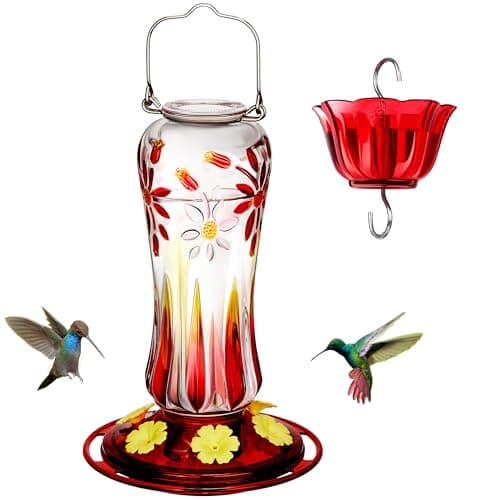
- Type
- Glass bottle
- Capacity
- 16 oz
- Feeding ports
- 6, flower-shaped
- Material
- Glass reservoir, plastic base
- Ant moat
- Included
- Bee guards
- Ports sized to exclude bees
Our score: 8.9/10 — an editorial rating, not a customer rating or a test result.
Cleaning access
Fully disassembles — reservoir, base and ports all come apart, which is what you want, because a six-port base has six places for residue to sit. The glass reservoir is the easy part; plan on a port brush for the flowers.
What works
- Six ports and a supplied ant moat at a mid-range price
- Glass stays visually clean, so the nectar level and its condition are readable at a glance
- Disassembles completely rather than to two pieces
What doesn’t
- More parts to wash than a saucer, every single time
- Glass and a full 16 oz make for a heavy hang
- Port sizing discourages bees but is not the same as a fitted Nectar-Guard tip
Specifications from Kingsyard — hummingbird feeder range and Amazon — Kingsyard Glass Hummingbird Feeders for Outdoors. We have not handled this feeder — here is what we did instead.
2. The larger version
Kingsyard 24 oz Glass Feeder
The 24 oz version of the same idea, with a see-through base so you can read the nectar level without unhooking it. Buy it only if your yard genuinely drinks that much.
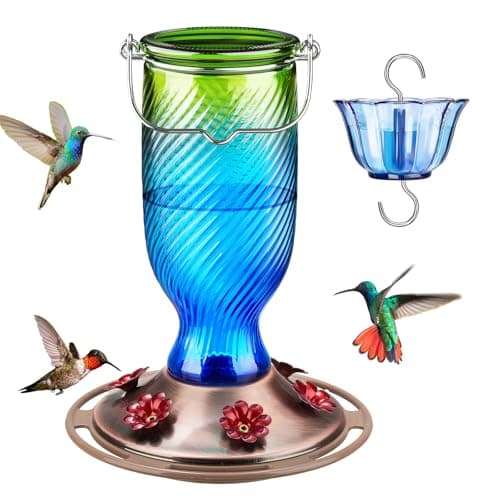
- Type
- Glass bottle
- Capacity
- 24 oz
- Feeding ports
- 6
- Material
- Glass
- Dimensions
- 6" diameter x 12" tall
- Ant moat
- Included, with stainless steel hook
- Filling
- Wide-mouth
Our score: 8.1/10 — an editorial rating, not a customer rating or a test result.
Cleaning access
Wide mouth, fully disassembles, see-through base. The catch is arithmetic rather than design: 24 oz on a two-to-five-day change cycle is a lot of sugar water going down the drain unless the yard is busy.
What works
- See-through base makes it obvious when the nectar has gone cloudy
- Wide mouth takes a full-size bottle brush
- Stainless hook and a large-capacity ant moat included
What doesn’t
- 12" of glass full of nectar is a serious weight on a shepherd's hook
- Capacity you will not use outside peak season, and unused nectar still spoils on schedule
- Six ports plus a moat is the most parts to wash of any feeder here
Price as of October 16, 2026. #ad How we’re funded
Specifications from Kingsyard — hummingbird feeder range and Walmart — Kingsyard Glass Hummingbird Feeder, 24 oz, ant moat included. We have not handled this feeder — here is what we did instead.
3. Cheaper glass
More Birds Ruby 10 oz Glass
A 10 oz glass bottle with four bee-guard ports, five perches and the ant moat built into the top — the cheapest way to get glass without giving up either insect defense.
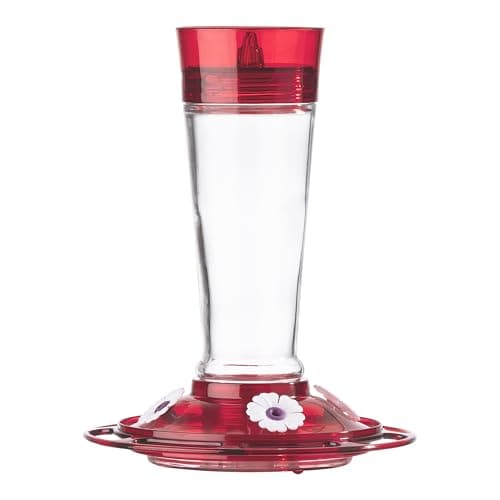
- Type
- Glass bottle
- Capacity
- 10 oz
- Feeding ports
- 4, bee-guard style
- Perches
- 5 integrated
- Material
- Glass, plastic and metal
- Dimensions
- 8.75"H x 6.5"W x 6.5"D
- Ant moat
- Built in, on top
- Base
- Detachable flat base
Our score: 8.5/10 — an editorial rating, not a customer rating or a test result.
Cleaning access
The flat base detaches and the bottle opening is wide, so you can reach every surface. Glass is the real advantage: it does not hold the cloudy film polycarbonate develops after a couple of seasons of sugar water, so 'clean' and 'looks clean' stay the same thing.
What works
- Glass reservoir does not stain or cloud the way polycarbonate does
- Four bee-guard ports and a built-in ant moat, both included rather than sold as extras
- Five perches on a 10 oz feeder is generous — perched birds drink longer and fight less
What doesn’t
- Glass breaks; a pole-mounted feeder in a windy spot is a bad match
- 10 oz is modest, so this is a second feeder in a busy yard rather than the only one
- Still an inverted bottle, so it shares the bottle-design drip risk
Specifications from Perky-Pet — More Birds Bird Health+ Ruby Hummingbird Feeder and Amazon — More Birds Bird Health+ Ruby Hummingbird Feeder. We have not handled this feeder — here is what we did instead.
Common questions
Frequently asked
Does the Kingsyard glass feeder come with an ant moat?
Yes, included rather than sold separately — which is unusual in the glass category and is a large part of why it is our glass pick.
Do the ports really keep bees out?
The ports are sized so that only hummingbird beaks get through, which helps. But it is an inverted bottle, so it drips — and spilled nectar on the outside is what bees mostly feed on regardless of port size.
Is a glass hummingbird feeder harder to clean?
The glass itself is easier — it does not scratch or haze. What adds time here is six ports plus full disassembly, against four ports on a two-part saucer.
Should I get the 16 oz or the 24 oz?
The 16 oz for most yards. Nectar spoils on a fixed schedule regardless of volume, so the 24 oz mostly means pouring more away — and it is 12 inches of glass full of liquid on your hook.
Sources
Where this came from
Read next
Related reading
By Scooter M.
an enthusiast who's genuinely into this. I read the manuals, compile the published specs, and do the math. No lab coat.
Published September 1, 2026