Feeders
Glass vs plastic hummingbird feeders
One of these keeps looking clean for a decade. The other one keeps surviving being dropped. Which matters depends entirely on where you are hanging it.
We earn a commission on purchases made through our links, at no extra cost to you. We don’t accept free products or paid placements. Full disclosure.
Buy plastic if the feeder hangs anywhere windy, high, or above something hard; buy glass otherwise. The real difference is not durability, it is optical: plastic develops a permanent haze after a couple of seasons of sugar water and sun, and once it does you cannot tell by looking whether the nectar has gone cloudy. Glass looks the same in year ten as year one.
What we recommend here
| # | Product | Best for | Score | Price |
|---|---|---|---|---|
| 1 |  Kingsyard 16 oz Glass Feeder Six ports, ant moat included, fully disassembles | Best glass | 8.9 out of 10 | $19.99 on Amazon $22.99 13% off |
| 2 |  Aspects HummZinger HighView 12 oz Polycarbonate saucer, two parts, built-in moat | Best plastic | 9.2 out of 10 | |
| 3 |  More Birds Ruby 10 oz Glass Glass bottle with bee guards and a built-in moat | Cheapest way into glass | 8.5 out of 10 | $16.99 on Amazon $22.48 24% off |
Scores are our own editorial ratings from the criteria on our methodology page. They are not customer ratings and they are not test results.
The comparison, straight
| Glass | Plastic (polycarbonate) | |
|---|---|---|
| Ageing | Stays optically clear indefinitely | Permanent UV haze after ~2 seasons |
| Weight (full) | Heavy — a 24 oz glass feeder is a real load | Light |
| Breakage | Shatters | Effectively unbreakable |
| Typical design | Nearly always an inverted bottle | Saucers and bottles both |
| Cost | Higher | Lower |
| Cleaning | Easy surface; depends on whether the base detaches | Easy; scratches if you use an abrasive brush |
Why the haze matters more than it sounds
It would be easy to file plastic hazing under “cosmetic”. It is not, and the reason connects to the one thing that actually harms hummingbirds.
Nectar has to be changed every three to five days in moderate weather and daily when it is very hot. Almost nobody runs that on a calendar. In practice people look at the feeder, see the nectar is cloudy or the ports are dark, and go and wash it. That visual check is the mechanism that keeps the schedule roughly honest — and a hazed reservoir removes it. You end up unable to distinguish “this feeder is clouded” from “this nectar is clouded,” and the safe assumption stops being made.
This is why we rate the visibility advantage of glass above its aesthetic one. See how often to clean a hummingbird feeder for what you are protecting, and the mold page for what happens when it slips.
Why plastic still wins in a lot of yards
Three situations where we would take plastic without hesitating:
- Anywhere windy. A swinging glass reservoir on a thin hook is a matter of time.
- Anywhere above a hard surface. A patio, a path, a deck. Broken glass and sugar water is a bad afternoon.
- Anywhere you want a saucer. Almost every saucer feeder is polycarbonate, and the saucer design solves dripping and most of the bee problem on its own — which we rate above the material question entirely. See saucer vs bottle.
That last one is worth stating clearly: a plastic saucer beats a glass bottle for most people. Design outranks material. If that settles it for you, the picks are in the best plastic hummingbird feeders.
What about the safety question?
People sometimes ask whether plastic leaches into nectar in the heat. Feeder bodies in this category are polycarbonate and reputable makers state BPA-free construction — More Birds lists it explicitly for the Ruby. There is no established reason to prefer glass on health grounds for the birds. Prefer it for visibility and longevity, which are real.
What genuinely does matter for safety is what you put in the feeder. That is on what not to put in hummingbird nectar.
Choose glass if… choose plastic if…
Choose glass if the feeder hangs somewhere sheltered, at a height you can reach safely, over grass or a bed rather than paving — and you care about being able to see the nectar clearly for years. The glass roundup has the models that actually come apart.
Choose plastic if the spot is exposed or high, if children or pets are about, if you want a saucer design, or if you would rather spend the difference on a second feeder — which, given hummingbirds are territorial, is often the better upgrade anyway.
Recommended for this
What we’d buy
1. Best glass
Kingsyard 16 oz Glass Feeder
Six flower ports sized to admit a hummingbird bill and not much else, a thick glass reservoir, and an ant moat in the box — the glass feeder that does not make you buy accessories to finish it.
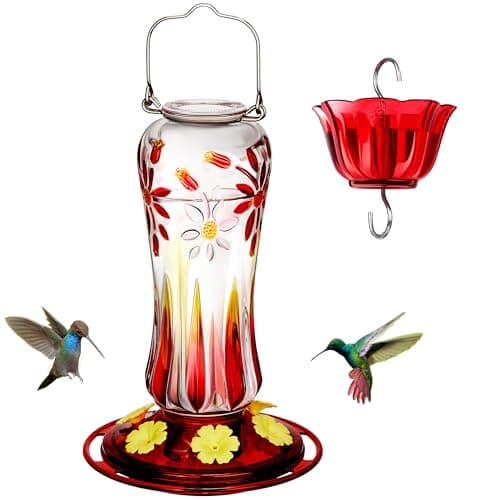
- Type
- Glass bottle
- Capacity
- 16 oz
- Feeding ports
- 6, flower-shaped
- Material
- Glass reservoir, plastic base
- Ant moat
- Included
- Bee guards
- Ports sized to exclude bees
Our score: 8.9/10 — an editorial rating, not a customer rating or a test result.
Cleaning access
Fully disassembles — reservoir, base and ports all come apart, which is what you want, because a six-port base has six places for residue to sit. The glass reservoir is the easy part; plan on a port brush for the flowers.
What works
- Six ports and a supplied ant moat at a mid-range price
- Glass stays visually clean, so the nectar level and its condition are readable at a glance
- Disassembles completely rather than to two pieces
What doesn’t
- More parts to wash than a saucer, every single time
- Glass and a full 16 oz make for a heavy hang
- Port sizing discourages bees but is not the same as a fitted Nectar-Guard tip
Specifications from Kingsyard — hummingbird feeder range and Amazon — Kingsyard Glass Hummingbird Feeders for Outdoors. We have not handled this feeder — here is what we did instead.
2. Best plastic
Aspects HummZinger HighView 12 oz
A four-port saucer feeder with the ant moat built into the lid and a cover that lifts straight off — the shortest path from hanging it up to washing it out.
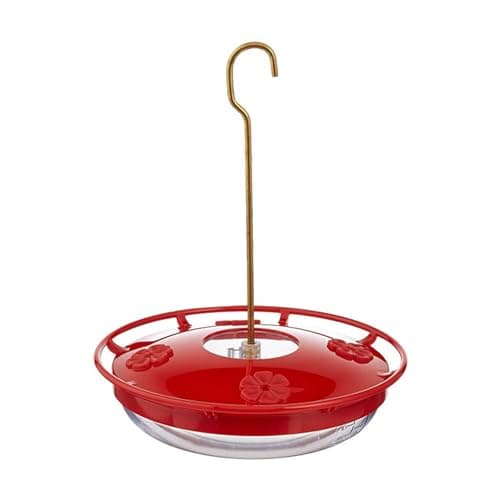
- Type
- Saucer (dish)
- Capacity
- 12 oz
- Feeding ports
- 4
- Material
- Polycarbonate, metal hanger
- Dimensions
- 7.75" x 7.75" x 1.75"
- Ant moat
- Built in
- Perch
- Raised wraparound perch
- Mounting
- Hang or post mount
Our score: 9.2/10 — an editorial rating, not a customer rating or a test result.
Cleaning access
Two parts. The cover lifts off the base with no tools and no threads to cross, and the whole dish is one open bowl — a two-minute wash with a brush and hot water, which is exactly the cadence a nectar feeder needs. The moat is part of the lid, so there is no separate accessory to lose or forget to refill.
What works
- Saucer design puts nectar below the ports, so it does not drip as the air inside warms
- Ant moat is integral to the lid rather than a separate hanging accessory
- Opens to a single shallow bowl — the easiest shape in the category to scrub
- Raised ports shed rain, which keeps the nectar from being diluted
What doesn’t
- 12 oz is small for a busy yard
- Polycarbonate clouds over several seasons in a way glass does not
- No bee-excluding port tips fitted — that is the Ultra's feature, not the HighView's
Specifications from Duncraft — Aspects High View HummZinger and Amazon — Aspects HummZinger HighView 12 oz. We have not handled this feeder — here is what we did instead.
3. Cheapest way into glass
More Birds Ruby 10 oz Glass
A 10 oz glass bottle with four bee-guard ports, five perches and the ant moat built into the top — the cheapest way to get glass without giving up either insect defense.
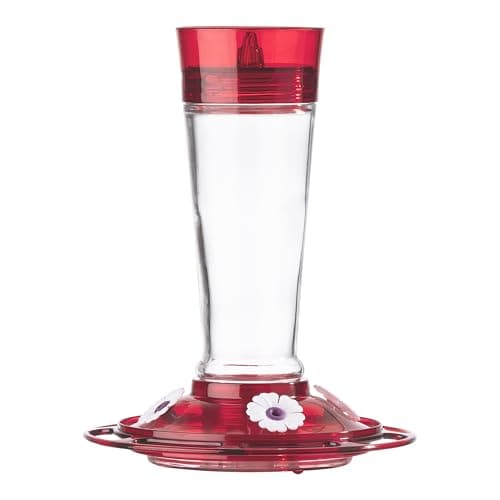
- Type
- Glass bottle
- Capacity
- 10 oz
- Feeding ports
- 4, bee-guard style
- Perches
- 5 integrated
- Material
- Glass, plastic and metal
- Dimensions
- 8.75"H x 6.5"W x 6.5"D
- Ant moat
- Built in, on top
- Base
- Detachable flat base
Our score: 8.5/10 — an editorial rating, not a customer rating or a test result.
Cleaning access
The flat base detaches and the bottle opening is wide, so you can reach every surface. Glass is the real advantage: it does not hold the cloudy film polycarbonate develops after a couple of seasons of sugar water, so 'clean' and 'looks clean' stay the same thing.
What works
- Glass reservoir does not stain or cloud the way polycarbonate does
- Four bee-guard ports and a built-in ant moat, both included rather than sold as extras
- Five perches on a 10 oz feeder is generous — perched birds drink longer and fight less
What doesn’t
- Glass breaks; a pole-mounted feeder in a windy spot is a bad match
- 10 oz is modest, so this is a second feeder in a busy yard rather than the only one
- Still an inverted bottle, so it shares the bottle-design drip risk
Specifications from Perky-Pet — More Birds Bird Health+ Ruby Hummingbird Feeder and Amazon — More Birds Bird Health+ Ruby Hummingbird Feeder. We have not handled this feeder — here is what we did instead.
Common questions
Frequently asked
Are glass or plastic hummingbird feeders better?
Glass for visibility and longevity, plastic for weight, cost and anywhere windy or high. But design beats material: a plastic saucer feeder outperforms a glass bottle feeder for most yards, because it cannot drip and washes faster.
Does plastic leach into hummingbird nectar?
There is no established reason to prefer glass on health grounds here. Feeder bodies are polycarbonate and reputable makers state BPA-free construction. What goes into the nectar matters far more than what the feeder is made of.
Can you put a glass hummingbird feeder in the dishwasher?
The glass reservoir usually survives it; the plastic base and ports often do not, and can warp. Check the maker’s own instruction — First Nature specifically says warm soapy water rather than a dishwasher.
Why does my plastic feeder look cloudy even after washing?
That is UV haze in the polycarbonate itself, not residue, and it does not come off. It is the main practical reason to prefer glass — a hazed reservoir hides the state of the nectar inside it.
Sources
Where this came from
Read next
Related reading
By Scooter M.
an enthusiast who's genuinely into this. I read the manuals, compile the published specs, and do the math. No lab coat.
Published September 1, 2026