Cleaning
Vinegar vs bleach for a hummingbird feeder
One of these is a routine. The other is a reset. Using the reset weekly is the mistake.
We earn a commission on purchases made through our links, at no extra cost to you. We don’t accept free products or paid placements. Full disclosure.
Use vinegar for the weekly wash and save bleach for established mold. Clemson’s extension guidance recommends breaking the feeder down once a week and washing with a four-to-one vinegar and water solution plus a scrub brush. Bleach is an accepted sanitizing option — Cornell notes you can clean feeders with a dilute bleach solution — but with an unconditional requirement to rinse off all residue and air dry completely before refilling.
What we recommend here
| # | Product | Best for | Score | Price |
|---|---|---|---|---|
| 1 | No product photo yet Hummingbird Feeder Brush Kit (3-piece) Mechanical scrubbing is what actually removes residue | Does more than either liquid | 8.7 out of 10 | |
| 2 |  Aspects HummZinger HighView 12 oz Nothing hidden for mold to establish in | Least likely to need the reset | 9.0 out of 10 | |
| 3 |  Kingsyard 16 oz Glass Feeder Glass is unbothered by vinegar or bleach | Best surface for either | 8.4 out of 10 | $19.99 on Amazon $22.99 13% off |
Scores are our own editorial ratings from the criteria on our methodology page. They are not customer ratings and they are not test results.
The comparison
| Vinegar (4:1 water to vinegar) | Dilute bleach | |
|---|---|---|
| Use it for | The weekly break-down wash | Established mold; a seasonal reset |
| Rinse demand | Thorough, but forgiving | Exhaustive, and non-negotiable |
| Risk if under-rinsed | Low | Real — residue must not reach the nectar |
| Effect on plastic | None at this dilution | Repeated use can degrade seals over time |
| Cost and availability | Cheap, already in the cupboard | Cheap, already in the cupboard |
Why vinegar is the default
Three reasons, and the third is the one that matters most in practice.
It is effective on the residue that actually forms in a nectar feeder — sugar film and early growth. It is cheap and permanently to hand. And critically, it is forgiving of an imperfect rinse. Real cleaning happens on a Tuesday evening in a hurry, and a routine that fails safe when you cut a corner is a better routine than one that does not.
Clemson’s guidance puts it at four parts water to one part vinegar with a scrub brush, weekly, alongside refilling twice a week. That is a sensible standing routine.
When bleach earns its place
Established mold, or a feeder that has been left too long and needs resetting rather than washing. Cornell lists a dilute bleach solution as an alternative cleaning approach, and every source that mentions it attaches the same condition: rinse them thoroughly and allow them to air dry before refilling.
Take that condition seriously.
- Rinse until there is no smell whatsoever.
- Then rinse again — particularly inside the ports, where liquid sits.
- Air dry completely. Not towel-dry, not “mostly dry”.
- Never mix bleach with vinegar or any other cleaner. That produces toxic gas.
If you have reached the point of needing bleach, read the mold page as well — clearing it once is easy, and the more useful question is why it got established.
What about soap?
Guidance genuinely differs here and we would rather show that than flatten it. Cornell advises hot water and a bottle brush for nectar feeders and specifically says not to use soap or detergent. Perky-Pet, on its own product pages, recommends cleaning at least once per week with a mild soap and water solution.
Our reading: the concern with soap is residue in a liquid a bird will drink, and the strength of that concern depends entirely on how well you rinse. Hot water plus a brush, with vinegar weekly, sidesteps the argument completely — which is why it is what we recommend on the method page.
The thing neither liquid does
Neither one cleans inside a feeding port. Soaking helps, but the residue in a port is physically attached and it comes off mechanically or not at all. That is a port brush, and no solution substitutes for it.
Recommended for this
What we’d buy
1. Does more than either liquid
Hummingbird Feeder Brush Kit (3-piece)
A bottle brush, a socket brush and a thin port brush. The port brush is the one that matters — it is the only thing that reaches inside a flower port, and a flower port is where mold starts.
photo yet
- Bottle brush
- Typically 13.5" long, 1.5" bristle diameter
- Socket brush
- Typically 8" long, 1" bristle diameter
- Port brush
- Typically 8.25" long, sized for feeding ports
- Bristles
- Nylon — non-scratching on glass and plastic
Our score: 8.7/10 — an editorial rating, not a customer rating or a test result.
Cleaning access
Rinse the brushes when you rinse the feeder and stand them up to dry. A brush stored wet in a drawer grows its own problem.
What works
- The port brush reaches the one surface a sponge and a stream of water never will
- Nylon bristles will not scratch polycarbonate, which is what makes it cloud
- Cheap enough that there is no argument for not owning one
What doesn’t
- Kit contents vary by seller — check the port brush is actually included
- A 13.5" bottle brush will not reach the bottom of a tall 32 oz reservoir
- Bristles wear out; a splayed brush stops reaching into ports
Specifications from Duncraft — Nectar Brush Set and Blue Bird Landing — Hummingbird Feeder Cleaning Brush 3-Piece Kit. We have not handled this feeder — here is what we did instead.
2. Least likely to need the reset
Aspects HummZinger HighView 12 oz
A four-port saucer feeder with the ant moat built into the lid and a cover that lifts straight off — the shortest path from hanging it up to washing it out.
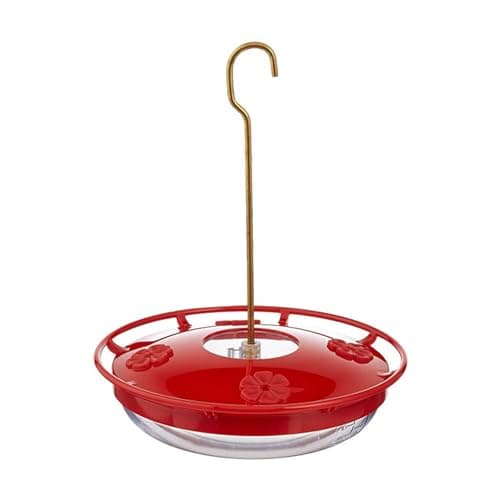
- Type
- Saucer (dish)
- Capacity
- 12 oz
- Feeding ports
- 4
- Material
- Polycarbonate, metal hanger
- Dimensions
- 7.75" x 7.75" x 1.75"
- Ant moat
- Built in
- Perch
- Raised wraparound perch
- Mounting
- Hang or post mount
Our score: 9.0/10 — an editorial rating, not a customer rating or a test result.
Cleaning access
Two parts. The cover lifts off the base with no tools and no threads to cross, and the whole dish is one open bowl — a two-minute wash with a brush and hot water, which is exactly the cadence a nectar feeder needs. The moat is part of the lid, so there is no separate accessory to lose or forget to refill.
What works
- Saucer design puts nectar below the ports, so it does not drip as the air inside warms
- Ant moat is integral to the lid rather than a separate hanging accessory
- Opens to a single shallow bowl — the easiest shape in the category to scrub
- Raised ports shed rain, which keeps the nectar from being diluted
What doesn’t
- 12 oz is small for a busy yard
- Polycarbonate clouds over several seasons in a way glass does not
- No bee-excluding port tips fitted — that is the Ultra's feature, not the HighView's
Specifications from Duncraft — Aspects High View HummZinger and Amazon — Aspects HummZinger HighView 12 oz. We have not handled this feeder — here is what we did instead.
3. Best surface for either
Kingsyard 16 oz Glass Feeder
Six flower ports sized to admit a hummingbird bill and not much else, a thick glass reservoir, and an ant moat in the box — the glass feeder that does not make you buy accessories to finish it.
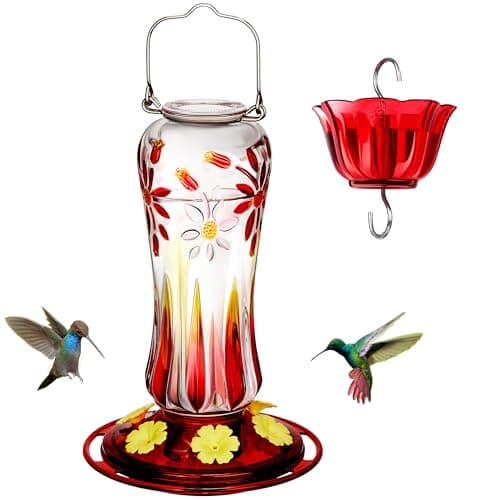
- Type
- Glass bottle
- Capacity
- 16 oz
- Feeding ports
- 6, flower-shaped
- Material
- Glass reservoir, plastic base
- Ant moat
- Included
- Bee guards
- Ports sized to exclude bees
Our score: 8.4/10 — an editorial rating, not a customer rating or a test result.
Cleaning access
Fully disassembles — reservoir, base and ports all come apart, which is what you want, because a six-port base has six places for residue to sit. The glass reservoir is the easy part; plan on a port brush for the flowers.
What works
- Six ports and a supplied ant moat at a mid-range price
- Glass stays visually clean, so the nectar level and its condition are readable at a glance
- Disassembles completely rather than to two pieces
What doesn’t
- More parts to wash than a saucer, every single time
- Glass and a full 16 oz make for a heavy hang
- Port sizing discourages bees but is not the same as a fitted Nectar-Guard tip
Specifications from Kingsyard — hummingbird feeder range and Amazon — Kingsyard Glass Hummingbird Feeders for Outdoors. We have not handled this feeder — here is what we did instead.
Common questions
Frequently asked
Can you use vinegar to clean a hummingbird feeder?
Yes, and it is the sensible weekly default. Clemson’s extension guidance recommends a four-to-one water-to-vinegar solution with a scrub brush for the weekly break-down wash.
Is bleach safe for a hummingbird feeder?
A dilute bleach solution is an accepted option for sanitizing, provided every trace of residue is rinsed off and the feeder is allowed to air dry completely before refilling. Save it for established mold rather than routine use.
Can I mix vinegar and bleach to clean a feeder?
Never. Mixing bleach with vinegar or any acid produces toxic gas. Use one or the other, never together and never in sequence without a thorough rinse between.
Should I use dish soap on a hummingbird feeder?
Sources differ — Cornell advises against soap or detergent for nectar feeders, while Perky-Pet recommends mild soap and water weekly for its own products. Hot water, a brush and weekly vinegar avoids the question entirely.
Sources
Where this came from
Read next
Related reading
By Scooter M.
an enthusiast who's genuinely into this. I read the manuals, compile the published specs, and do the math. No lab coat.
Published September 1, 2026