Feeders
The best hummingbird feeders for windy areas
A feeder that swings empties itself down its own side, and the sticky trail it leaves is a bigger problem than the spill.
We earn a commission on purchases made through our links, at no extra cost to you. We don’t accept free products or paid placements. Full disclosure.
The Aspects HummZinger HighView, post-mounted rather than hung. In wind the variable that matters is not the feeder’s toughness but whether it swings: a swinging feeder slops nectar down its own body, and that sticky trail is what brings ants and bees. A low, shallow saucer on a post beats a tall bottle on a shepherd’s hook every time. And skip glass — a full glass reservoir on a moving hook is the one genuine breakage risk in this hobby.

Quick picks
| # | Product | Best for | Score | Price |
|---|---|---|---|---|
| 1 |  Aspects HummZinger HighView 12 oz Low profile, light, and Aspects lists post mounting | Best for wind overall | 9.2 out of 10 | |
| 2 | 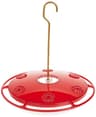 Aspects HummZinger Excel 16 oz Wider dish, same post-mount option | Best for a windy, busy yard | 8.7 out of 10 | |
| 3 | 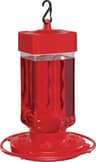 First Nature 3051 16 oz Light plastic and a sealing ring in the base | Best budget pick for wind | 8.6 out of 10 |
Scores are our own editorial ratings from the criteria on our methodology page. They are not customer ratings and they are not test results.
How we judged these
We have not tested these in wind. The picks come from published manufacturer and retailer specifications, what each maker states about mounting, and reasoning about the specific failure modes wind causes — the method is here. Criteria, in order:
- Can it be post-mounted? The highest-value feature by a distance, because it removes swing entirely rather than reducing it.
- Profile. A shallow dish presents almost nothing to a gust. A tall bottle is a sail.
- Does the design spill when it moves? A saucer holds nectar below the ports, so tilting it does not push liquid out the way it does in a pressurized bottle.
- Weight and material. Light plastic survives being knocked down. Filled glass does not.
- Cleaning access, weighted as it always is on this site — a windy yard still needs the same wash every three to five days.
What wind actually does
The obvious worry is that the feeder blows down. That happens, but it is rare and cheap. The three things that actually ruin a windy-yard setup are quieter.
It spills its own nectar. A feeder swinging on a hook sloshes. In an inverted bottle, motion plus the pressure already in the reservoir pushes nectar out of the ports and down the outside of the feeder, where it dries sticky. You will not usually see this happen; you will see the consequence, which is ants on the hook and bees at the base. The mechanism is the same one described on the no-leak roundup.
It empties the ant moat. A moat is a cup of plain water, and a cup of water on a pendulum does not stay full. An empty moat is worse than no moat, because you stop checking it. See keeping ants out of a hummingbird feeder.
It makes the birds work harder. A hummingbird is hovering to feed, and a moving target costs it energy it came to collect. Birds will use a swinging feeder, but a stable one in the same yard gets the traffic — which is the whole reason to solve this.
Post-mounting is the actual answer
Almost everything else on this page is a mitigation. This is a fix.
Aspects lists both the HighView and the Excel as hang or post mount, and on a windy site that second option is worth more than any other spec. A feeder fixed to the top of a post cannot swing, cannot slop, keeps its moat full, and gives the birds something steady to work against. It also makes a baffle practical if you have squirrels or raccoons.
If a post is genuinely not an option, the mitigations in rough order of usefulness: hang it from a short hook rather than a long one, because the shorter the pendulum the smaller the arc; hang it close to a wall, a fence or under a deep eave; use a hook rated well above the filled weight so the hook itself is not flexing; and fill the feeder part way, which lowers the mass that is moving. Placement basics are on where to hang a hummingbird feeder.
1. Aspects HummZinger HighView — best overall for wind
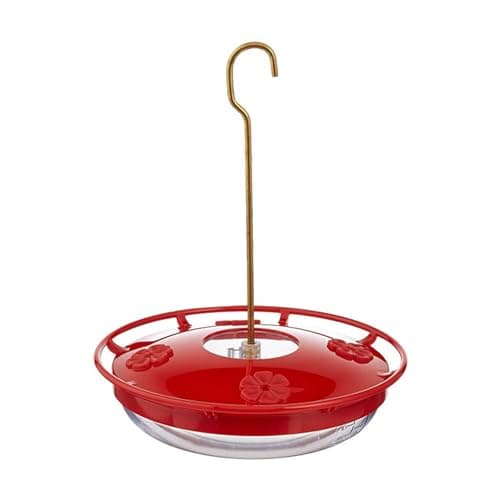
Aspects item 429: 12 oz, four ports, UV-stabilized polycarbonate, wraparound perch, built-in ant moat, raised flowers that divert rain, hang or post mount, lifetime guarantee. Roughly 7-3/4 inches across and 1-3/4 inches tall.
Read those last dimensions again, because they are the argument. This is a disc. There is almost nothing for wind to push against, the nectar sits below the ports so motion does not force it out, and Aspects supports mounting it on a post. Polycarbonate means that on the day something does knock it down, you rinse it and hang it back up.
Honest cons: 12 oz is small for a busy yard; the polycarbonate clouds over several seasons; no bee-guard tips fitted as standard; and the built-in moat still needs topping up, wind or no wind. Full write-up: the HighView review.
2. Aspects HummZinger Excel — for a windy yard with traffic
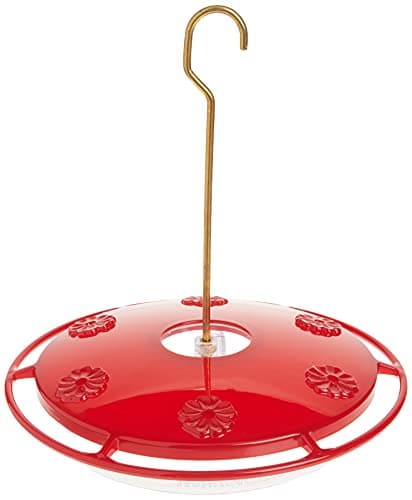
Aspects item 143: 16 oz, six ports, built-in ant moat, integrated wraparound perch, hang or post mount, lifetime guarantee. The same shallow-dish geometry, scaled up.
A wider dish is marginally more surface for wind to catch, but it is still a dish, and the six ports matter if wind is not your only problem. It shares the post-mount option, which is the reason it is here rather than a larger bottle.
Honest cons: 16 oz spoils exactly as fast as 12, so the capacity is not permission to clean less often; it is physically wider, which matters under a narrow eave — and an eave is exactly where you want a feeder in a windy yard; and no Nectar-Guard tips as standard. Full write-up: the Excel review.
3. First Nature 3051 — best budget pick
Sixteen ounces, ten ports, wide-mouth jar, two-part base that twists apart, and a sealing ring in the base that First Nature describes as preventing nectar dripping. Made in America from a durable polymer.
It is here because it is light and cheap, which is a genuinely good combination in a yard where things get knocked about. The sealing ring also does real work against the sloshing problem — it will not beat a saucer, but it is better than an unsealed bottle.
Honest cons: it is still an inverted bottle, so it is the pick on this page most likely to spill when it swings, and it is tall, which is the profile wind likes least. No post-mount option is listed. And it must not meet scalding water or a dishwasher. Full write-up: the 3051 review.
Pick the aspect before you pick the feeder
Wind in a yard is not uniform, and the cheapest fix available is to notice that before you buy anything. Most yards have a lee — a side of the house, a fence line, a hedge, a corner that stays calm when the rest of the garden is moving. Stand outside on a blustery day and watch where the leaves are still.
That spot is worth more than any feature on this page. It has to be balanced against the other placement rules, which do not go away: four to six feet up, partial shade so the nectar does not cook, within about ten feet of a perch the birds can rest on, and reachable without a ladder. The full set is on where to hang a hummingbird feeder.
There is a behavioral reason to care beyond the spilling. A hummingbird feeds while hovering, and hovering in gusts costs it energy it came to the feeder to collect — a sheltered feeder is simply a better deal for the bird. Perches matter more here than elsewhere for the same reason, which is a point in favor of the wraparound perch the HummZinger line fits as standard: a perched bird is not fighting the wind while it drinks.
One more thing worth doing in an exposed yard: check the hook itself after the first real blow of the season. Hooks bend gradually rather than suddenly, and a hook that has opened up slightly is how a feeder ends up on the ground on the one windy night nobody was watching.
What about glass?
We like glass and say so on the glass roundup — it does not develop the permanent haze polycarbonate gets, so clean and looks-clean stay the same thing. But the honest answer for an exposed, windy site is plastic, and it is not close.
The trade is spelled out in full on glass vs plastic. The short version for this page: design beats material, weight is a liability on a moving hook, and the best wind answer — a low dish on a post — is made of polycarbonate.
The picks in full
Every pick, in detail
1. Best for wind overall
Aspects HummZinger HighView 12 oz
A four-port saucer feeder with the ant moat built into the lid and a cover that lifts straight off — the shortest path from hanging it up to washing it out.
- Type
- Saucer (dish)
- Capacity
- 12 oz
- Feeding ports
- 4
- Material
- Polycarbonate, metal hanger
- Dimensions
- 7.75" x 7.75" x 1.75"
- Ant moat
- Built in
- Perch
- Raised wraparound perch
- Mounting
- Hang or post mount
Our score: 9.2/10 — an editorial rating, not a customer rating or a test result.
Cleaning access
Two parts. The cover lifts off the base with no tools and no threads to cross, and the whole dish is one open bowl — a two-minute wash with a brush and hot water, which is exactly the cadence a nectar feeder needs. The moat is part of the lid, so there is no separate accessory to lose or forget to refill.
What works
- Saucer design puts nectar below the ports, so it does not drip as the air inside warms
- Ant moat is integral to the lid rather than a separate hanging accessory
- Opens to a single shallow bowl — the easiest shape in the category to scrub
- Raised ports shed rain, which keeps the nectar from being diluted
What doesn’t
- 12 oz is small for a busy yard
- Polycarbonate clouds over several seasons in a way glass does not
- No bee-excluding port tips fitted — that is the Ultra's feature, not the HighView's
Price as of September 14, 2026. #ad How we’re funded
Specifications from Duncraft — Aspects High View HummZinger and Amazon — Aspects HummZinger HighView 12 oz. We have not handled this feeder — here is what we did instead.
2. Best for a windy, busy yard
Aspects HummZinger Excel 16 oz
The saucer design scaled up to 16 oz and six ports, for the yard where a 12 oz feeder is empty by Tuesday and birds are queuing.
- Type
- Saucer (dish)
- Capacity
- 16 oz
- Feeding ports
- 6
- Material
- Polycarbonate
- Ant moat
- Built in
- Guarantee
- Lifetime guarantee (Aspects)
Our score: 8.7/10 — an editorial rating, not a customer rating or a test result.
Cleaning access
Identical two-part saucer routine to the rest of the HummZinger line — cover off, wash the bowl, done. The larger dish is if anything easier to get a brush around than the 12 oz.
What works
- Six ports genuinely reduces the fighting at a busy feeder
- Still a two-part saucer, so the extra capacity costs nothing in cleaning time
- Aspects' lifetime guarantee covers defects in material and workmanship
What doesn’t
- 16 oz of nectar spoils just as fast as 12 oz — capacity is not permission to clean less often
- Physically wider, which matters under a narrow eave
- No Nectar-Guard tips fitted as standard
Price as of September 14, 2026. #ad How we’re funded
Specifications from Greenhouse Megastore — Aspects HummZinger Excel and Amazon — Aspects HummZinger Excel. We have not handled this feeder — here is what we did instead.
3. Best budget pick for wind
First Nature 3051 16 oz
Ten ports, a wide-mouth reservoir and a base that twists into two pieces — the cheapest feeder in the category that is genuinely easy to clean, which is the only reason it is here.
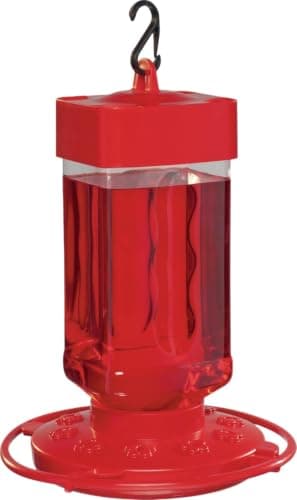
- Type
- Inverted bottle
- Capacity
- 16 oz
- Feeding ports
- 10
- Material
- Plastic
- Base
- Patented two-part base, twists apart
- Reservoir
- Wide-mouth
- Ant moat
- Built into the base
- Dishwasher
- Not dishwasher safe — warm soapy water
Our score: 8.6/10 — an editorial rating, not a customer rating or a test result.
Cleaning access
Better than the price suggests. The reservoir mouth is wide enough to take a bottle brush without contortions, and the base twists into two pieces so you can reach the underside of the ports — the spot that grows mold first on a cheap bottle feeder. First Nature specifies warm soapy water, not the dishwasher.
What works
- Wide-mouth reservoir takes a standard bottle brush, unlike most budget bottle feeders
- Two-part base opens up the port undersides, which is where mold starts
- Ten ports and an integrated ant moat at the bottom of the category's price range
What doesn’t
- It is an inverted bottle, so it can drip as trapped air warms and pushes nectar out
- Not dishwasher safe, and the thin plastic would not enjoy a hot wash anyway
- Fill all 16 oz in a quiet yard and you will pour most of it away
Price as of September 14, 2026. #ad How we’re funded
Specifications from Amazon — First Nature 10-Port Hummingbird Feeder 3051, 16 oz and Oak Ridge Stores — First Nature FN3051. We have not handled this feeder — here is what we did instead.
What we’d skip
Glass bottle feeders on a shepherd's hook in an exposed yard
Glass is the right call for a lot of buyers — it does not cloud the way polycarbonate does, and we recommend it elsewhere on this site. It is the wrong call here. A filled glass reservoir is heavy, and weight on a thin hook in gusting wind is leverage: the hook flexes, the feeder swings wider, and eventually something gives. When it does, the failure mode is broken glass on a patio rather than a plastic feeder you pick up and rinse. If you want glass in a windy yard, mount it on a post against a wall or under a deep eave, not out in the open.
Common questions
Frequently asked
What kind of hummingbird feeder is best for a windy yard?
A low, shallow saucer feeder, post-mounted rather than hung. The profile gives wind almost nothing to push, and post mounting removes the swinging that makes a feeder spill nectar down its own side.
How do I stop my hummingbird feeder from swinging?
Post-mount it if the model allows — Aspects lists hang or post mount on the HummZinger line. Otherwise shorten the hook, move it close to a wall or under an eave, use a hook rated well above the filled weight, and fill the feeder only part way.
Will wind make my feeder leak?
An inverted bottle feeder, yes — motion plus the pressure already in the reservoir pushes nectar out of the ports and down the outside, where it dries sticky and brings ants. A saucer holds nectar below the ports and does not do this.
Is a glass hummingbird feeder a bad idea in wind?
In an exposed spot, yes. A filled glass reservoir is heavy, and weight on a flexing hook in gusts is how things break. If you want glass in a windy yard, put it on a post against a wall or under a deep eave rather than out in the open.
Sources
Where this came from
Read next
Related reading
By Scooter M.
an enthusiast who's genuinely into this. I read the manuals, compile the published specs, and do the math. No lab coat.
Published September 13, 2026