Reviews
HummZinger HighView vs Excel
Two feeders from the same line separated by four ounces and two ports, priced so closely that the usual size logic stops applying.
We earn a commission on purchases made through our links, at no extra cost to you. We don’t accept free products or paid placements. Full disclosure.
Buy the HighView for most yards; buy the Excel if birds are fighting over the ports. Aspects builds both in Rhode Island as polycarbonate saucers with a built-in ant moat, a wraparound perch, hang-or-post mounting and a lifetime guarantee. The HighView (item 429) is 12 oz with four ports; the Excel (item 143) is 16 oz with six. They usually sit within a very small margin of each other in price, which means the deciding factor is not value — it is port count and how much space you have.
What we recommend here
| # | Product | Best for | Score | Price |
|---|---|---|---|---|
| 1 |  Aspects HummZinger HighView 12 oz 12 oz, four ports, smaller footprint | The default choice | 9.2 out of 10 | |
| 2 |  Aspects HummZinger Excel 16 oz 16 oz, six ports, same two-part wash | If one bird is guarding the feeder | 8.7 out of 10 | |
| 3 | No product photo yet Hummingbird Feeder Brush Kit (3-piece) The ports are the surface a rinse never reaches | Buy with either | 8.4 out of 10 |
Scores are our own editorial ratings from the criteria on our methodology page. They are not customer ratings and they are not test results.
Side by side
| HummZinger HighView | HummZinger Excel | |
|---|---|---|
| Aspects item | 429 | 143 |
| Capacity | 12 oz | 16 oz |
| Feeding ports | 4 | 6 |
| Design | Saucer (dish) | Saucer (dish) |
| Material | UV stabilized polycarbonate | Polycarbonate |
| Ant moat | Built in | Built in |
| Perch | Integrated wraparound | Integrated wraparound |
| Rain | Raised flowers divert rain | Raised flowers divert rain |
| Mounting | Hang or post mount | Hang or post mount |
| Guarantee | Lifetime | Lifetime |
| Made in | Rhode Island, USA | Rhode Island, USA |
| Comes apart into | 2 pieces | 2 pieces |
Ten rows identical, two different. That is the whole comparison, and it makes the decision unusually clean — provided you weigh the two differences correctly, which most people do not.
The price twist that changes the usual advice
This site spends a lot of words telling people not to buy the bigger feeder. Capacity is not storage: nectar spoils on a schedule set by the weather rather than by how much you poured, so a large feeder in a quiet yard means throwing away most of a batch every few days. That advice is correct and it is on what size hummingbird feeder to buy.
Normally that advice also saves you money, because the bigger feeder costs more. Here it does not. These two are usually priced within a very small margin of each other — check the live buttons above rather than trusting any number written into prose, but the ordering holds consistently enough to say this: you are not paying meaningfully more for the Excel.
That removes the usual reason to default to the smaller one, and it means the decision has to be made on the two things that genuinely differ.
Difference one: ports, and this is the real one
Hummingbirds are territorial. A dominant bird will pick a lookout perch and spend the season driving other birds off a single feeder — not occasionally, but as its main daytime occupation. From a kitchen window that looks like a quiet yard with one resident bird, and it usually is not; the others are being intercepted.
Four ports on a compact dish are easy for one bird to police. Six ports spread around a wider dish are meaningfully harder. That is the Excel’s actual advantage, and it has nothing to do with the four extra ounces.
It is worth knowing the alternative, though, because it is better still: two feeders placed out of sight of each other beat one large feeder at this job, because a bird cannot guard what it cannot see. If you have somewhere to put a second, that is the stronger move — how many feeders you need.
Difference two: capacity, which is mostly a liability
Sixteen ounces spoils exactly as fast as twelve. In a quiet yard the extra volume is not headroom, it is waste — you will pour away more sugar water every few days for no benefit.
Half-filling the Excel is always allowed and is what we would do in an average yard. But if you are going to half-fill it, the honest question is what the extra width is buying you, and the answer is the ports rather than the volume.
Where the capacity genuinely earns its place: a busy yard in peak season, or a feeder you cannot service daily in hot weather. Both are real situations, and both are narrower than people assume.
What is identical, and why it matters
The cleaning routine does not change between them, and that is the most important line on this page. Both are two pieces: Aspects describes the bright red cover as removing easily so the bowl can be cleaned quickly and thoroughly. Lift the cover, wash one open dish, reassemble.
That is unusual. Most feeders punish extra capacity — a taller bottle needs a longer brush, a wider base hides more surface. The Excel adds volume and ports without adding steps at the sink, which is the only reason we are comfortable recommending a 16 oz feeder at all. Cadence on how often to clean a hummingbird feeder.
Both also carry the same insect story: a built-in ant moat, and saucer geometry that keeps nectar below the ports so the feeder cannot drip and leave the sticky trail that recruits bees. Neither has fitted Nectar-Guard tips — that is the Ultra, and if bees are your problem see HighView vs Ultra instead of this page.
The tie-breaker nobody mentions: physical size
The HighView is roughly 7-3/4 inches across. The Excel is wider. On an open shepherd’s hook that is irrelevant; under a narrow eave, on a crowded balcony rail, or anywhere the feeder has to fit a space rather than a yard, it decides the question.
It also matters in wind, where a wider dish catches marginally more, though both are low enough that post-mounting solves it either way — see feeders for windy areas.
Buy the HighView if… buy the Excel if…
Buy the HighView if you have one to a few regular visitors, a space constraint, or no evidence of fighting at the ports. It is the smaller, tidier version of an identical feeder and it remains our default recommendation site-wide.
Buy the Excel if you are watching one hummingbird chase every other one away, or your feeder genuinely empties in a day in peak season. Six ports is the fix, the wash does not get longer, and the price barely moves.
Buy neither, quite, if what you actually have is a bee problem or a two-feeder-shaped yard. Full write-ups: the HighView review and the Excel review.
Recommended for this
What we’d buy
1. The default choice
Aspects HummZinger HighView 12 oz
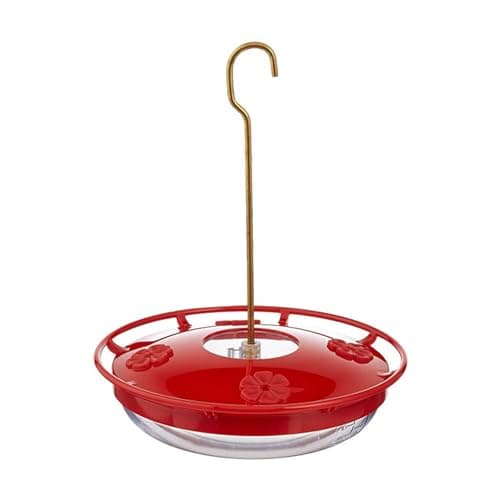
A four-port saucer feeder with the ant moat built into the lid and a cover that lifts straight off — the shortest path from hanging it up to washing it out.
- Type
- Saucer (dish)
- Capacity
- 12 oz
- Feeding ports
- 4
- Material
- Polycarbonate, metal hanger
- Dimensions
- 7.75" x 7.75" x 1.75"
- Ant moat
- Built in
- Perch
- Raised wraparound perch
- Mounting
- Hang or post mount
Our score: 9.2/10 — an editorial rating, not a customer rating or a test result.
Cleaning access
Two parts. The cover lifts off the base with no tools and no threads to cross, and the whole dish is one open bowl — a two-minute wash with a brush and hot water, which is exactly the cadence a nectar feeder needs. The moat is part of the lid, so there is no separate accessory to lose or forget to refill.
What works
- Saucer design puts nectar below the ports, so it does not drip as the air inside warms
- Ant moat is integral to the lid rather than a separate hanging accessory
- Opens to a single shallow bowl — the easiest shape in the category to scrub
- Raised ports shed rain, which keeps the nectar from being diluted
What doesn’t
- 12 oz is small for a busy yard
- Polycarbonate clouds over several seasons in a way glass does not
- No bee-excluding port tips fitted — that is the Ultra's feature, not the HighView's
Price as of September 14, 2026. #ad How we’re funded
Specifications from Duncraft — Aspects High View HummZinger and Amazon — Aspects HummZinger HighView 12 oz. We have not handled this feeder — here is what we did instead.
2. If one bird is guarding the feeder
Aspects HummZinger Excel 16 oz
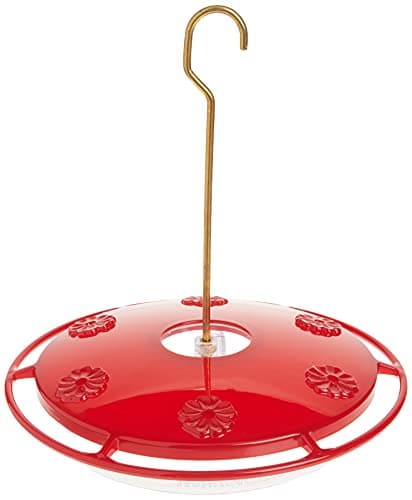
The saucer design scaled up to 16 oz and six ports, for the yard where a 12 oz feeder is empty by Tuesday and birds are queuing.
- Type
- Saucer (dish)
- Capacity
- 16 oz
- Feeding ports
- 6
- Material
- Polycarbonate
- Ant moat
- Built in
- Guarantee
- Lifetime guarantee (Aspects)
Our score: 8.7/10 — an editorial rating, not a customer rating or a test result.
Cleaning access
Identical two-part saucer routine to the rest of the HummZinger line — cover off, wash the bowl, done. The larger dish is if anything easier to get a brush around than the 12 oz.
What works
- Six ports genuinely reduces the fighting at a busy feeder
- Still a two-part saucer, so the extra capacity costs nothing in cleaning time
- Aspects' lifetime guarantee covers defects in material and workmanship
What doesn’t
- 16 oz of nectar spoils just as fast as 12 oz — capacity is not permission to clean less often
- Physically wider, which matters under a narrow eave
- No Nectar-Guard tips fitted as standard
Price as of September 14, 2026. #ad How we’re funded
Specifications from Greenhouse Megastore — Aspects HummZinger Excel and Amazon — Aspects HummZinger Excel. We have not handled this feeder — here is what we did instead.
3. Buy with either
Hummingbird Feeder Brush Kit (3-piece)
A bottle brush, a socket brush and a thin port brush. The port brush is the one that matters — it is the only thing that reaches inside a flower port, and a flower port is where mold starts.
photo yet
- Bottle brush
- Typically 13.5" long, 1.5" bristle diameter
- Socket brush
- Typically 8" long, 1" bristle diameter
- Port brush
- Typically 8.25" long, sized for feeding ports
- Bristles
- Nylon — non-scratching on glass and plastic
Our score: 8.4/10 — an editorial rating, not a customer rating or a test result.
Cleaning access
Rinse the brushes when you rinse the feeder and stand them up to dry. A brush stored wet in a drawer grows its own problem.
What works
- The port brush reaches the one surface a sponge and a stream of water never will
- Nylon bristles will not scratch polycarbonate, which is what makes it cloud
- Cheap enough that there is no argument for not owning one
What doesn’t
- Kit contents vary by seller — check the port brush is actually included
- A 13.5" bottle brush will not reach the bottom of a tall 32 oz reservoir
- Bristles wear out; a splayed brush stops reaching into ports
Specifications from Duncraft — Nectar Brush Set and Blue Bird Landing — Hummingbird Feeder Cleaning Brush 3-Piece Kit. We have not handled this feeder — here is what we did instead.
Common questions
Frequently asked
What is the difference between the HummZinger HighView and the Excel?
Capacity and ports. The HighView (item 429) is 12 oz with four ports; the Excel (item 143) is 16 oz with six. Everything else — polycarbonate saucer, built-in ant moat, wraparound perch, hang or post mount, Rhode Island build, lifetime guarantee — is the same.
Is the Excel worth the extra money over the HighView?
The price gap is unusually small, so the question is really whether you need six ports. If a dominant bird is guarding your feeder, yes. If not, the extra four ounces is mostly more nectar to pour away.
Is the Excel harder to clean than the HighView?
No. Both are two pieces — cover off, wash one open dish. A wider shallow dish is if anything easier to get a brush around. Use a port brush on the ports either way.
Should I buy one Excel or two HighViews?
Two feeders out of sight of each other beat one bigger feeder for territorial fighting, because a bird cannot guard what it cannot see. The cost is exactly twice the cleaning, on the same schedule.
Sources
Where this came from
Read next
Related reading
By Scooter M.
an enthusiast who's genuinely into this. I read the manuals, compile the published specs, and do the math. No lab coat.
Published September 13, 2026