Reviews
Aspects HummZinger Ultra review
One design change separates this from the feeder we normally recommend, and it is the only change in the category that stops a bee by physics rather than by hope.
We earn a commission on purchases made through our links, at no extra cost to you. We don’t accept free products or paid placements. Full disclosure.
Buy it if you have a bee or wasp problem. Otherwise buy the HighView. The Ultra (Aspects item 367) is a 12 oz polycarbonate saucer with four ports, a wraparound perch, a built-in ant moat and a lifetime guarantee — the same feeder as our overall pick, with Nectar-Guard tips fitted to every port. Those tips are a physical barrier a bee’s tongue cannot get past. They also add a small cleaning job you cannot skip.
What we recommend here
| # | Product | Best for | Score | Price |
|---|---|---|---|---|
| 1 | No product photo yet Aspects HummZinger Ultra 12 oz Nectar-Guard tips fitted to all four ports | Our pick for bees and wasps | 8.9 out of 10 | |
| 2 | No product photo yet Aspects HummZinger HighView 12 oz Same body, same wash, less money | Buy this instead if you have no bees | 9.2 out of 10 | |
| 3 | No product photo yet Hummingbird Feeder Brush Kit (3-piece) The port brush is what keeps the tips working | Buy alongside it, not later | 8.4 out of 10 |
Scores are our own editorial ratings from the criteria on our methodology page. They are not customer ratings and they are not test results.
What it is
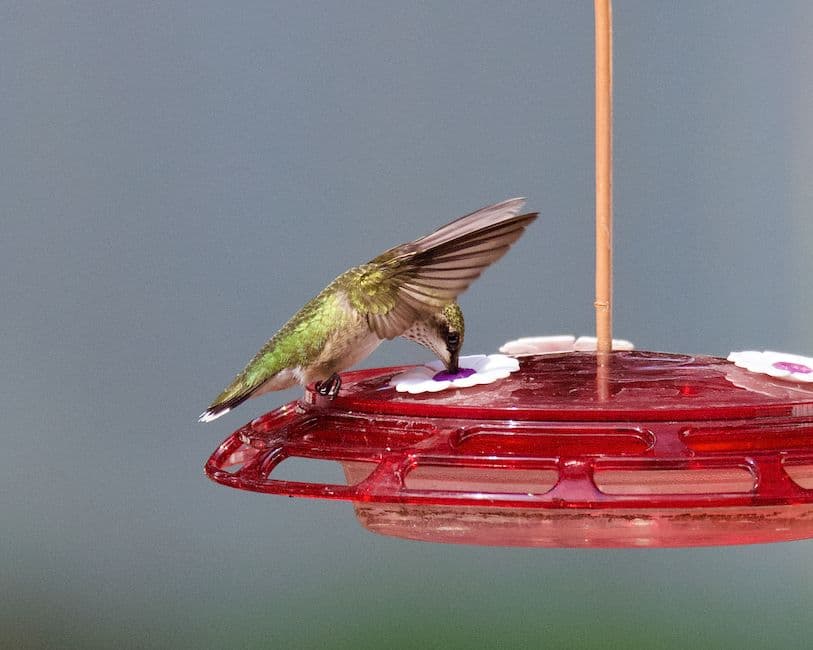
The HummZinger Ultra is the bee-guard model in the Aspects HummZinger line. Aspects publishes it as item 367: a 12 oz saucer feeder, four feeding ports, polycarbonate construction, an integrated wraparound perch, a built-in ant moat, raised flowers that divert rain, hang or post mount, and a lifetime guarantee.
Read that list next to the HighView and you will notice it is nearly identical. That is the correct impression. The two feeders share a body, a capacity, a port count and a cleaning routine. The Ultra adds Nectar-Guard tips, and the entire question of whether to buy it is the question of whether you need them.
We have not handled this feeder. Everything above is from Aspects’ own published material and the retailer listings cited at the bottom of this page — this is what we do instead of testing.
What Nectar-Guard tips actually do
Most “bee-proof” marketing in this category describes a deterrent: a yellow part removed, a port narrowed a little, a color chosen. Those things help at the margin. Nectar-Guard tips are a different kind of answer.
Each tip is a small flexible collar seated in the feeding port. A hummingbird’s bill pushes straight through it and its tongue reaches the nectar below. A bee has neither the bill to open the collar nor the tongue length to reach past it. The insect is not discouraged from the nectar; it is mechanically separated from it.
That distinction matters because the alternatives mostly are not mechanisms. Moving the feeder, painting things, hanging fake nests — the full accounting of what works and what is folklore is on how to keep bees off a hummingbird feeder. Port geometry is the short list, and this is the cleanest expression of it.
One thing the tips do not address: ants. Ants are stopped by water, not by port size, which is why the Ultra also ships with a moat built in. Two unrelated problems, two unrelated fixes, both handled by the stock feeder. That is unusual and it is most of why this model exists.
The saucer argument still does the heavy lifting
It is worth being clear about why a HummZinger resists bees even before the tips are fitted. In a saucer, the nectar sits below the ports rather than above them. There is no vacuum pushing liquid out, so the feeder does not drip — and a feeder that does not drip leaves no sticky trail on the base and the ground advertising itself to every insect in the yard.
Drips are how most bee problems start. The tips close the last gap. The underlying argument is on saucer vs bottle feeders, and it is the reason this site defaults to saucers regardless of the insect question.
Cleaning: honest about the extra thirty seconds
The base routine is the best in the category. Aspects describes the bright red cover as removing easily so the bowl can be cleaned quickly and thoroughly. Lift the cover, wash an open dish, reassemble. Nectar needs changing every three to five days in moderate weather and daily when it is hot, so a feeder that resists that schedule is a feeder that quietly stops getting cleaned. The cadence is on how often to clean a hummingbird feeder.
The Nectar-Guard tips are the catch. They are small collars with a narrow throat, and sugar residue collects exactly where the throat narrows. A rinse will not clear them. You need a port brush, you need to use it on every wash, and if you skip it the tips gum up and stop admitting a bill cleanly.
This is not a reason to avoid the feeder. It is a reason to buy the brush kit in the same order rather than telling yourself you will get one later. A bee-guard tip you never brush is a bee-guard tip that becomes a blocked port.
Where it is weak
- Twelve ounces and four ports. Fine for one to a few regular visitors, small for a genuinely busy yard. If birds are queueing, the six-port HummZinger Excel is the same design with more room.
- Polycarbonate clouds. After several seasons of sugar water and UV a plastic reservoir develops a haze that makes it hard to tell clean from dirty by eye. Glass does not do this — see glass vs plastic.
- The tips need their own brush. Covered above, and it is the one genuine ongoing cost of choosing this model.
- You pay more for a feature you may not need. This is the important one, and it is the next section.
Who should not buy this
- Anyone without a bee or wasp problem. If insects are not currently at your feeder, the tips buy you nothing and cost you a small recurring cleaning job. Buy the HighView, save the difference, and come back here if bees turn up. We have put the two side by side in HummZinger HighView vs Ultra.
- Anyone with a high-traffic yard. Twelve ounces across four ports is the constraint, and no port fitting changes it.
- Anyone who will not brush the ports. Said plainly because it is the realistic failure mode: the feature that justifies this model is the feature that needs maintaining.
- Anyone whose actual problem is ants. The moat handles those, and so does the cheaper HighView’s. Tips are not an ant solution — see keeping ants out of a hummingbird feeder.
Where it sits
The Ultra is our standing recommendation on the bee-proof feeder roundup and it is the model we point at whenever a reader describes bees crowding the ports. Against the rest of the category it is on the main roundup.
Recommended for this
What we’d buy
1. Our pick for bees and wasps
Aspects HummZinger Ultra 12 oz
The same saucer body as the HighView with Nectar-Guard tips fitted to every port — the one design change that physically keeps a bee's tongue out of the nectar instead of merely discouraging it.
photo yet
- Type
- Saucer (dish)
- Capacity
- 12 oz
- Feeding ports
- 4, with Nectar-Guard tips
- Material
- Polycarbonate, brass hanger
- Dimensions
- 8.25" x 2"
- Ant moat
- Built into the brass hanger
- Cover
- Twist-off
Our score: 8.9/10 — an editorial rating, not a customer rating or a test result.
Cleaning access
Twist-off cover, same open-dish base as the HighView. The one extra step is the Nectar-Guard tips: they are small flexible collars in each port, and sugar residue collects exactly where the tip narrows. Budget an extra thirty seconds and buy a port brush alongside the feeder.
What works
- Nectar-Guard tips are a physical barrier, not a deterrent — the mechanism that actually works on bees
- Brass hanger doubles as the ant moat, so ants and bees are both handled by the stock feeder
- Saucer body means no drip, and drips are what draw insects in the first place
What doesn’t
- The port tips need their own small brush; skip that and they clog
- Same 12 oz capacity as the HighView, so not the answer for a high-traffic yard
- Costs more than the HighView for a feature you only need if you have a bee problem
Specifications from Duncraft — Aspects HummZinger Ultra and Amazon — Aspects 367 HummZinger Ultra. We have not handled this feeder — here is what we did instead.
2. Buy this instead if you have no bees
Aspects HummZinger HighView 12 oz
A four-port saucer feeder with the ant moat built into the lid and a cover that lifts straight off — the shortest path from hanging it up to washing it out.
photo yet
- Type
- Saucer (dish)
- Capacity
- 12 oz
- Feeding ports
- 4
- Material
- Polycarbonate, metal hanger
- Dimensions
- 7.75" x 7.75" x 1.75"
- Ant moat
- Built in
- Perch
- Raised wraparound perch
- Mounting
- Hang or post mount
Our score: 9.2/10 — an editorial rating, not a customer rating or a test result.
Cleaning access
Two parts. The cover lifts off the base with no tools and no threads to cross, and the whole dish is one open bowl — a two-minute wash with a brush and hot water, which is exactly the cadence a nectar feeder needs. The moat is part of the lid, so there is no separate accessory to lose or forget to refill.
What works
- Saucer design puts nectar below the ports, so it does not drip as the air inside warms
- Ant moat is integral to the lid rather than a separate hanging accessory
- Opens to a single shallow bowl — the easiest shape in the category to scrub
- Raised ports shed rain, which keeps the nectar from being diluted
What doesn’t
- 12 oz is small for a busy yard
- Polycarbonate clouds over several seasons in a way glass does not
- No bee-excluding port tips fitted — that is the Ultra's feature, not the HighView's
Specifications from Duncraft — Aspects High View HummZinger and Amazon — Aspects HummZinger HighView 12 oz. We have not handled this feeder — here is what we did instead.
3. Buy alongside it, not later
Hummingbird Feeder Brush Kit (3-piece)
A bottle brush, a socket brush and a thin port brush. The port brush is the one that matters — it is the only thing that reaches inside a flower port, and a flower port is where mold starts.
photo yet
- Bottle brush
- Typically 13.5" long, 1.5" bristle diameter
- Socket brush
- Typically 8" long, 1" bristle diameter
- Port brush
- Typically 8.25" long, sized for feeding ports
- Bristles
- Nylon — non-scratching on glass and plastic
Our score: 8.4/10 — an editorial rating, not a customer rating or a test result.
Cleaning access
Rinse the brushes when you rinse the feeder and stand them up to dry. A brush stored wet in a drawer grows its own problem.
What works
- The port brush reaches the one surface a sponge and a stream of water never will
- Nylon bristles will not scratch polycarbonate, which is what makes it cloud
- Cheap enough that there is no argument for not owning one
What doesn’t
- Kit contents vary by seller — check the port brush is actually included
- A 13.5" bottle brush will not reach the bottom of a tall 32 oz reservoir
- Bristles wear out; a splayed brush stops reaching into ports
Specifications from Duncraft — Nectar Brush Set and Blue Bird Landing — Hummingbird Feeder Cleaning Brush 3-Piece Kit. We have not handled this feeder — here is what we did instead.
Common questions
Frequently asked
What is the difference between the HummZinger HighView and the Ultra?
The Ultra has Nectar-Guard tips fitted to all four ports; the HighView does not. Same 12 oz saucer body, same four ports, same built-in ant moat, same lifetime guarantee. Buy the Ultra only if you have a bee or wasp problem.
Do Nectar-Guard tips really keep bees out?
They are a physical barrier rather than a deterrent — a flexible collar a hummingbird’s bill opens and a bee cannot. That is a mechanism, which is more than can be said for most bee advice. They do nothing for ants; that is what the moat is for.
Are the Nectar-Guard tips hard to clean?
They need a port brush on every wash. Sugar residue collects where the collar narrows and rinsing will not shift it. Budget an extra thirty seconds and buy a brush kit at the same time as the feeder.
Does the HummZinger Ultra come with an ant moat?
Yes — Aspects lists a built-in ant moat on this model. Keep it topped up with plain water; an empty moat is a bridge rather than a barrier.
Sources
Where this came from
Read next
Related reading
By Scooter M.
an enthusiast who's genuinely into this. I read the manuals, compile the published specs, and do the math. No lab coat.
Published September 7, 2026