Feeders
The best decorative hummingbird feeders
There is nothing wrong with wanting a feeder that is nice to look at. There is something wrong with almost every one of them, and it is the same thing in every case.
We earn a commission on purchases made through our links, at no extra cost to you. We don’t accept free products or paid placements. Full disclosure.
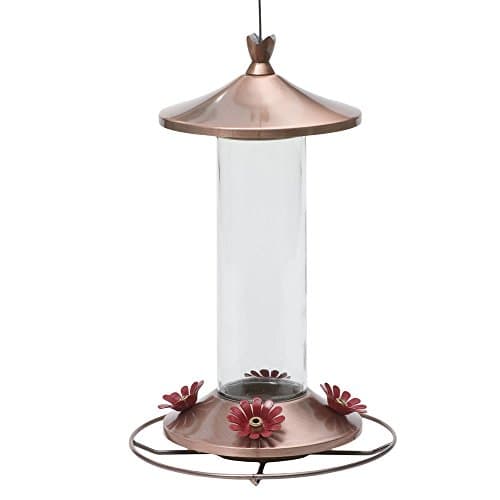
The Perky-Pet Elegant Copper Glass feeder, because it is the only pretty one at a sane capacity. A glass reservoir in a brushed copper frame, four red flower ports with bee guards built into them, a full circular perch, and 12 ounces — which matters more than any of the rest, because decorative feeders are almost all 20 to 36 oz and nectar has to be thrown out every three to five days whether the birds drank it or not. If you want hand-blown glass specifically, the Grateful Gnome is the real thing; just plan to fill it a third full.
Quick picks
| # | Product | Best for | Score | Price |
|---|---|---|---|---|
| 1 |  Perky-Pet Elegant Copper Glass 12 oz (710B) 12 oz, documented specs, bee guards in the ports | Best decorative feeder overall | 8.6 out of 10 | |
| 2 |  Perky-Pet Lavender Field Top-Fill Glass 16 oz 16 oz, five ports, a perch at every one of them | Prettiest at the right size | 8.5 out of 10 | |
| 3 |  Nature's Way Dewdrop Column 23 oz Six ports, a full perch ring, ant moat in the box | Best antique-glass look | 8.2 out of 10 | |
| 4 |  Grateful Gnome Large Blue Egg Hand-Blown Glass 36 oz Genuinely hand-blown, and genuinely too big | The statement piece | 7.4 out of 10 |
Scores are our own editorial ratings from the criteria on our methodology page. They are not customer ratings and they are not test results.
How we judged these
We have not handled any of these feeders. Every figure is quoted from the manufacturer’s own page where one exists, or a major retail listing where it does not, and cited at the foot of the page — our method is here. Because this is a category bought on appearance, the criteria are deliberately about everything except appearance:
- Capacity, first and hardest. Nectar is discarded on a schedule set by temperature, not by how much is left. A decorative feeder at 32 oz is a commitment to pouring sugar water down the drain twice a week.
- Can you see into it? Colored and textured glass is the whole point of the category and it is also the problem: it hides both the nectar level and the state of the inside. Clear glass is the easiest feeder in the world to audit at a glance.
- How does it come apart? The standing first-class criterion on this site. Pretty is worthless if the base does not separate.
- Does the maker publish anything? In a category this crowded with unbranded glass, a published spec sheet is most of the signal.
- Insect defense. An ant moat or bee guards included, versus left as your problem.
The systematic problem with decorative feeders
Worth stating before the picks, because it explains the ranking and it is the single most useful thing on this page.
Decorative hummingbird feeders are too big, almost without exception, and the reason is aesthetic rather than functional. A large blown-glass vessel looks better than a small one. It has room for the swirl, the color gradient, the shape. So the category clusters at 20 to 36 ounces: the feeders on this page run 12, 16, 23 and 36 oz, and the three decorative lines we looked at and did not feature ran to 28 and 29 oz as standard.
Now put that next to the rule that governs everything on this site. Nectar must be replaced every three to five days in moderate weather, and daily in real heat, whether the birds emptied it or not — the full reasoning is in how often to clean a hummingbird feeder. Capacity is therefore not storage. It is the amount you are committing to throw away. A 36 oz decorative feeder in an average yard is not a feeder that needs refilling less often; it is a feeder that wastes about a quart of sugar water a week and takes longer to wash.
The arithmetic in full is in what size feeder to get, and the answer there is 8 to 16 oz for almost every yard. Only one feeder on this page is inside that range, which is why it wins.
The fix, if you have fallen in love with a big one
Buy it and under-fill it. Nothing about a 36 oz reservoir obliges you to put 36 oz in it. Fill a third, change it on the same schedule, and you have the object you wanted and the hygiene you need. The cost is that it looks half empty, which on colored glass is less obvious than you would think. We mention this because the alternative advice — “never buy a decorative feeder” — is both unhelpful and not what we think.
Colored glass hides two things you want to see
The second honest cost, and it is specific to this category rather than to glass in general.
This site recommends glass over plastic for a reason that has nothing to do with looks: glass stays clear, so in year three you can still tell clean from dirty, whereas polycarbonate clouds and hides its own condition. That argument is in glass vs plastic.
Antique, stained and crackle glass gives that advantage back. Through deep red or teal glass you cannot read the nectar level, and more importantly you cannot see the first wisps of cloudiness that tell you fermentation has started. You are back to running the feeder on the calendar alone.
That is survivable — the calendar is the right way to run a feeder anyway — but it removes your safety net. If you are the kind of person who checks a feeder by looking at it, the pale and clear-glass options in this category are a better fit than the dramatic ones.
Copper: what you are actually buying
“Copper hummingbird feeder” is one of the most-searched phrases in this category, so it is worth being precise about what the products are.
On every copper feeder we could verify, including the Perky-Pet below, the copper is the frame, the cap, the hanger or the finish — and the nectar sits in glass. That is the normal construction, and it means the decision is purely aesthetic: real copper develops a patina outdoors instead of flaking the way a copper-colored coating does, and it costs more.
You will find pages online claiming specific figures for copper leaching into nectar, and attributing a flat prohibition to major bird organizations. We went looking for the primary sources behind those claims and could not verify any of them — no study we could locate, and no such statement on the organizations’ own sites. So we are not going to repeat them, and we are not going to reassure you either. What we can say is narrower and actually checkable: on the copper feeder we recommend, nectar touches glass and plastic ports, not copper, so the question does not arise. We do not feature an all-copper reservoir, and that is the reason.
The picks
Perky-Pet Elegant Copper Glass, 12 oz (710B) — the one to buy
Perky-Pet publishes 12 oz, four red flower-shaped ports each with a bee guard built in, a circular wraparound perch allowing 360-degree feeding, glass and copper construction with a brushed copper finish, 10.8 inches high by 6.7 in diameter, a wide-mouth bottle to reduce spills while filling, and a base that comes apart to make cleaning easy.
It wins on the thing the category gets wrong. Twelve ounces is inside the range this site recommends, which means you are not throwing away most of what you make. Everything else is a bonus: bee guards integrated into the ports rather than sold as an add-on is a real functional feature, a continuous perch means birds drink sitting rather than hovering, and clear glass in a copper frame gets you the look without losing sight of the nectar.
Honest downsides. No ant moat is published for it, so you hang a separate moat above it or accept ants. It is a gravity bottle rather than a saucer, which means nectar sits above the ports and will drip if the base is not seated square — the structural argument against bottles is in saucer vs bottle. Perky-Pet publishes no weight and does not say the ports are removable, so assume a port brush is needed. And the copper is the reason for the price: it buys appearance, not performance.
Perky-Pet Lavender Field Top-Fill, 16 oz — prettiest at a size that works
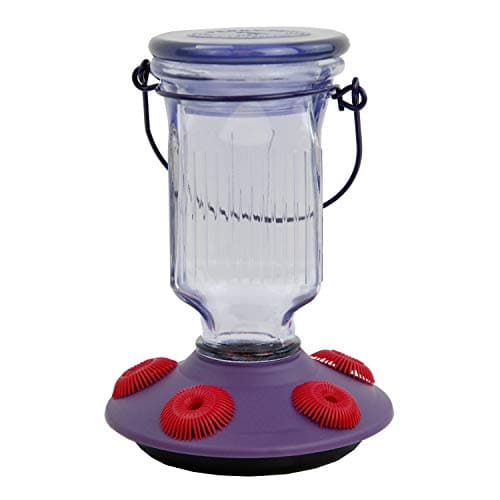
Sixteen ounces of colored glass with five zinnia-inspired ports, a perch at every one of them, long port stems that deter bees without an add-on, a gasket in the base for leaks, and top-fill so the lid comes off rather than the whole feeder being inverted.
This is the pick for anyone who wants decorative and practical and will not compromise on either. Top-fill is the mechanism that makes a glass bottle tolerable, five perches is generous, and 16 oz is still inside the sane range.
Against it: no ant moat again, the purple glass is decorative rather than functional, the bottle geometry still drips if the base is not square, and five ports on 16 oz can outpace a quiet yard — more ports means more seals to keep honest.
Nature’s Way Dewdrop Column, 23 oz — best antique look
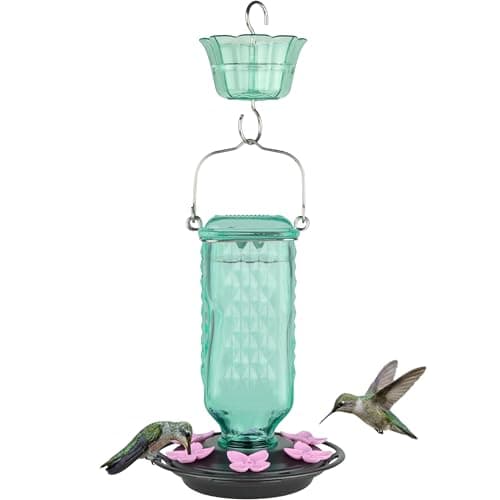
Antique teal glass on a UV-stabilized pewter plastic base with six flexible flower ports, a continuous perch ring, a steel hanger, 9 inches high, and — the detail that lifts it — a matching ant moat supplied in the box. Nature’s Way states the base fully disassembles and the flower ports are removable, which on a six-port feeder is the specification that matters most: six ports is six more places for mold if they do not come out.
It ranks third rather than first purely on capacity. Twenty-three ounces will be thrown away half full in most yards. If you like this look, this is the feeder to under-fill.
Other honest marks against it: the antique glass obscures the nectar level, as discussed above; the moat is a separate piece and separate pieces get lost; and six ports on a gravity bottle is a lot of seal to maintain.
Grateful Gnome Large Blue Egg, 36 fl oz — the statement piece
Genuinely hand-blown stained glass, 36 fluid ounces, shipped with the S-hook, an ant moat and a cleaning brush in the box. This is the real article rather than moulded glass sold as artisan, the maker sells it directly, and no two are identical — which is the actual reason to buy one.
It is last because of the two things we have to be straight about. Thirty-six fluid ounces is roughly triple what this site recommends; you are either under-filling it or pouring most of a liter of sugar water away twice a week. And Grateful Gnome publishes almost nothing: a name, a capacity and a price. No port count, no dimensions, no perch detail, and nothing about how the base separates — which on a 36 oz bottle is precisely the thing you most want to know.
The included brush is a point in its favour, and not a small one: a maker that puts a brush in the box has thought about the wash. Buy it as the ornament you wanted, hang it where you can see it, fill it a third full, and keep a plain saucer somewhere else in the yard as the feeder that does the work.
If you want one feeder that is both
The honest summary of this whole page: decorative and functional are not in conflict, but they are in tension, and the tension resolves at capacity. The pretty feeders that work are the small ones.
If appearance matters and performance matters equally, buy the 12 oz Perky-Pet or the 16 oz Lavender Field and stop there. If appearance is the point and you accept the maintenance cost, buy whatever you love and under-fill it. And if you would rather have the best feeder and not care how it looks, the answer on this site has never changed: a plain plastic saucer that comes apart in two pieces, covered in the best hummingbird feeders.
The picks in full
Every pick, in detail
1. Best decorative feeder overall
Perky-Pet Elegant Copper Glass 12 oz (710B)
The only feeder we found that is sold on its looks and still holds a defensible 12 oz — a glass reservoir in a brushed copper frame, four ports with bee guards built into them, and a base that comes apart.
- Type
- Glass bottle, copper frame
- Capacity
- 12 oz
- Feeding ports
- 4, red flower-shaped
- Bee guards
- Built into each port
- Perch
- Circular wraparound, 360-degree feeding
- Material
- Glass, copper (brushed copper finish)
- Dimensions
- 10.8"H x 6.7" diameter
- Filling
- Wide-mouth bottle
- Ant moat
- Not published
Our score: 8.6/10 — an editorial rating, not a customer rating or a test result.
Cleaning access
Perky-Pet states the base comes apart to make cleaning easy, and the reservoir is a wide-mouth glass bottle that takes a brush without a fight. Glass is also the material that stays legible: at 12 oz you can see the nectar level and you can see when the inside has gone cloudy, which is the whole argument for glass on this site. The four ports are the surface to actually watch — Perky-Pet does not say they are removable, so budget a port brush.
What works
- 12 oz is a capacity that matches a three-to-five-day discard cycle, which almost nothing else in the decorative category manages
- Bee guards are built into the ports rather than sold as an add-on
- A full circular perch means birds drink sitting down
- Real glass and real copper, so the finish ages instead of flaking
- Manufacturer publishes dimensions, capacity, port count and materials — rare in this category
What doesn’t
- No ant moat published, so you hang one above it or accept ants
- A gravity bottle drips if the base is not seated square, unlike a saucer
- Perky-Pet publishes no weight and does not say the ports are removable
- Copper is the reason for the price; it buys you appearance, not function
Price as of November 2, 2026. #ad How we’re funded
Specifications from Perky-Pet — Elegant Copper Glass Hummingbird Feeder (710B): 12 oz capacity, 4 flower-shaped ports with built-in bee guards, circular perch, glass and copper, 10.8in H x 6.7in diameter, base comes apart for cleaning, wide-mouth bottle. We have not handled this feeder — here is what we did instead.
2. Prettiest at the right size
Perky-Pet Lavender Field Top-Fill Glass 16 oz
Sixteen ounces, five ports and a perch at each one — the size in this line that actually matches how fast a feeder ought to be emptied and washed.
- Type
- Glass bottle, top-fill
- Capacity
- 16 oz
- Feeding ports
- 5, zinnia-inspired
- Perches
- 5 (one per port)
- Bee guards
- Long-stem port design
- Leak control
- Gasket in the base
- Material
- Glass, plastic
- Dimensions
- 7.75"H
Our score: 8.5/10 — an editorial rating, not a customer rating or a test result.
Cleaning access
Perky-Pet states it is designed to fully disassemble so every internal component can be cleaned. At 16 oz there is also simply less feeder to wash, which matters more than any single design feature when the job comes around twice a week.
What works
- 16 oz is the honest size for most yards in this style
- A perch at every one of the five ports
- Long port stems deter bees without an add-on
- Top fill plus a published anti-leak gasket
What doesn’t
- No ant moat; you would need to hang one above it
- Bottle geometry still drips if the base is not seated square
- The purple glass is decorative, not a functional feature
- Five ports on 16 oz can outpace a quiet yard
Price as of November 2, 2026. #ad How we’re funded
Specifications from Perky-Pet — Lavender Field Top-Fill Glass Hummingbird Feeder (9101). We have not handled this feeder — here is what we did instead.
3. Best antique-glass look
Nature's Way Dewdrop Column 23 oz
Six ports and a continuous perch ring on a 23 oz column, with the ant moat supplied in the box rather than left as your problem.
- Type
- Glass gravity bottle
- Capacity
- 23 oz
- Feeding ports
- 6, flexible flower-shaped
- Perch
- Continuous ring
- Ant moat
- Included, matching color
- Material
- Antique glass, UV-stabilized pewter plastic base, steel hanger
- Dimensions
- 9"H x 6.35"W x 6.35"D
- Base
- Fully disassembles, removable flower ports
Our score: 8.2/10 — an editorial rating, not a customer rating or a test result.
Cleaning access
Nature's Way states the base fully disassembles and the flower ports are removable, which is the specification that matters most on a six-port feeder — six ports is six more places for mold if they do not come out. The wide-mouth bottle takes a brush.
What works
- Six ports and a full perch ring suit a yard with real traffic
- Ant moat supplied rather than sold as an accessory
- Ports are removable, so all six can actually be cleaned
- UV-stabilized base and steel hanger will not rust
What doesn’t
- 23 oz will be thrown away half full in most yards
- The moat is a separate piece, and separate pieces get lost
- Antique glass obscures the nectar level
- Six ports on a gravity bottle is a lot of seal to keep honest
Price as of November 2, 2026. #ad How we’re funded
Specifications from Nature's Way Bird Products — Dewdrop Column Antique Hummingbird Gravity Feeder. We have not handled this feeder — here is what we did instead.
4. The statement piece
Grateful Gnome Large Blue Egg Hand-Blown Glass 36 oz
A genuinely hand-blown stained-glass reservoir that ships with the S-hook, the ant moat and the brush in the box — and a 36 fl oz capacity that is three times what this site tells you to buy.
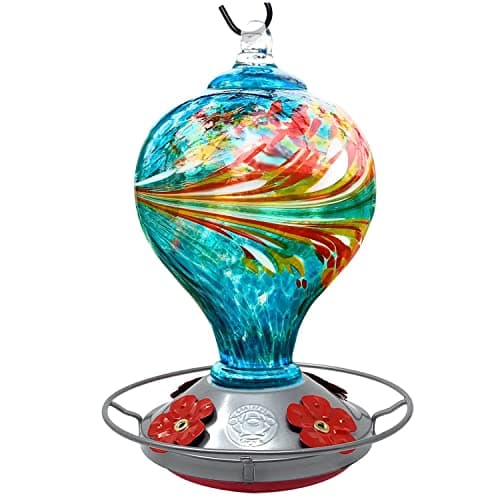
- Type
- Hand-blown stained glass gravity bottle
- Capacity
- 36 fl oz
- Design
- Large Blue Egg
- In the box
- S-hook, ant moat, cleaning brush
- Feeding ports
- Not published
- Dimensions
- Not published
- Perch
- Not published
Our score: 7.4/10 — an editorial rating, not a customer rating or a test result.
Cleaning access
A brush is included, which is a fair signal that the maker expects you to use one, and the reservoir is glass so you can see what you are dealing with. Beyond that we are guessing and will not: Grateful Gnome publishes a name, a capacity and a price, and does not publish a port count, dimensions, a perch or how the base separates. On a 36 oz bottle the thing you most want to know is how the base comes off, and that is exactly what is missing.
What works
- Hand-blown glass, so no two are identical — the actual reason to buy one
- Ant moat and brush supplied rather than sold separately
- S-hook included, which several pricier feeders leave out
- The maker sells it directly, so there is a company behind it
What doesn’t
- 36 fl oz is roughly triple the capacity this site recommends; fill it a third full or pour most of it away twice a week
- Almost no published specification — no port count, no dimensions, no perch detail
- Stained glass hides the nectar level and the state of the inside
- Hand-blown glass is breakable and this is the heaviest thing here when full
Price as of November 2, 2026. #ad How we’re funded
Specifications from Grateful Gnome — Large Blue Egg Hummingbird Feeder, 36 fluid ounces (maker's own store listing) and Amazon — Hummingbird Feeder by Grateful Gnome, Large Hand Blown Stained Glass, accessories S-hook, ant moat and brush, 36 fl oz, Large Blue Egg design. We have not handled this feeder — here is what we did instead.
What we’d skip
Unbranded hand-blown glass feeders, and Muse Garden
Two different skips with the same cause. First, the generic tier: search for a hand-blown glass hummingbird feeder and most of what comes back is near-identical colored glass from sellers with no presence outside a marketplace listing - we logged Tegarbed, WOSIBO, Jarkyfine, BirdKiss, FEED GARDEN and several unbranded 'Seafoam Ombre' style listings while researching this page, none of which publishes a port count, a disassembly method or a dimension you can check. Second, and more awkwardly: Muse Garden. It is the most-searched name in this category after the big brands, it is genuinely purchasable, and we still did not feature it, because we could not establish what we would be recommending. There is no manufacturer site we could find, and the retail listings for its feeders contradict each other on the single most important specification - we found the same product line described as 20, 24, 25, 27 and 32 oz across different listings, with port counts given variously as four or not at all. That is not a reason to believe the feeder is bad. It is a reason we will not put a number next to it and call it a specification.
Common questions
Frequently asked
What is the best decorative hummingbird feeder?
The Perky-Pet Elegant Copper Glass feeder, because it is the only one we found that is sold on its looks and still holds a defensible 12 oz. It has four red flower ports with bee guards built in, a full circular perch, and a base that comes apart for cleaning.
Are copper hummingbird feeders safe?
On every copper feeder we could verify, the copper is the frame or the finish and the nectar sits in glass, so nectar never touches copper. Claims circulating online about copper leaching into nectar cite studies and organizational statements we could not trace to any primary source, so we neither repeat them nor dismiss them — we simply do not feature an all-copper reservoir.
Why are decorative hummingbird feeders so large?
Because a big blown-glass vessel looks better than a small one — there is room for the shape and the color. The category clusters at 20 to 36 oz for aesthetic reasons, which collides with the fact that nectar has to be discarded every three to five days regardless of how much is left.
Can I buy a large decorative feeder and just not fill it up?
Yes, and it is the right answer if you have fallen for a big one. Fill it a third, change it on the normal three-to-five-day schedule, and you get the object you wanted with the hygiene you need. The only cost is that it looks half empty.
Is hand-blown glass worth the money on a hummingbird feeder?
Only as an ornament. Hand-blown glass holds nectar exactly as well as moulded glass, so you are paying for the fact that no two are the same. That is a perfectly good reason to spend the money — it is just not a functional upgrade, and the hand-blown options tend to be the largest and least documented in the category.
Does colored glass bother hummingbirds?
No. It bothers you. Birds respond to the ports and the nectar, not to the glass tint, but deep antique or stained glass hides the nectar level and hides early cloudiness, so you lose the ability to spot a problem by looking.
Sources
Where this came from
- Perky-Pet - Elegant Copper Glass Hummingbird Feeder (710B): 12 oz, 4 flower-shaped ports with built-in bee guards, circular perch with 360-degree feeding, glass and copper, 10.8in H x 6.7in diameter, wide-mouth bottle, base comes apart for cleaning
- Perky-Pet - Lavender Field Top-Fill Glass Hummingbird Feeder (9101): 16 oz, 5 zinnia-inspired ports, 5 perches, long port stems, base gasket
- Nature's Way Bird Products - Dewdrop Column Antique Hummingbird Gravity Feeder: 23 oz, 6 flexible flower ports, continuous perch ring, included ant moat, base fully disassembles with removable ports
- Grateful Gnome - Large Blue Egg Hummingbird Feeder, 36 fluid ounces (maker's own store listing)
Read next
Related reading
By Scooter M.
an enthusiast who's genuinely into this. I read the manuals, compile the published specs, and do the math. No lab coat.
Published October 23, 2026