Feeders
Do hummingbird feeders have to be red?
Red is how a bird finds a feeder it has never seen. It is not how a bird decides to come back, and it has no business being in the sugar water.
We earn a commission on purchases made through our links, at no extra cost to you. We don’t accept free products or paid placements. Full disclosure.
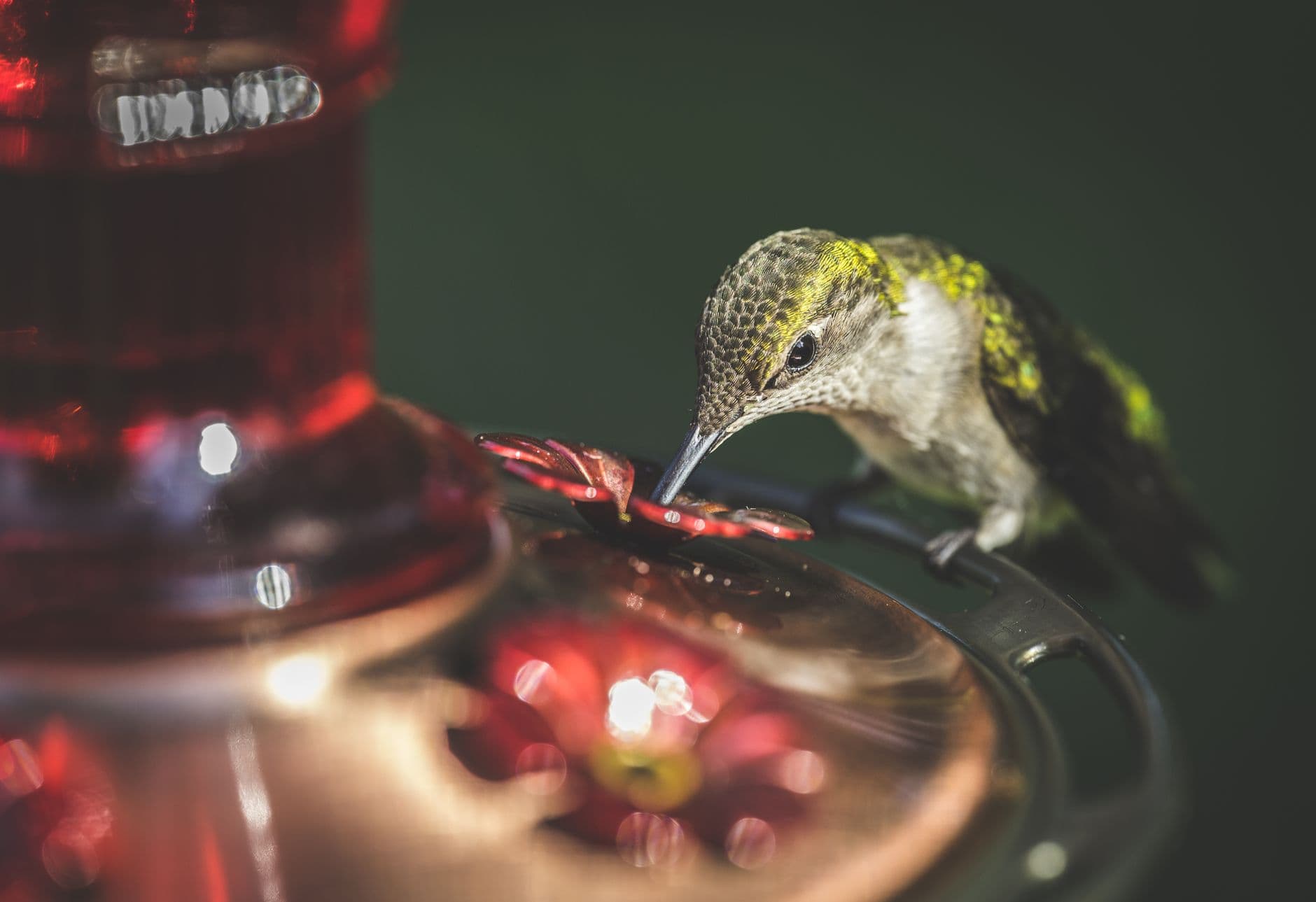
No — the feeder does not have to be red, but it should have some red on it, and the nectar must never be dyed. Red flower-shaped ports or a red cap are enough; the body can be clear glass, copper, teal or plain plastic. Red is a finding aid, and Audubon’s own summary of the research is that “it’s the nectar, not the color that makes the most difference with hummingbirds” — researchers switched birds away from red to whichever flowers held the most nectar. So buy the feeder you will keep clean, and make sure something at the ports is red.
What we recommend here
| # | Product | Best for | Score | Price |
|---|---|---|---|---|
| 1 |  Perky-Pet Elegant Copper Glass 12 oz (710B) Copper and glass body, four red flower ports | Best answer to the question | 8.6 out of 10 | |
| 2 |  Aspects HummZinger HighView 12 oz 12 oz saucer, two parts, built-in moat | The feeder to buy regardless of color | 9.2 out of 10 | |
| 3 |  Nature's Way Dewdrop Column 23 oz Antique teal glass, six flower ports, moat included | Proof a feeder need not be red at all | 8.2 out of 10 | |
| 4 | No product photo yet Trap-It Ant Moat A red moat above a colorless feeder does two jobs | The cheapest way to add red | 8.8 out of 10 |
Scores are our own editorial ratings from the criteria on our methodology page. They are not customer ratings and they are not test results.
The short version
Three claims, in order of how much they matter.
- Red helps a hummingbird find a feeder it has not used before. Their color vision is weighted that way, and red flowers are reliably worth visiting.
- After that, red stops being the deciding factor. They learn where food is and they prefer whichever source has the most nectar, red or not.
- Red in the nectar is not needed and may be harmful. This is the one part of the question with a flat answer.
Everything below is the evidence for those three, and then what to actually buy.
What red actually does
Hummingbirds see the red end of the spectrum unusually well. Audubon describes oil droplets in the eye acting as filters that “appear to heighten color sensitivity in the red to yellow range, while muting colors such as blue.” And the association is learned against a real pattern: as Audubon puts it, “red flowers, and of course red feeders, are often rich sources of food for hummingbirds,” and the color “often signals high-octane fuel for their intensely active way of life.”
So red is a signal that has been reliable for a long time, and a bird arriving in a yard it does not know uses it. That is the honest case for red, and it is a real one. It is also narrower than the marketing implies.
Why it stops mattering after the first week
This is the part that most pages on this question leave out, and it is the reason the answer is “no” rather than “yes.”
The preference for red is not a hard rule the bird cannot override. Audubon reports that “by varying the nectar content of flowers, researchers were quickly able to switch hummers from a preference for red” to a preference for the most nectar-rich flowers, regardless of color — and sums it up as “it turns out that it’s the nectar, not the color that makes the most difference with hummingbirds.” They are, in Audubon’s phrase, “fast learners” that “will go to where the nourishment is.”
Put that together with what hummingbirds do in a yard. They are territorial, they return to known sources, and a dominant bird will sit and guard a feeder all season — the behavior behind how many feeders you need. A bird that has found your feeder is not re-evaluating its color each morning. It knows where the feeder is.
Which means the color of the feeder is a first-contact problem. It matters in the days after you hang something new, and in the spring when migrants arrive looking for anything at all. It does not matter for the rest of the season, and it is nowhere near as important as whether the nectar in it is fresh.
The one place red must never go
The nectar. This has a clear answer from both major authorities and it is the only part of this topic where we will be blunt.
Cornell’s All About Birds puts it as directly as it can: “There is absolutely no reason to add any red dyes to hummingbird sugar water. After all, natural flower nectar is clear, and hummingbird feeders have colorful parts that attract hummingbird regardless of the color of the sugar water.” Audubon’s nectar guidance says the same, warning against red food coloring as “not necessary and could also prove harmful to birds.”
Note the reasoning in the Cornell line, because it is exactly the argument of this page: the feeder already has colored parts, so the dye is solving a problem that the plastic flower on the port has already solved. The full treatment, including what to do about the supermarket bottles of red premixed nectar, is in is red dye bad for hummingbirds? — and the recipe you should use instead is in the nectar recipe: four parts water, one part plain white sugar, nothing else.
So how much red do you need?
Something at the ports. That is the practical answer, and almost every feeder sold already satisfies it.
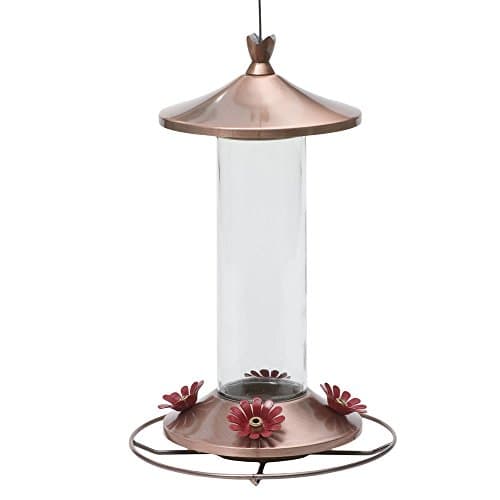
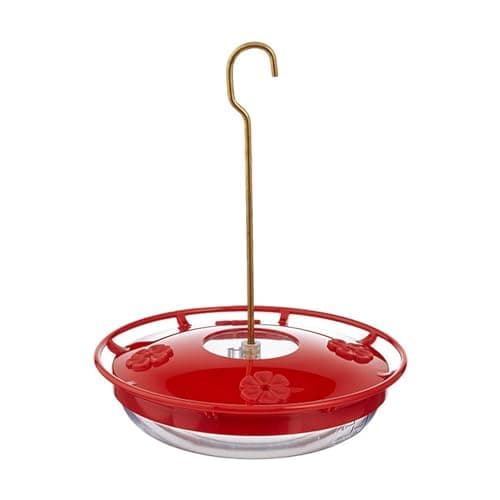
Look at what the feeders on this site actually are. The Perky-Pet below is a glass bottle in a copper frame — and it has four red flower-shaped ports. The Aspects Gem is a clear basin with a red lid. The HummZinger range is largely clear polycarbonate with a colored cover. In each case the red is a small part of the object, positioned where the bird feeds, and that is sufficient.
If you genuinely have a feeder with no red on it at all — some antique glass and all-copper designs qualify — there are three fixes, in ascending order of how much we like them:
- Hang a red ant moat above it. Our favorite, because it does two useful jobs at once: the moat is the only thing that reliably stops ants, and the ones we recommend come in red. Covered in the best ant moats.
- Plant something red near it. Slower, free, and the better long-term answer for attracting birds in the first place.
- Tie a red ribbon to the hanger. It works and it looks like what it is. Take it off once birds are visiting.
What is not on that list: dyeing the nectar, and buying a second feeder purely because the first one is the wrong color.
The thing people are usually asking instead
Most people who ask whether a feeder has to be red are really asking why nothing is coming to theirs. Color is almost never the reason, and it is worth knowing the order of likelihood before you buy a redder feeder:
- Season and timing. If the birds have not arrived in your region yet, no feeder of any color will work. See when to put feeders out.
- The nectar has gone off. Cloudy or fermented nectar empties a yard fast and the feeder still looks fine from a window. See how long nectar lasts.
- Placement. Too exposed, too hidden, full afternoon sun, or no perch nearby. See where to hang a feeder.
- A dominant bird is guarding it. You may have one hummingbird, not none.
- Insects got there first. A feeder covered in bees is a feeder hummingbirds will abandon. See keeping bees off.
The full diagnostic, in order, is why hummingbirds are not coming to your feeder. Work through it before spending anything.
What we would buy
The honest recommendation is that you should not let this question drive the purchase at all. Choose the feeder on cleaning access and capacity, the way how to choose a hummingbird feeder sets out, and then check that it has red somewhere near the ports. It almost certainly will.
The picks below cover the three honest positions: the best feeder that answers the question by having red ports on a non-red body, the feeder we would buy irrespective of color, a deliberately non-red feeder to prove the point, and the cheapest way to add red to anything you already own.
Recommended for this
What we’d buy
1. Best answer to the question
Perky-Pet Elegant Copper Glass 12 oz (710B)
The only feeder we found that is sold on its looks and still holds a defensible 12 oz — a glass reservoir in a brushed copper frame, four ports with bee guards built into them, and a base that comes apart.
- Type
- Glass bottle, copper frame
- Capacity
- 12 oz
- Feeding ports
- 4, red flower-shaped
- Bee guards
- Built into each port
- Perch
- Circular wraparound, 360-degree feeding
- Material
- Glass, copper (brushed copper finish)
- Dimensions
- 10.8"H x 6.7" diameter
- Filling
- Wide-mouth bottle
- Ant moat
- Not published
Our score: 8.6/10 — an editorial rating, not a customer rating or a test result.
Cleaning access
Perky-Pet states the base comes apart to make cleaning easy, and the reservoir is a wide-mouth glass bottle that takes a brush without a fight. Glass is also the material that stays legible: at 12 oz you can see the nectar level and you can see when the inside has gone cloudy, which is the whole argument for glass on this site. The four ports are the surface to actually watch — Perky-Pet does not say they are removable, so budget a port brush.
What works
- 12 oz is a capacity that matches a three-to-five-day discard cycle, which almost nothing else in the decorative category manages
- Bee guards are built into the ports rather than sold as an add-on
- A full circular perch means birds drink sitting down
- Real glass and real copper, so the finish ages instead of flaking
- Manufacturer publishes dimensions, capacity, port count and materials — rare in this category
What doesn’t
- No ant moat published, so you hang one above it or accept ants
- A gravity bottle drips if the base is not seated square, unlike a saucer
- Perky-Pet publishes no weight and does not say the ports are removable
- Copper is the reason for the price; it buys you appearance, not function
Price as of November 2, 2026. #ad How we’re funded
Specifications from Perky-Pet — Elegant Copper Glass Hummingbird Feeder (710B): 12 oz capacity, 4 flower-shaped ports with built-in bee guards, circular perch, glass and copper, 10.8in H x 6.7in diameter, base comes apart for cleaning, wide-mouth bottle. We have not handled this feeder — here is what we did instead.
2. The feeder to buy regardless of color
Aspects HummZinger HighView 12 oz
A four-port saucer feeder with the ant moat built into the lid and a cover that lifts straight off — the shortest path from hanging it up to washing it out.
- Type
- Saucer (dish)
- Capacity
- 12 oz
- Feeding ports
- 4
- Material
- Polycarbonate, metal hanger
- Dimensions
- 7.75" x 7.75" x 1.75"
- Ant moat
- Built in
- Perch
- Raised wraparound perch
- Mounting
- Hang or post mount
Our score: 9.2/10 — an editorial rating, not a customer rating or a test result.
Cleaning access
Two parts. The cover lifts off the base with no tools and no threads to cross, and the whole dish is one open bowl — a two-minute wash with a brush and hot water, which is exactly the cadence a nectar feeder needs. The moat is part of the lid, so there is no separate accessory to lose or forget to refill.
What works
- Saucer design puts nectar below the ports, so it does not drip as the air inside warms
- Ant moat is integral to the lid rather than a separate hanging accessory
- Opens to a single shallow bowl — the easiest shape in the category to scrub
- Raised ports shed rain, which keeps the nectar from being diluted
What doesn’t
- 12 oz is small for a busy yard
- Polycarbonate clouds over several seasons in a way glass does not
- No bee-excluding port tips fitted — that is the Ultra's feature, not the HighView's
Price as of November 2, 2026. #ad How we’re funded
Specifications from Duncraft — Aspects High View HummZinger and Amazon — Aspects HummZinger HighView 12 oz. We have not handled this feeder — here is what we did instead.
3. Proof a feeder need not be red at all
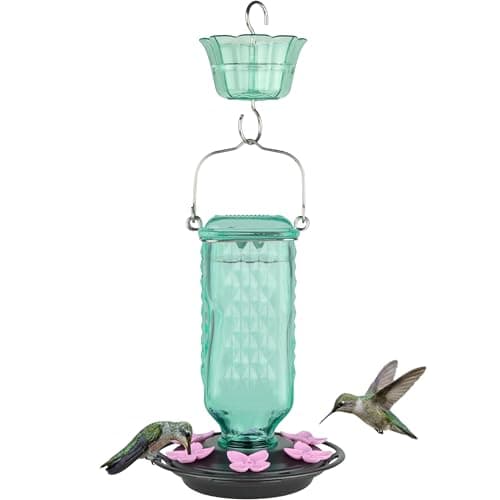
Nature's Way Dewdrop Column 23 oz
Six ports and a continuous perch ring on a 23 oz column, with the ant moat supplied in the box rather than left as your problem.
- Type
- Glass gravity bottle
- Capacity
- 23 oz
- Feeding ports
- 6, flexible flower-shaped
- Perch
- Continuous ring
- Ant moat
- Included, matching color
- Material
- Antique glass, UV-stabilized pewter plastic base, steel hanger
- Dimensions
- 9"H x 6.35"W x 6.35"D
- Base
- Fully disassembles, removable flower ports
Our score: 8.2/10 — an editorial rating, not a customer rating or a test result.
Cleaning access
Nature's Way states the base fully disassembles and the flower ports are removable, which is the specification that matters most on a six-port feeder — six ports is six more places for mold if they do not come out. The wide-mouth bottle takes a brush.
What works
- Six ports and a full perch ring suit a yard with real traffic
- Ant moat supplied rather than sold as an accessory
- Ports are removable, so all six can actually be cleaned
- UV-stabilized base and steel hanger will not rust
What doesn’t
- 23 oz will be thrown away half full in most yards
- The moat is a separate piece, and separate pieces get lost
- Antique glass obscures the nectar level
- Six ports on a gravity bottle is a lot of seal to keep honest
Price as of November 2, 2026. #ad How we’re funded
Specifications from Nature's Way Bird Products — Dewdrop Column Antique Hummingbird Gravity Feeder. We have not handled this feeder — here is what we did instead.
4. The cheapest way to add red
Trap-It Ant Moat
A three-quarter-cup water moat that hangs above any feeder. It holds more water than most, which is the only spec that matters — a moat that dries out on a hot afternoon is a bridge.
photo yet
- Type
- Hanging water ant moat
- Water capacity
- 3/4 cup
- Dimensions
- Approx. 3" diameter x 3.5" tall including hooks
- Material
- One-piece weather-resistant plastic
- Hooks
- Open eye hooks top and bottom, 3/8 in diameter
- Colors
- Red, orange
Our score: 8.8/10 — an editorial rating, not a customer rating or a test result.
Cleaning access
One open cup. Tip it out, rinse it, refill with plain water when you refill the feeder — conveniently the same visit.
What works
- Larger water capacity than most moats, so it survives a hot day without going dry
- Open hooks top and bottom fit almost any hanging feeder
- One piece of plastic — nothing to break or lose
What doesn’t
- Does nothing whatsoever for bees or wasps; that is a port-size problem
- Needs topping up, and an empty moat is worse than none because you stop checking
- Only useful on a hanging feeder — a pole-mounted feeder needs a different answer
Specifications from Duncraft — Trap-It Ant Moat. We have not handled this feeder — here is what we did instead.
Common questions
Frequently asked
Do hummingbird feeders have to be red?
No. The feeder body can be clear glass, copper, teal or plain plastic as long as something near the feeding ports is red — red flower-shaped ports or a red cap are enough. Red helps a bird find a feeder it has never used; it is not what makes a bird come back.
Should I put red dye in hummingbird nectar?
No. Cornell’s All About Birds states there is “absolutely no reason to add any red dyes to hummingbird sugar water,” noting that natural flower nectar is clear and feeders already have colored parts. Audubon calls red food coloring unnecessary and says it could prove harmful. Use four parts water to one part plain white sugar and nothing else.
What color hummingbird feeder is best?
Red at the ports, and whatever you like for the body. There is no evidence that any particular shade outperforms another once birds know the feeder is there — Audubon reports researchers could switch hummingbirds off red entirely by making other flowers more nectar-rich. Pick on cleaning access instead.
Will hummingbirds use a feeder with no red on it?
Yes, especially once they have found it. The color matters most in the first days after you hang something new. If you want to speed that up, hang a red ant moat above it or plant something red nearby — both work and neither involves dye.
Does a yellow part on the feeder attract wasps?
It is a reasonable worry, which is why most modern feeders use red rather than yellow ports — yellow is a color wasps investigate. Older feeders with yellow bee guards are the usual culprits. The reliable fix for wasps is not color, though: it is a saucer design that keeps nectar below the ports. See wasps on a hummingbird feeder.
My feeder is red and nothing is coming. What now?
Color is almost never the reason. Check, in this order: whether the birds have arrived in your region yet, whether the nectar has fermented, where the feeder is hung, whether one dominant bird is guarding it, and whether bees got there first.
Sources
Where this came from
- National Audubon Society - Hummingbirds See Red: oil droplets heighten color sensitivity in the red to yellow range; researchers switched hummingbirds from a preference for red to the most nectar-rich flowers regardless of color; "it's the nectar, not the color that makes the most difference"
- Cornell Lab of Ornithology, All About Birds - Should I use red food coloring in hummingbird food? "There is absolutely no reason to add any red dyes to hummingbird sugar water... hummingbird feeders have colorful parts that attract hummingbird regardless of the color of the sugar water."
- National Audubon Society - How to Make Hummingbird Nectar: advises against red food coloring as "not necessary and could also prove harmful to birds"
- Perky-Pet - Elegant Copper Glass Hummingbird Feeder (710B): four red flower-shaped ports on a glass and copper body
Read next
Related reading
By Scooter M.
an enthusiast who's genuinely into this. I read the manuals, compile the published specs, and do the math. No lab coat.
Published October 23, 2026