Pests
Bee guards vs ant moats: which do you need?
Buying the wrong one is the most common mistake in this category, and it is easy to make because the packaging never explains the difference.
We earn a commission on purchases made through our links, at no extra cost to you. We don’t accept free products or paid placements. Full disclosure.
Ants need a water moat. Bees and wasps need port geometry. Neither one does the other’s job. An ant moat is a cup of plain water hanging above the feeder that crawling insects will not cross — it does nothing whatsoever about bees. Bee guards narrow the port so a hummingbird’s tongue reaches the nectar and an insect’s does not — they do nothing about ants, which arrive along the hook rather than through the port. If you have both, buy a feeder that includes both.
What we recommend here
| # | Product | Best for | Score | Price |
|---|---|---|---|---|
| 1 |  Aspects HummZinger Ultra 12 oz Fitted Nectar-Guard tips plus a built-in ant moat | Best if you have both problems | 8.9 out of 10 | |
| 2 |  Aspects HummZinger HighView 12 oz Built-in moat and saucer geometry, no tips to clean | Best if you only have ants | 9.2 out of 10 | |
| 3 | No product photo yet Trap-It Ant Moat Hangs above any feeder; holds enough not to dry out | Best add-on moat for a feeder without one | 8.0 out of 10 |
Scores are our own editorial ratings from the criteria on our methodology page. They are not customer ratings and they are not test results.
Work out which insect you actually have
This sounds obvious and it is where most people go wrong, because the two problems produce a similar feeling — bugs on the feeder — and completely different fixes.
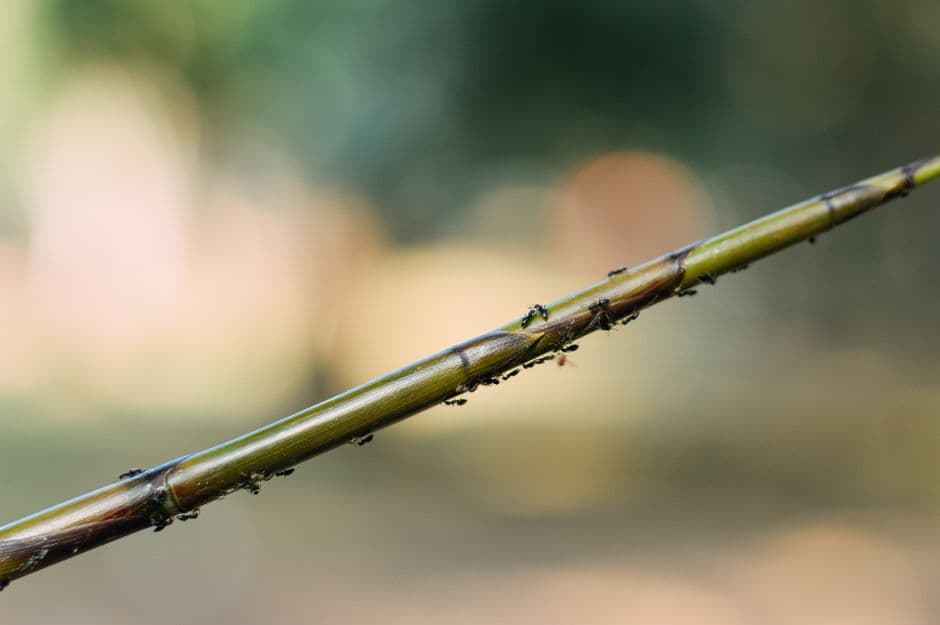
Ants arrive in a line. They come down the hook, the wire or the chain, cross the top of the feeder, and go into the ports or into any spill. You will see a trail rather than individuals, and it will be there in the morning before it is warm. Ants cannot fly, and that single fact is the whole basis of the fix.
Bees and wasps arrive through the air and hover at the ports. They do not form a trail, they get worse as the day warms, and they cluster where the nectar is closest to the opening. A bee is trying to reach nectar through the port; a wasp will also work at spills on the outside of the feeder.
Two different arrival routes. That is why the fixes are not interchangeable, and why buying the wrong one feels like the product failed when in fact it was never aimed at your problem.
How an ant moat works
A moat is a small cup that hangs between the hook and the feeder. You fill it with plain water. Ants coming down the hook reach the water and stop, because they will not cross it. That is the entire mechanism, and it works essentially completely.
It is the most reliable insect fix in this hobby, and it fails in exactly one way: it dries out. An empty moat is not a neutral — it is worse than no moat, because you stop checking it and assume the problem is handled. On a hot day a small moat can empty in an afternoon, which is why capacity is the spec that matters most when buying one.
Things that belong in a moat: plain water. Things that do not: oil, petroleum jelly, soap, or insecticide. The National Audubon Society warns that oils and petroleum products damage feathers and that pesticides can injure and kill birds, and a hummingbird will contact anything you put near the hole it feeds from. Full detail on keeping ants out of a hummingbird feeder.
How bee guards work
Bee guards attack the geometry instead. There are two grades of them and the difference is worth understanding before you spend anything.
Narrowed or tapered ports. The opening is shaped so a hummingbird’s long bill and longer tongue reach the nectar while a bee’s much shorter tongue cannot. This is what the bee-guard ports on the More Birds Ruby and the tapered ports on the Perky-Pet 217 do. It is a real barrier and it is included on some feeders at no extra cost.
Fitted Nectar-Guard tips. A flexible collar seated in each port that a hummingbird’s bill pushes through and that closes behind it. Nothing stays open for an insect to land on. This is the strongest version available and it is what the HummZinger Ultra fits as standard.
There is also a third thing that is not a guard at all but does most of the work: saucer geometry. In a dish feeder the nectar sits below the ports and the feeder cannot drip. No drip means no sticky trail on the base and the ground, and drips are how most bee problems begin. That is why a plain saucer with no guards at all often has fewer bees than a bottle feeder with guards fitted — see saucer vs bottle and how to keep bees off a feeder.
The decision, in four cases
- Ants only. Buy a feeder with a built-in moat, or add one. Bee guards would cost you money and a small cleaning job for nothing. The HummZinger HighView has the moat integrated into the lid, which is better than an accessory because you cannot forget to buy it and topping it up becomes part of the refill.
- Bees or wasps only. Buy port geometry — ideally fitted tips on a saucer body, which is the Ultra. Note that a moat will not help you at all here, however many listings imply otherwise.
- Both. Buy one feeder that includes both rather than bolting accessories onto a feeder that includes neither. The Ultra ships with Nectar-Guard tips and a built-in moat; the More Birds Ruby ships with bee-guard ports and a moat on top at a lower price.
- You already own a feeder you like. Then an add-on moat is a few dollars and solves the ant half immediately. The bee half is harder to retrofit — Aspects sells Nectar-Guard tips as a separate part, so check compatibility with your exact model, but many feeders cannot take them at all.
What to look for in an add-on moat
If you are buying a moat separately rather than getting one built in, the specs that matter are short and not the ones listings lead with.
- Water capacity, first and by a distance. A moat that holds more survives a hot afternoon without going dry. This is the whole failure mode, so it is the whole spec.
- Hooks at both ends, open enough to take your feeder’s hanger and your hook. Closed rings mean disassembling something.
- One piece. Fewer seams, nothing to split, nothing to lose.
- A color you do not mind. Red is fine and common; nothing about a moat needs to be yellow, and Audubon specifically advises avoiding yellow feeder decor because bees are drawn to the color.
The one we point at is the Trap-It, at about three quarters of a cup with open eye hooks top and bottom — the capacity is the reason. Note that our buy link for it goes to a live search rather than a fixed listing, because we could not confirm a current listing for that exact product; the criteria above are what to match if you buy something else. More options on the ant moat roundup.
What bee guards cost you
Every honest recommendation has a downside and this one has a specific, predictable one.
A narrowed port is harder to clean than an open one. Sugar residue collects exactly where the opening pinches, and a rinse will not shift it. Fitted Nectar-Guard tips are worse in this respect than molded bee-guard ports, because the collar has a throat. Either way you need a thin port brush and you need to use it on every wash.
Skip that and the tips gum up, which produces the worst outcome available: a blocked port that no longer admits a bill cleanly, on a feeder you bought specifically to solve insects. That is not a reason to avoid guards — it is a reason to buy the brush in the same order rather than telling yourself you will get one later.
A moat, by contrast, costs you almost nothing to maintain: you tip it out and refill it with plain water when you refill the feeder, which is the same visit.
The fix that helps with both
Before you buy either accessory, deal with drips — it is free and it reduces both problems at once.
Spilled nectar on the base and the ground is what advertises the feeder to insects. Ants find it and recruit; wasps work at it directly. An inverted bottle feeder drips when the air trapped above the nectar warms and expands, which is normal physics rather than a fault. A saucer feeder holds nectar below the ports and structurally cannot do it.
So the single highest-value change for anyone fighting both insects is usually not an accessory at all — it is moving to a dish feeder, and cleaning up whatever has already been spilled underneath. See the no-leak roundup.
Things that do not work, whichever insect you have
- Aluminum foil on the hook. There is no mechanism behind it and it does not stop ants — the full debunk is here.
- Oil, petroleum jelly or cooking spray on the wire. Actively harmful. Audubon warns these damage feathers, and a hummingbird contacts anything near the port.
- Insecticide anywhere near the feeder. Audubon is explicit that pesticides can injure, kill and reduce populations of birds and bees.
- Moving the feeder repeatedly. Buys a few days and confuses the hummingbirds, which navigate by remembered locations.
- A moat bought for a bee problem, which is the specific mistake this page exists to prevent.
Recommended for this
What we’d buy
1. Best if you have both problems
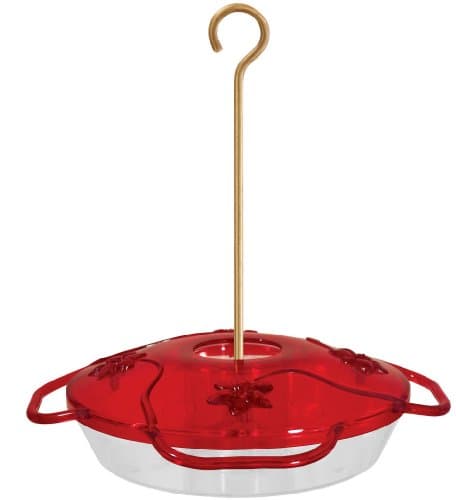
Aspects HummZinger Ultra 12 oz
The same saucer body as the HighView with Nectar-Guard tips fitted to every port — the one design change that physically keeps a bee's tongue out of the nectar instead of merely discouraging it.
- Type
- Saucer (dish)
- Capacity
- 12 oz
- Feeding ports
- 4, with Nectar-Guard tips
- Material
- Polycarbonate, brass hanger
- Dimensions
- 8.25" x 2"
- Ant moat
- Built into the brass hanger
- Cover
- Twist-off
Our score: 8.9/10 — an editorial rating, not a customer rating or a test result.
Cleaning access
Twist-off cover, same open-dish base as the HighView. The one extra step is the Nectar-Guard tips: they are small flexible collars in each port, and sugar residue collects exactly where the tip narrows. Budget an extra thirty seconds and buy a port brush alongside the feeder.
What works
- Nectar-Guard tips are a physical barrier, not a deterrent — the mechanism that actually works on bees
- Brass hanger doubles as the ant moat, so ants and bees are both handled by the stock feeder
- Saucer body means no drip, and drips are what draw insects in the first place
What doesn’t
- The port tips need their own small brush; skip that and they clog
- Same 12 oz capacity as the HighView, so not the answer for a high-traffic yard
- Costs more than the HighView for a feature you only need if you have a bee problem
Price as of September 14, 2026. #ad How we’re funded
Specifications from Duncraft — Aspects HummZinger Ultra and Amazon — Aspects 367 HummZinger Ultra. We have not handled this feeder — here is what we did instead.
2. Best if you only have ants
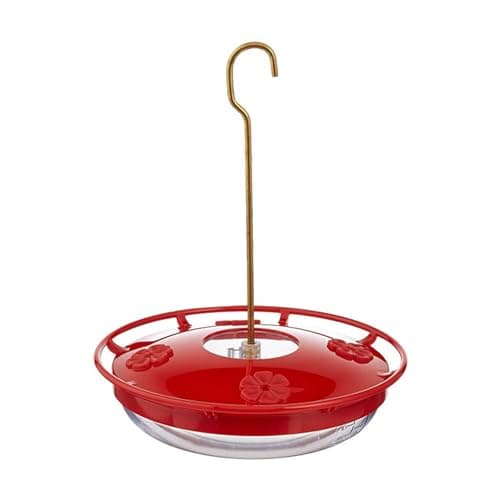
Aspects HummZinger HighView 12 oz
A four-port saucer feeder with the ant moat built into the lid and a cover that lifts straight off — the shortest path from hanging it up to washing it out.
- Type
- Saucer (dish)
- Capacity
- 12 oz
- Feeding ports
- 4
- Material
- Polycarbonate, metal hanger
- Dimensions
- 7.75" x 7.75" x 1.75"
- Ant moat
- Built in
- Perch
- Raised wraparound perch
- Mounting
- Hang or post mount
Our score: 9.2/10 — an editorial rating, not a customer rating or a test result.
Cleaning access
Two parts. The cover lifts off the base with no tools and no threads to cross, and the whole dish is one open bowl — a two-minute wash with a brush and hot water, which is exactly the cadence a nectar feeder needs. The moat is part of the lid, so there is no separate accessory to lose or forget to refill.
What works
- Saucer design puts nectar below the ports, so it does not drip as the air inside warms
- Ant moat is integral to the lid rather than a separate hanging accessory
- Opens to a single shallow bowl — the easiest shape in the category to scrub
- Raised ports shed rain, which keeps the nectar from being diluted
What doesn’t
- 12 oz is small for a busy yard
- Polycarbonate clouds over several seasons in a way glass does not
- No bee-excluding port tips fitted — that is the Ultra's feature, not the HighView's
Price as of September 14, 2026. #ad How we’re funded
Specifications from Duncraft — Aspects High View HummZinger and Amazon — Aspects HummZinger HighView 12 oz. We have not handled this feeder — here is what we did instead.
3. Best add-on moat for a feeder without one
Trap-It Ant Moat
A three-quarter-cup water moat that hangs above any feeder. It holds more water than most, which is the only spec that matters — a moat that dries out on a hot afternoon is a bridge.
photo yet
- Type
- Hanging water ant moat
- Water capacity
- 3/4 cup
- Dimensions
- Approx. 3" diameter x 3.5" tall including hooks
- Material
- One-piece weather-resistant plastic
- Hooks
- Open eye hooks top and bottom, 3/8 in diameter
- Colors
- Red, orange
Our score: 8.0/10 — an editorial rating, not a customer rating or a test result.
Cleaning access
One open cup. Tip it out, rinse it, refill with plain water when you refill the feeder — conveniently the same visit.
What works
- Larger water capacity than most moats, so it survives a hot day without going dry
- Open hooks top and bottom fit almost any hanging feeder
- One piece of plastic — nothing to break or lose
What doesn’t
- Does nothing whatsoever for bees or wasps; that is a port-size problem
- Needs topping up, and an empty moat is worse than none because you stop checking
- Only useful on a hanging feeder — a pole-mounted feeder needs a different answer
Specifications from Duncraft — Trap-It Ant Moat and Amazon — Trap-It Ant Trap. We have not handled this feeder — here is what we did instead.
Common questions
Frequently asked
Do ant moats keep bees away?
No, not at all. A moat stops crawling insects coming down the hook by putting water in their path. Bees fly to the ports and never touch the hook, so a moat is irrelevant to them — they are stopped by port geometry instead.
Do bee guards keep ants out?
No. Bee guards narrow the port opening, but ants arrive along the hanger and will walk into any spill on the outside of the feeder. Ants are stopped by water and nothing else.
Which is better, a built-in ant moat or an add-on one?
Built-in, for a practical reason rather than a performance one: it is one you cannot forget to buy, and topping it up becomes part of the same visit as refilling. An add-on is the right answer only when you already own a feeder without one.
What should I put in an ant moat?
Plain water, and nothing else. Not oil, petroleum jelly, soap or insecticide — Audubon warns that oils damage feathers and that pesticides injure and kill birds, and hummingbirds contact whatever is near the port.
Can I add bee guards to a feeder that does not have them?
Sometimes. Aspects sells Nectar-Guard tips as a separate part, so check compatibility with your exact model — but many feeders cannot take them at all. Retrofitting a moat is easy; retrofitting bee guards often is not.
Sources
Where this came from
Read next
Related reading
By Scooter M.
an enthusiast who's genuinely into this. I read the manuals, compile the published specs, and do the math. No lab coat.
Published September 13, 2026