Reviews
Birdfy vs FeatherSnap
Two smart hummingbird feeders that answer the subscription question in opposite directions. Then there is the question neither brand wants to discuss, which is the washing-up.
We earn a commission on purchases made through our links, at no extra cost to you. We don’t accept free products or paid placements. Full disclosure.
FeatherSnap if you refuse to pay a subscription; the Birdfy Hum Feeder Duo if you care more about the nectar than the footage. FeatherSnap puts AI species identification, the live feed and photo downloads in the free app, which is the best free tier in this category. Birdfy’s Duo answers with two 2K cameras, two ant moats on the solar variants, and — the specification that actually decides it on this site — a 20 oz reservoir against FeatherSnap’s full liter. Both are a lot of nectar to throw away twice a week.

What we recommend here
| # | Product | Best for | Score | Price |
|---|---|---|---|---|
| 1 |  FeatherSnap Smart Hummingbird Feeder Species ID, live feed and photos in the free app | Best if you will not pay a subscription | 8.0 out of 10 | |
| 2 |  Birdfy Hum Feeder Duo 20 oz, dual 2K cameras, two ant moats on solar variants | Best if you want the smaller reservoir | 8.1 out of 10 | |
| 3 | No product photo yet Bird Buddy Smart Hummingbird Feeder Pro 2K video, 5MP stills, HDR, 122-degree field of view | Best camera hardware of the three | 8.3 out of 10 |
Scores are our own editorial ratings from the criteria on our methodology page. They are not customer ratings and they are not test results.
How we judged these
We have not tested either feeder. Every specification here is quoted from the manufacturers’ own published pages and cited at the foot of this comparison — our method. Both brands have full individual reviews on this site: the Birdfy Hum Feeder Duo and FeatherSnap.
The criteria, and note that the camera is third:
- Capacity. How much nectar you are committing to discard every three to five days.
- What costs extra. Which features are free, which are behind a subscription, and what happens to your footage if you stop paying.
- The camera and the app. Resolution, field of view, species identification.
- Cleaning. How hard it is to wash a feeder with electronics attached.
- Power and warranty. Solar, battery, what the maker stands behind.
One note on availability before we start
The exact Birdfy Hum Feeder Duo listing we had been tracking went currently unavailable with no price in October 2026, and it is still dead. A live listing for the same model has since replaced it, and that is what the buy link here points at: in stock, priced, and matching Birdfy’s own Hum Feeder Duo specification sheet on every published figure — 20 fl oz, dual 2K cameras, a 5000 mAh battery, optional solar and 2.4 GHz Wi-Fi.
We have not quietly swapped a different product in behind the specifications below. Do still check that what you are ordering matches the figures here, because Birdfy sells several dual-camera hummingbird feeders and the configuration you select decides both the AI terms and whether the solar panel and ant moats are in the box. The FeatherSnap was in stock and priced at verification as well.
The specification that decides it, and neither brand leads with it
Capacity. We are putting it first because it is the one axis on which these two products genuinely differ by a lot, and it is the axis this site cares about most.
FeatherSnap publishes one liter, about 34 fl oz. Birdfy’s Duo publishes 20 oz. The base Birdfy Hum Feeder is 14 oz.
Now the rule that governs every page here: nectar is replaced every three to five days in moderate weather and daily in genuine heat, whether or not the birds emptied it, because what spoils it is time and temperature rather than use. The reasoning is in how often to clean a feeder, and the sizing arithmetic in what size feeder to get, which lands on 8 to 16 oz for almost every yard.
So FeatherSnap is roughly double the top of that range and the Duo is a quarter above it. In practice: a liter of sugar water, mixed, carried out, and then poured down the drain twice a week for a whole season. Neither product is well sized for its own cleaning schedule, and FeatherSnap is the worse offender by a wide margin.
There is a straightforward mitigation and we would use it on either: do not fill it. Nothing obliges you to put a liter in a liter reservoir. Fill a third, change it on time, and the capacity problem becomes a non-issue at the cost of the feeder looking under-filled on camera.
Subscriptions: FeatherSnap wins this outright
This is the question most people arrive with, and it has a clear answer.
FeatherSnap puts AI species identification and Bird ID in the free app, along with the live feed and photo downloads, with three-day photo retention. Its Premium plan, at $6.99 a month or $59.99 a year, adds video download and longer retention. So the thing people most want from a camera feeder — knowing what just landed on it — does not cost a recurring fee.
Birdfy comes at it differently. The Duo is the model in the Birdfy line you can buy outright, and that is the framing we used in camera feeders without a subscription: on the base Hum Feeder, the full AI feature set generally sits behind a plan, so check exactly what is included with the variant you are ordering before you order it.
Two cautions, in fairness to both. Free tiers are a commercial decision and commercial decisions change; a tier that is free today is not contractually free next year. And three-day photo retention is short — if you want an archive of your season rather than a live view, FeatherSnap’s free tier is not what you are buying. We said the same thing, about ourselves as much as anyone, in the warning-about-comparison-pages section of that page.
The cameras
Closer than the marketing suggests, and neither is the best in the category.
FeatherSnap publishes a 4MP camera with a wide field of view. Birdfy’s Duo publishes a dual-camera setup at 2K. The Duo’s genuine advantage is the second angle: a hummingbird at a feeder is a blur at fifty wingbeats a second, and two viewpoints meaningfully raises the chance that one of them catches the bird facing the lens.
Worth knowing: neither is the best camera here. That is Bird Buddy’s Hummingbird Feeder Pro, which publishes 2K video, 5MP stills, a 1/2.7-inch sensor with HDR and a 122-degree field of view, and it is included in the picks for that reason. If image quality is the thing you are buying, neither feeder on this page is the answer — see also Birdfy vs Bird Buddy and FeatherSnap vs Bird Buddy.
Power, hardware and what is in the box
FeatherSnap is solar with a rechargeable battery and USB-C as a fallback, publishes an operating range of -20 F to 130 F — an unusually specific claim, and a useful one if you are in a hard climate — measures 13 by 12 by 14.5 inches, and includes a pole stand, so it does not need an existing hook. Warranty is one year from activation.
The Duo offers a solar panel variant, and on the solar variants Birdfy includes two ant moats. That is a real point in its favor and it is the kind of thing that gets overlooked in camera-feeder comparisons: ants are a far more likely problem at a nectar feeder than anything the camera will film, and a moat is the only thing that reliably stops them, as set out in the best ant moats.
On the other side, FeatherSnap publishes no bee-guard specification and no detail on its ant moat beyond a reference in the setup instructions. Neither company treats insect defense as a headline feature, which tells you something about where cameras sit in their priorities.
The included pole stand on the FeatherSnap deserves a mention for anyone without a hook, because the alternative is buying mounting hardware separately — see feeder poles and stands.
The part neither brand advertises
Cleaning, and it applies equally to both.
Every camera feeder is a product that must be washed every few days with electronics bolted to it. The reservoir separates from the camera module on both of these, so it is not impossible — it is just slower and more careful than washing a plain plastic saucer, and you will be doing it around a solar panel and a battery.
That friction is the actual risk of this category, and it is a bird-welfare risk rather than an inconvenience. Fermented nectar and mold in the ports are what harm hummingbirds, and the thing that prevents them is a wash you keep doing on schedule. A feeder that makes the wash a fifteen-minute careful job instead of a two-minute rinse is a feeder that gets washed less often. We say this on every camera page on this site and we are not going to stop: the camera feeder roundup covers it under “the cleaning problem nobody writes about.”
If that gives you pause, the honest alternative is a plain feeder you will actually keep clean plus a phone on a tripod when you want pictures. The guaranteed-zero option is laid out in the no-subscription page.
Which to buy
Buy FeatherSnap if the subscription is the dealbreaker. Species ID, the live feed and photo downloads in the free app is the best free offer in this category, it comes with a pole stand, and the published temperature range is reassuring if you are somewhere extreme. Accept that you are buying a one-liter reservoir and plan to under-fill it, and accept three-day photo retention unless you pay.
Buy the Birdfy Hum Feeder Duo if you want the smaller reservoir, two camera angles on a fast-moving bird, and ant moats included on the solar variant. Twenty ounces is still above what we would recommend, but it is a long way better than a liter, and on this site that counts for more than a megapixel.
Buy neither if what you want is the best hummingbird feeder. The honest position, held across this whole site, is that the best feeder is a 12 oz plastic saucer that comes apart in two pieces and washes in two minutes — the flagship roundup. A camera feeder is a different product bought for a different reason, and that reason is that you want to watch. Which is a perfectly good reason. It is just not the same as feeding birds better.
Recommended for this
What we’d buy
1. Best if you will not pay a subscription
FeatherSnap Smart Hummingbird Feeder
A 4MP solar camera on a one-liter reservoir, with AI species ID in the free app rather than behind the paywall — and a capacity that fights the cleaning schedule harder than anything else we cover.
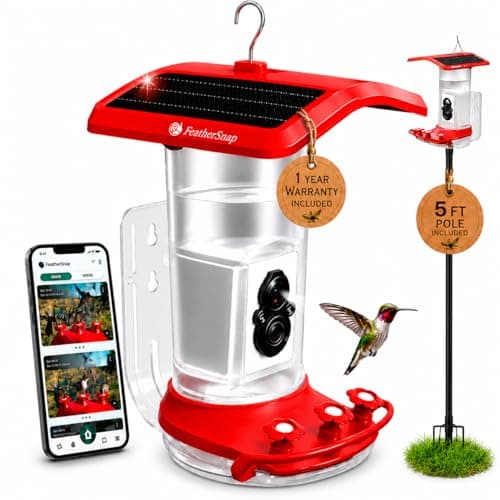
- Type
- Smart camera feeder
- Capacity
- 1 liter (about 34 oz)
- Feeding ports
- 3, shaped to mimic flower clusters
- Camera
- 4MP, wide field of view
- Power
- Solar with rechargeable battery; USB-C optional
- Wi-Fi
- 2.4 GHz
- Dimensions
- 13" x 12" x 14.5" (L x W x H)
- Operating range
- -20 F to 130 F
- Warranty
- 1 year from activation date
Our score: 8.0/10 — an editorial rating, not a customer rating or a test result.
Cleaning access
The hard part of this product. A liter of nectar has to come out and be washed on the same three-to-five-day clock as any other feeder — daily in real heat — and here that job is wrapped around a solar panel, a battery and a camera module. FeatherSnap's setup instructions reference an ant moat, but the company publishes no specification for it and none for bee guards. Assume the wash is slower and more careful than on a plain saucer, and plan for that before you buy rather than after.
What works
- AI species identification and Bird ID sit in the FREE app, not behind the subscription
- Live feed and photo downloads are free too, with 3-day photo retention
- Solar with a rechargeable battery, and USB-C as a fallback
- Published operating range of -20 F to 130 F, which is an unusually specific claim
- A pole stand is included, so it does not need an existing hook
What doesn’t
- One liter is roughly three times the nectar most yards should be putting out at once
- Video download and longer retention are subscription-only at $6.99/month or $59.99/year
- Photo retention on the free tier is only 3 days
- FeatherSnap publishes no bee-guard specification and no detail on the ant moat
- Warranty runs 1 year from activation, well short of the lifetime guarantees elsewhere on this site
Price as of November 2, 2026. #ad How we’re funded
Specifications from FeatherSnap - Smart Wi-Fi Hummingbird Feeder (capacity, ports, camera, power, dimensions, warranty) and FeatherSnap - App and Premium Plan overview (what is free vs paid). We have not handled this feeder — here is what we did instead.
2. Best if you want the smaller reservoir
Birdfy Hum Feeder Duo
Two 2K cameras pointed at opposite sides of a 20 oz, three-port feeder. It is the only design here that does not miss the bird landing on the far side.
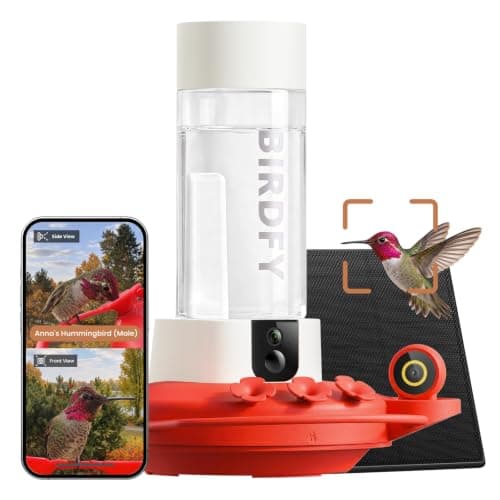
- Type
- Smart camera feeder
- Capacity
- 20 oz
- Camera
- Dual camera, 2K
- Feeding ports
- 3
- Power
- Solar panel variant available
- Ant moat
- 2 included (solar variants)
- Software
- AI bird recognition; lifetime-AI bundle offered
Our score: 8.1/10 — an editorial rating, not a customer rating or a test result.
Cleaning access
Three ports and a 20 oz reservoir to wash on a nectar schedule, around two camera modules. Better than the single-cam model in that the reservoir is larger and the ports are conventional, but the same tension applies: the more careful the wash, the more likely it gets postponed.
What works
- Dual cameras remove the single-camera blind side, the real limitation of the format
- 2K rather than 1080p
- Three ports and 20 oz make it a usable feeder, not just a camera mount
- A lifetime-AI bundle avoids an open-ended subscription
What doesn’t
- The most expensive feeder we cover, by a wide margin
- Two ant moats are listed for solar variants — confirm what your variant ships with
- Still electronics on a device that needs washing every few days
Price as of November 2, 2026. #ad How we’re funded
Specifications from Birdfy — Hum Feeder Duo, dual camera, 2K and Amazon — Birdfy Smart Hummingbird Feeder with Camera, Dual 2K Cameras, 20 fl oz. We have not handled this feeder — here is what we did instead.
3. Best camera hardware of the three
Bird Buddy Smart Hummingbird Feeder Pro
The best-specified camera in the category — 2K video, 5MP stills, a 1/2.7" sensor with HDR and a 122-degree field of view — on a 14 oz basin with five ports, three open and two closed.
photo yet
- Type
- Smart camera feeder
- Capacity
- 14 fl oz (1.75 cups)
- Camera
- 2K video, 5MP stills
- Sensor
- 1/2.7", HDR
- Field of view
- 122 degrees
- Feeding ports
- 3 open flower, 2 closed flower
- Power
- Solar roof variant available
Our score: 8.3/10 — an editorial rating, not a customer rating or a test result.
Cleaning access
A basin rather than a bottle, which helps — the nectar sits in an open reservoir you can reach into, and the camera module detaches. It is still the slowest wash of anything in this guide, and if a two-day change cycle already sounds like a chore, this is the feeder where it will become one.
What works
- Genuinely the best camera hardware here — HDR, a wide field of view and slow motion
- Five ports, three of them open, so it works as a feeder and not only as a camera
- Solar roof variant removes the recharging chore that kills enthusiasm for these
What doesn’t
- Premium price, and the solar roof is a separate variant
- 14 oz is modest for the money
- Every camera feeder trades cleaning speed for footage, and cleaning speed is what keeps nectar safe
Specifications from Bird Buddy — Smart Hummingbird Feeder Pro Solar. We have not handled this feeder — here is what we did instead.
Common questions
Frequently asked
Is Birdfy or FeatherSnap better?
FeatherSnap if you will not pay a subscription — species identification, the live feed and photo downloads are in its free app. The Birdfy Hum Feeder Duo if you care more about the feeder than the footage, because its 20 oz reservoir is far closer to a sane capacity than FeatherSnap’s full liter, and the solar variants include two ant moats.
Does FeatherSnap require a subscription?
No for the features most people want. AI species identification, Bird ID, the live feed and photo downloads sit in the free app, with three-day photo retention. Video download and longer retention are Premium, at $6.99 a month or $59.99 a year.
Which has the better camera?
FeatherSnap publishes 4MP with a wide field of view; the Birdfy Duo publishes dual cameras at 2K, and the second angle is a real advantage on a bird that moves this fast. Neither is the best in the category — that is Bird Buddy’s Pro, with 2K video, 5MP stills, HDR and a 122-degree field of view.
Is a one-liter nectar reservoir a problem?
Yes, unless you under-fill it. Nectar is discarded every three to five days whatever is left, so a liter means mixing and then pouring away about a quart of sugar water twice a week. Fill it a third and the problem goes away.
Are camera hummingbird feeders hard to clean?
Harder than a plain feeder, and that is the real cost of the category. The reservoir separates from the camera on both of these, but you are washing around a solar panel and a battery every few days. A slower wash is a wash that happens less often, and fermentation and mold are what actually harm hummingbirds.
Do either come with an ant moat?
Birdfy includes two ant moats on the solar variants of the Duo. FeatherSnap references an ant moat in its setup instructions but publishes no specification for it, and publishes nothing at all about bee guards. If ants are your problem, hang a dedicated moat above whichever you buy.
Sources
Where this came from
- FeatherSnap - Smart Wi-Fi Hummingbird Feeder: 1 liter capacity, 3 ports, 4MP camera, solar with rechargeable battery and USB-C, 13 x 12 x 14.5in, operating range -20F to 130F, 1-year warranty from activation, pole stand included
- FeatherSnap - App and Premium Plan overview: AI species ID, Bird ID, live feed and photo downloads free with 3-day photo retention; video download and longer retention $6.99/month or $59.99/year
- Birdfy - Hum Feeder Duo: 20 oz capacity, dual 2K cameras, 3 ports, solar panel variant, two ant moats on solar variants
- Bird Buddy - Smart Hummingbird Feeder Pro Solar: 2K video, 5MP stills, 1/2.7in HDR sensor, 122-degree field of view, 14 fl oz
Read next
Related reading
By Scooter M.
an enthusiast who's genuinely into this. I read the manuals, compile the published specs, and do the math. No lab coat.
Published October 23, 2026