Reviews
FeatherSnap Smart Hummingbird Feeder review
The most generous free tier of any camera feeder we cover, bolted to the largest reservoir on this site. Those two facts pull in opposite directions.
We earn a commission on purchases made through our links, at no extra cost to you. We don’t accept free products or paid placements. Full disclosure.
Buy it for the free tier, not for the feeder. FeatherSnap puts AI species identification, Bird ID, live feed and photo downloads in the free app, with the subscription reserved for video downloads and longer retention — the most generous split of any camera feeder we cover. The problem is the other half of the product: a 1 liter reservoir is roughly three times what most yards should be putting out at once, and nectar spoils on the weather’s schedule no matter how good the camera is.
What we recommend here
| # | Product | Best for | Score | Price |
|---|---|---|---|---|
| 1 |  FeatherSnap Smart Hummingbird Feeder AI species ID is free; video is the paid part | Best free tier on a camera feeder | 7.9 out of 10 | |
| 2 |  Birdfy Hum Feeder Duo Dual 2K cameras and a lifetime-AI variant | The camera alternative | 8.5 out of 10 | |
| 3 |  Aspects HummZinger HighView 12 oz Two parts, 12 oz, washes in a minute | If you can live without the camera | 9.2 out of 10 |
Scores are our own editorial ratings from the criteria on our methodology page. They are not customer ratings and they are not test results.
What it is
A solar-powered smart feeder with a 4MP camera and a wide field of view, on a reservoir FeatherSnap lists at 1 liter with three nectar ports “designed to mimic flower clusters found in nature.” It runs on a rechargeable battery charged by solar, with USB-C as an optional fallback, and connects over 2.4 GHz Wi-Fi.
FeatherSnap publishes the physical numbers: 13 x 12 x 14.5 inches (L x W x H), an operating range of −20 F to 130 F, and a warranty of one year from the activation date. The Amazon listing confirms a pole stand is included, which matters more than it sounds — at that size it is not something you casually hang from an existing hook.
We have not tested this feeder. Everything here comes from FeatherSnap’s own published specifications and its own plan page, and where the company publishes nothing we say so rather than filling the gap. Our method is in how we choose picks.
The free tier is the reason to consider it
Camera feeders are usually sold on the camera and monetized on the subscription, and the interesting question is always which features sit on which side of the line. FeatherSnap draws that line in an unusually generous place.
On FeatherSnap’s own plan page, the free app includes receiving and downloading photos, live feed access, species identification with AI and Bird ID, the Bird Book, and community access, with photo retention of three days. The Premium plan — $6.99 monthly or $59.99 annually — extends retention to ten days and adds video requests and downloads, plus a set of extras.
The headline there is that AI species identification is free. On most camera feeders that is the single feature the subscription exists to sell. If the reason you want a camera feeder is to find out what is visiting your yard, FeatherSnap answers that question without a recurring fee.
A discrepancy worth knowing about
Several third-party reviews of FeatherSnap state that AI bird identification is a subscription-only feature. FeatherSnap’s own app page lists “Species Identification with AI & Bird ID” in the free column.
We have gone with the manufacturer, because it is the party that sets the terms and the one that updates them. But we are flagging the conflict rather than quietly picking a side, for two reasons. Plan terms in this category change without a new model number, so a review written eighteen months ago may have been accurate when published. And this is exactly the failure mode we ran into researching Bird Buddy’s plans, where third-party summaries confidently contradicted the maker.
Check the current plan page before you buy. That is true of every feeder in the no-subscription roundup, and it is the single most useful habit in this whole category.
The one-liter problem
Now the part that keeps this off the top of our list.
One liter is about 34 fluid ounces. That is the largest reservoir of any feeder on this site — bigger than the 32 oz bottle feeders we already argue against, and nearly three times our usual recommendation of 8 to 16 oz.
Capacity is not storage. Nectar has to be changed every three to five days in moderate weather and daily in very hot weather, and that clock runs regardless of how much the birds actually drank. A liter of nectar in a quiet yard is not a month of feeding; it is three days of feeding and a great deal of sugar water poured down the drain. The arithmetic is worked through in what size feeder should you get, and in heat the answer moves smaller still, which is the argument in feeders for hot weather.
There is a specific tension here that applies to camera feeders more than to plain ones. A camera feeder is bought to be watched, which means it is bought by people who want birds at it often. But a reservoir this size only makes sense if the yard genuinely drinks a liter every few days, and a yard that busy is rare. For most buyers the large capacity is not a feature they will use; it is a larger object to wash.
What FeatherSnap does not publish
Two gaps, both worth knowing before you spend $130.
The ant moat. FeatherSnap’s setup instructions reference an ant moat, but the company publishes no specification for it — no capacity, no description of whether it is molded in or supplied separately. On a feeder at this price that is a surprising omission, and it matters, because a moat that holds very little water dries out fastest in exactly the hot, still weather when ants are worst. The background is in feeders with a built-in ant moat.
Bee guards. Not mentioned in the published specifications at all. Three ports shaped like flower clusters tells you about the styling, not about whether the port geometry excludes an insect. Assume no bee defense until FeatherSnap says otherwise, and if bees are a problem where you live, read how to keep bees off a feeder first — and note that add-on guards will not help here, because every retrofit guard on the market is locked to one brand and FeatherSnap is not one of them.
Cleaning: the standing problem with every camera feeder
This site weights cleaning access above everything else, and camera feeders are where that criterion does the most damage.
A liter of nectar in a 14.5-inch-tall assembly has to be emptied, taken apart, scrubbed and dried on a three-to-five-day cycle, and that job is wrapped around a solar panel, a rechargeable battery and a camera module. None of those things wants to be submerged. The practical result is not that the feeder is impossible to clean — it is that the wash is slower and more careful, and a wash that is slower and more careful is a wash that gets postponed.
Fermented nectar and mold in the ports are what actually harm hummingbirds, so this is not a convenience complaint. Compare the routine with a two-part saucer like the HummZinger HighView, where the cover lifts off and the whole thing washes in a minute, and the gap is the real cost of the camera. The easiest feeders to clean makes the same point across the range.
The warranty is short for the price
One year from the activation date. That is unremarkable for consumer electronics and noticeably short next to the rest of this site, where Aspects backs its feeders, its domes and even its 4 oz HummBlossom with a lifetime guarantee.
It is a fair reflection of what you are buying, though. This is a camera with a feeder attached, and it should be judged on the timeline of a camera. Expect to replace it on the schedule you would replace a doorbell camera, not on the schedule of a polycarbonate dish. That framing is the whole point of who makes the best hummingbird feeders: the camera brands are consumer-electronics companies and should be judged on different criteria from feeder companies.
Against Bird Buddy specifically
These two are the closest comparison in the category — one gives away AI identification, the other has the better camera and app and no buy-outright option. We put them side by side in FeatherSnap vs Bird Buddy.
FeatherSnap Scout is a different product
Worth stating plainly, because search results conflate the two constantly. The FeatherSnap Scout is a seed feeder with dual seed bins and a much larger feed capacity. The Smart Hummingbird Feeder reviewed here is a separate product with a nectar reservoir and three nectar ports.
Specifications quoted for one do not apply to the other. If a review you are reading mentions seed bins, it is not about this feeder.
How it compares
Against the Birdfy Hum Feeder Duo: Birdfy has two 2K cameras against FeatherSnap’s single 4MP one, which removes the blind side that is the real limitation of the single-camera format, and it sells an AI Lifetime Free variant with no recurring fee at all. Birdfy also costs considerably more. FeatherSnap wins on price and on what the free tier includes out of the box; Birdfy wins on the camera itself.
Against Bird Buddy: Bird Buddy’s free tier is better than it usually gets credit for, but there is no buy-outright option. FeatherSnap and Bird Buddy are arguing over similar ground, and the deciding factor is which company’s current plan page you like better on the day you buy.
Against a plain feeder: no contest on the feeding, and that is not a criticism of FeatherSnap specifically. A $30 saucer will hold the right amount of nectar, come apart in two pieces and last a decade. You are paying $130 for the photographs, and that is a perfectly reasonable thing to pay for as long as you know that is the trade.
The verdict
Recommended with a clear caveat. If you want a camera feeder and you do not want a subscription to find out what is visiting, FeatherSnap currently gives you more for free than anything else we cover, and the solar-plus-USB-C power arrangement and the published −20 F to 130 F range suggest a product designed to actually live outside.
Do not buy it expecting to fill it. Treat the 1 liter reservoir as a maximum you will never use, fill it part way, and change it on the same schedule you would use for a 12 oz feeder. Budget for solving ants yourself, since FeatherSnap publishes nothing useful about the moat, and assume no bee defense.
And if the camera is not actually the point for you, buy a saucer and spend the other hundred dollars on a second feeder placed out of sight of the first, which will do more for the number of birds in your yard than any camera will.
Recommended for this
What we’d buy
1. Best free tier on a camera feeder
FeatherSnap Smart Hummingbird Feeder
A 4MP solar camera on a one-liter reservoir, with AI species ID in the free app rather than behind the paywall — and a capacity that fights the cleaning schedule harder than anything else we cover.
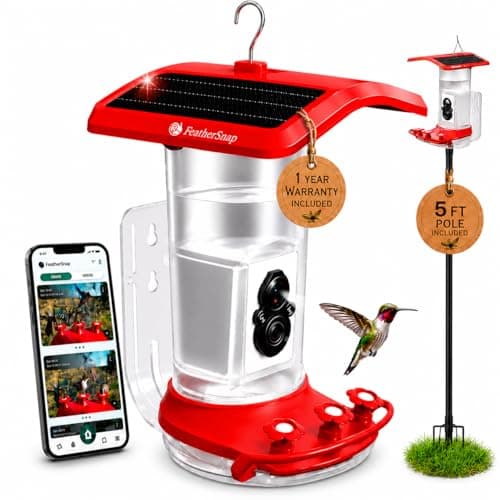
- Type
- Smart camera feeder
- Capacity
- 1 liter (about 34 oz)
- Feeding ports
- 3, shaped to mimic flower clusters
- Camera
- 4MP, wide field of view
- Power
- Solar with rechargeable battery; USB-C optional
- Wi-Fi
- 2.4 GHz
- Dimensions
- 13" x 12" x 14.5" (L x W x H)
- Operating range
- -20 F to 130 F
- Warranty
- 1 year from activation date
Our score: 7.9/10 — an editorial rating, not a customer rating or a test result.
Cleaning access
The hard part of this product. A liter of nectar has to come out and be washed on the same three-to-five-day clock as any other feeder — daily in real heat — and here that job is wrapped around a solar panel, a battery and a camera module. FeatherSnap's setup instructions reference an ant moat, but the company publishes no specification for it and none for bee guards. Assume the wash is slower and more careful than on a plain saucer, and plan for that before you buy rather than after.
What works
- AI species identification and Bird ID sit in the FREE app, not behind the subscription
- Live feed and photo downloads are free too, with 3-day photo retention
- Solar with a rechargeable battery, and USB-C as a fallback
- Published operating range of -20 F to 130 F, which is an unusually specific claim
- A pole stand is included, so it does not need an existing hook
What doesn’t
- One liter is roughly three times the nectar most yards should be putting out at once
- Video download and longer retention are subscription-only at $6.99/month or $59.99/year
- Photo retention on the free tier is only 3 days
- FeatherSnap publishes no bee-guard specification and no detail on the ant moat
- Warranty runs 1 year from activation, well short of the lifetime guarantees elsewhere on this site
Price as of October 16, 2026. #ad How we’re funded
Specifications from FeatherSnap - Smart Wi-Fi Hummingbird Feeder (capacity, ports, camera, power, dimensions, warranty) and FeatherSnap - App and Premium Plan overview (what is free vs paid). We have not handled this feeder — here is what we did instead.
2. The camera alternative
Birdfy Hum Feeder Duo
Two 2K cameras pointed at opposite sides of a 20 oz, three-port feeder. It is the only design here that does not miss the bird landing on the far side.
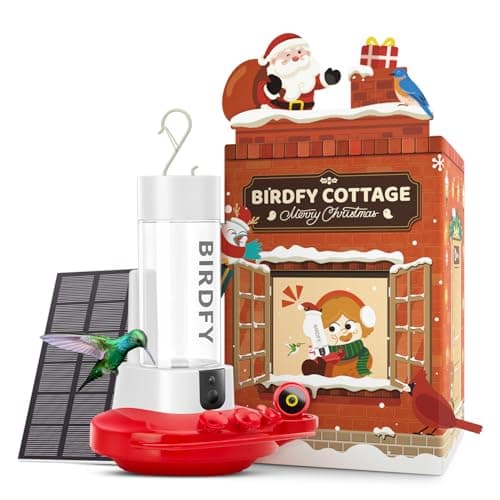
- Type
- Smart camera feeder
- Capacity
- 20 oz
- Camera
- Dual camera, 2K
- Feeding ports
- 3
- Power
- Solar panel variant available
- Ant moat
- 2 included (solar variants)
- Software
- AI bird recognition; lifetime-AI bundle offered
Our score: 8.5/10 — an editorial rating, not a customer rating or a test result.
Cleaning access
Three ports and a 20 oz reservoir to wash on a nectar schedule, around two camera modules. Better than the single-cam model in that the reservoir is larger and the ports are conventional, but the same tension applies: the more careful the wash, the more likely it gets postponed.
What works
- Dual cameras remove the single-camera blind side, the real limitation of the format
- 2K rather than 1080p
- Three ports and 20 oz make it a usable feeder, not just a camera mount
- A lifetime-AI bundle avoids an open-ended subscription
What doesn’t
- The most expensive feeder we cover, by a wide margin
- Two ant moats are listed for solar variants — confirm what your variant ships with
- Still electronics on a device that needs washing every few days
Specifications from Birdfy — Hum Feeder Duo, dual camera, 2K and Amazon — NETVUE by Birdfy Hummingbird Feeder with 2 Cameras, 20 oz. We have not handled this feeder — here is what we did instead.
3. If you can live without the camera
Aspects HummZinger HighView 12 oz
A four-port saucer feeder with the ant moat built into the lid and a cover that lifts straight off — the shortest path from hanging it up to washing it out.
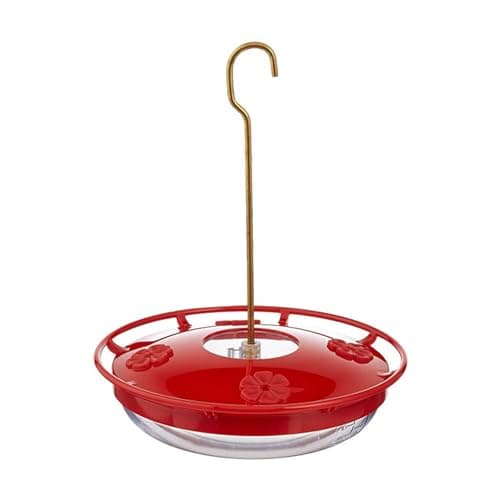
- Type
- Saucer (dish)
- Capacity
- 12 oz
- Feeding ports
- 4
- Material
- Polycarbonate, metal hanger
- Dimensions
- 7.75" x 7.75" x 1.75"
- Ant moat
- Built in
- Perch
- Raised wraparound perch
- Mounting
- Hang or post mount
Our score: 9.2/10 — an editorial rating, not a customer rating or a test result.
Cleaning access
Two parts. The cover lifts off the base with no tools and no threads to cross, and the whole dish is one open bowl — a two-minute wash with a brush and hot water, which is exactly the cadence a nectar feeder needs. The moat is part of the lid, so there is no separate accessory to lose or forget to refill.
What works
- Saucer design puts nectar below the ports, so it does not drip as the air inside warms
- Ant moat is integral to the lid rather than a separate hanging accessory
- Opens to a single shallow bowl — the easiest shape in the category to scrub
- Raised ports shed rain, which keeps the nectar from being diluted
What doesn’t
- 12 oz is small for a busy yard
- Polycarbonate clouds over several seasons in a way glass does not
- No bee-excluding port tips fitted — that is the Ultra's feature, not the HighView's
Specifications from Duncraft — Aspects High View HummZinger and Amazon — Aspects HummZinger HighView 12 oz. We have not handled this feeder — here is what we did instead.
Common questions
Frequently asked
Does the FeatherSnap hummingbird feeder require a subscription?
No. FeatherSnap’s own plan page lists photo downloads, live feed access, species identification with AI and Bird ID, the Bird Book and community access in the free app, with three-day photo retention. Premium, at $6.99 monthly or $59.99 annually, adds video requests and downloads and extends retention to ten days.
Is AI bird identification free on FeatherSnap?
According to FeatherSnap, yes — it is listed in the free column of the company’s own app page. Several third-party reviews say the opposite. We follow the maker, but plan terms in this category change without a new model number, so check the current page before buying.
How much nectar does it hold?
One liter, about 34 fluid ounces — the largest reservoir of any feeder we cover. That is roughly three times what most yards should put out at once, because nectar must be changed every three to five days regardless of how much is left. Fill it part way.
Does it have an ant moat or bee guards?
FeatherSnap’s setup instructions reference an ant moat but the company publishes no specification for it, and bee guards are not mentioned in the published specifications at all. Assume you will need to solve both yourself — see the best ant moats.
Is the FeatherSnap Scout the same as the hummingbird feeder?
No. The Scout is a seed feeder with dual seed bins; the Smart Hummingbird Feeder is a separate product with a nectar reservoir and three nectar ports. Specifications quoted for one do not apply to the other, and reviews frequently mix them up.
Sources
Where this came from
- FeatherSnap - Smart Wi-Fi Hummingbird Feeder: 1 liter, 3 nectar ports, 4MP, solar with rechargeable battery and optional USB-C, 2.4 GHz Wi-Fi, 13 x 12 x 14.5 in, -20 F to 130 F, 1 year warranty from activation
- FeatherSnap - App and Premium Plan: free tier includes photo download, live feed, AI species ID and Bird ID, Bird Book, 3-day retention; Premium $6.99/month or $59.99/year adds video and 10-day retention
Read next
Related reading
By Scooter M.
an enthusiast who's genuinely into this. I read the manuals, compile the published specs, and do the math. No lab coat.
Published September 22, 2026