Reviews
HummZinger HighView vs First Nature 3051
The feeder we recommend most often, against the cheapest feeder we are willing to recommend at all. They are not the same purchase.
We earn a commission on purchases made through our links, at no extra cost to you. We don’t accept free products or paid placements. Full disclosure.
Buy the Aspects HummZinger HighView for the better feeder; buy the First Nature 3051 for the better deal. The HighView is a 12 oz four-port saucer with the ant moat built into the lid and a cover that lifts straight off. The 3051 is a 16 oz ten-port inverted bottle with a wide-mouth jar and a base that twists into two pieces. The saucer will not drip and washes in about two minutes; the bottle holds a third more nectar, feeds far more birds at once, and sits at the very bottom of the category’s price range.
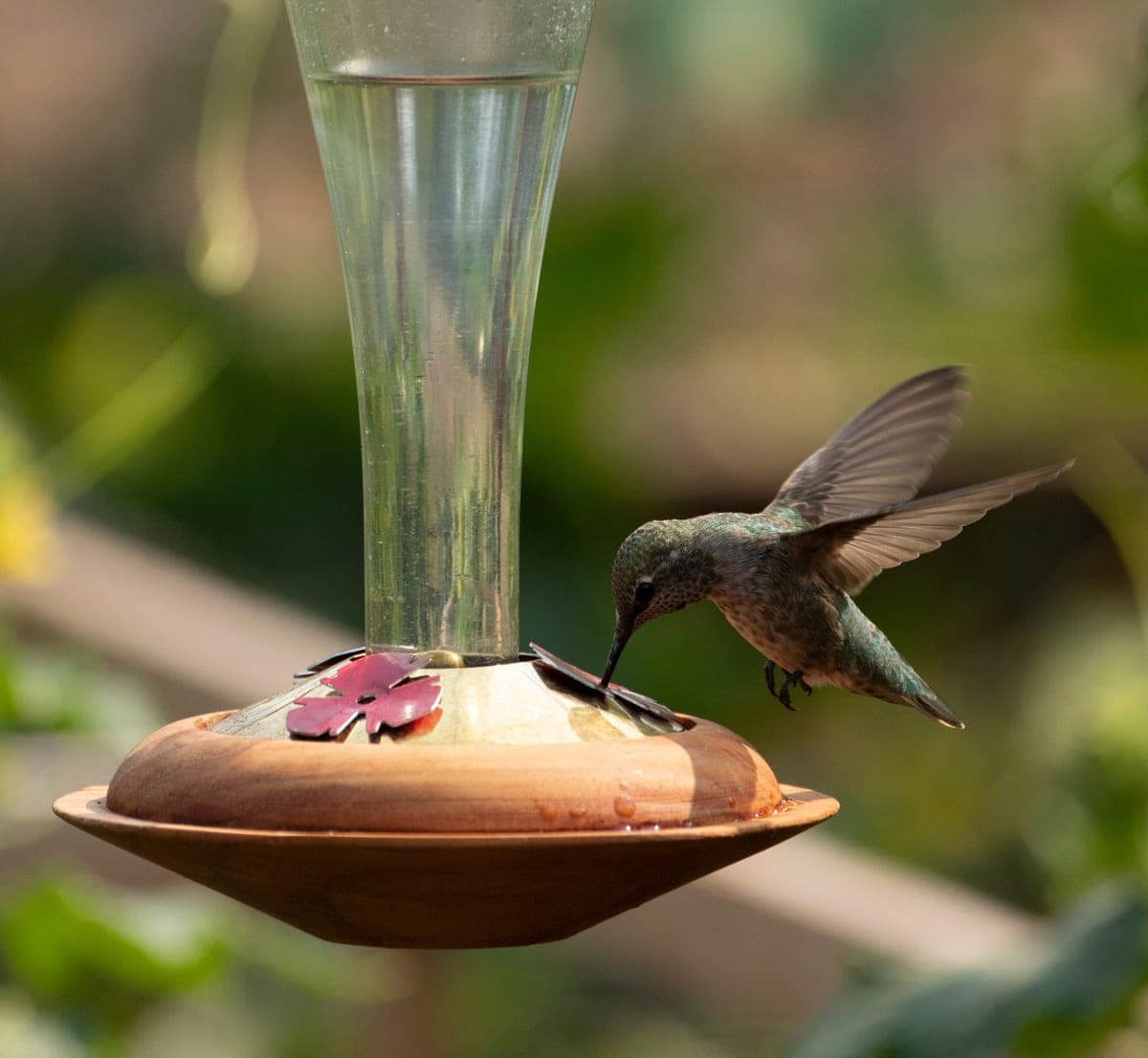
What we recommend here
| # | Product | Best for | Score | Price |
|---|---|---|---|---|
| 1 |  Aspects HummZinger HighView 12 oz Two-part saucer, moat in the lid, nothing to cross-thread | The better feeder | 9.2 out of 10 | |
| 2 | No product photo yet First Nature 3051 16 oz Ten ports and a wide-mouth jar for a fraction of the price | The better value | 8.6 out of 10 | |
| 3 |  Aspects HummZinger Excel 16 oz The same saucer design at 16 oz and six ports | If you want both | 8.7 out of 10 |
Scores are our own editorial ratings from the criteria on our methodology page. They are not customer ratings and they are not test results.
Why these two
These are the two feeders this site recommends more than any others, and they win on opposite grounds. The HummZinger HighView is our overall pick because it makes the every-few-days wash almost frictionless. The First Nature 3051 is our budget pick because it is the cheapest feeder in the category that is still genuinely easy to clean.
A reader who has read both of our reviews is usually stuck on one question: is the HighView worth several times the price of the 3051? That question has a real answer, and it is not the same answer for every yard.
We have not handled either feeder. Everything below is quoted from Aspects’ and First Nature’s published material and from retailer specifications, all cited at the bottom of this page. This is what we did instead of testing.
Side by side
| HummZinger HighView | First Nature 3051 | |
|---|---|---|
| Design | Saucer (dish) | Inverted bottle |
| Capacity | 12 oz | 16 oz |
| Feeding ports | 4 | 10 |
| Material | UV stabilized polycarbonate | Polymer, red and clear |
| Dimensions | 7-3/4" diameter x 1-3/4" tall | 7"D x 7"W x 9.25"H |
| Ant moat | Built into the lid | Not listed on every retailer’s spec sheet — check the bundle |
| Perch | Raised wraparound HighView perch | Round perch around the base |
| Leak control | Nectar sits below the ports; raised ports shed rain | Sealing ring in the base |
| Comes apart into | 2 pieces — cover lifts off the bowl | Jar plus a two-piece base |
| Dishwasher | Not stated | No — warm soapy water, no scalding water |
| Mounting | Hang or post mount | Hang |
| Made in | USA | USA |
One row in that table is deliberately hedged. Aspects states the ant moat as a built-in feature of the HighView lid. First Nature’s 3051 is sold in a lot of different bundles, and moats are called out on some listings and not on others — including bundles that ship moats as separate loose parts. We are not going to flatten that into a tick, because the reader who buys expecting a moat and does not get one has been misled by exactly the kind of tidy table that looks authoritative.
The design difference is the whole comparison
Everything else on this page follows from one structural fact: in a saucer, the nectar sits below the feeding ports. In an inverted bottle, it sits above them, held up by a vacuum.
That single difference is why the HighView cannot drip. There is no column of liquid pressing down on the ports, so when the sun warms the air in the reservoir there is nothing for the expanding air to push out. A bottle feeder in the same conditions can burp nectar onto the ground. First Nature addresses this with a sealing ring in the base, and it helps — but it is a seal fighting physics, where the saucer simply does not create the pressure in the first place.
It also explains the insect difference. Nectar that sits below the port is further from a bee’s reach, and a feeder that does not drip leaves no sticky trail advertising itself. The long-form version of this argument is on saucer vs bottle, and it is the reason this site defaults to saucers.
Cleaning access, which we treat as a safety spec
This is the criterion we weight most heavily, and not out of fastidiousness. Nectar needs changing every three to five days in moderate weather and daily when it is hot, with a wash at the same time. Over a season that is somewhere between forty and a hundred washes. A feeder that is a chore does not get cleaned on schedule, and fermented nectar and black mold in the ports are what actually harm birds. The cadence is on how often to clean a hummingbird feeder.
The HighView. Two pieces. Aspects describes the bright red cover as easily removed so the bowl can be cleaned quickly and thoroughly, and that is the entire procedure — lift the cover, wash a single open dish, reassemble. There are no threads to cross, no narrow neck, and no separate moat accessory to refill, because the moat is part of the lid.
The 3051. Better than its price suggests, which is precisely why it is the budget pick rather than a warning. The reservoir is a wide-mouth jar that takes a standard bottle brush without a fight, and the base comes apart in two pieces so you can reach the underside of the ports — the exact place mold takes hold on a cheap bottle feeder. First Nature’s stated method is to remove the entire two-piece base from the jar, wash with warm soapy water and rinse well.
It is still more steps. Three components instead of two, a jar that has to be inverted and reseated, and one explicit restriction: do not use scalding water and do not put it in the dishwasher, because the parts can deform. The HighView carries no such published warning. If you are the kind of person who cleans things by putting them somewhere hot, that restriction matters more than the price difference.
Either way, buy a port brush at the same time. The ports are the one place a stream of water does not reach, on both of these feeders.
Capacity and ports: 12 and 4 against 16 and 10
On paper the First Nature wins this outright — a third more nectar and more than twice the ports, for much less money. In practice it is more complicated, in both directions.
Capacity is not storage. Nectar spoils on the weather’s schedule, not on the schedule of how much you poured. Filling 16 oz in a quiet yard means pouring most of it down the drain every few days. For one or two regular visitors, the HighView’s 12 oz is closer to the right size, and half-filling either feeder is always allowed. There is a fuller treatment on what size hummingbird feeder to buy.
Ports are different, though. Hummingbirds are territorial, and a dominant bird will sit on a four-port feeder and drive others off. Ten ports spread around a wider body are genuinely harder for one bird to police. If you have a busy yard and you are watching one hummingbird chase every other one away, the 3051 is not the compromise option — it is the better answer, and it is also the cheaper one.
If that is your situation but you want the saucer design anyway, that is what the HummZinger Excel is for: the same two-part dish at 16 oz with six ports. It is the third pick above precisely because it resolves the tension this comparison is built on.
How long each one lasts
Aspects specifies UV stabilized polycarbonate, and the brand backs its feeders with a lifetime guarantee against defects in material and workmanship. Polycarbonate does eventually cloud over several seasons — glass does not, and we say so on glass vs plastic — but this is a feeder built to be kept.
The First Nature is a thinner polymer without an equivalent published guarantee, and the no-hot-water restriction is a hint about the material. Treat it as a feeder with a service life rather than an heirloom. That is not damning at this price; it is the honest frame for the purchase.
Price, and the arithmetic people get wrong
We do not print remembered prices anywhere on this site — the buttons above pull live figures or say “check price” instead. Qualitatively: the 3051 sits at the very bottom of the category’s price range, among the cheapest feeders you can buy that are worth buying, and the HighView sits in the mid range at several times that.
The tempting arithmetic is that you could buy several 3051s for one HighView, and that is true. But it is worth being honest about what it does and does not prove. Two feeders in different parts of the yard genuinely do reduce territorial fighting, so buying two cheap feeders instead of one good one is a real strategy and sometimes the right one. What it is not is a way to spend less time cleaning — two feeders is twice the washing, on the same schedule.
So the honest version is: if your constraint is money, the 3051 is an excellent feeder and you are not settling. If your constraint is the ten minutes on a Saturday morning, the HighView is what you are actually buying, and the price difference buys back roughly half the time you will spend at the sink over a season.
Where each one is weak
The HighView’s honest downsides. Twelve ounces and four ports is small for a genuinely busy yard. The polycarbonate clouds with age. It has no bee-excluding port tips fitted as standard — that is the HummZinger Ultra, a different model. And it costs several times what its rival does for less nectar and fewer ports, which is a real thing to swallow.
The 3051’s honest downsides. It is an inverted bottle, so it can drip as trapped air warms, and a dripping feeder is how an ant and bee problem starts. It is not dishwasher safe and must not meet scalding water. Sixteen ounces is more than most yards should be filling. And the ant-moat provision varies by bundle, so read what you are actually buying.
Buy the HighView if… buy the 3051 if…
Buy the Aspects HummZinger HighView if this is your main feeder and you intend to keep it for years. You have one to a few regular visitors, you want the wash to take two minutes and never involve a cross-threaded lid, and you would rather the ant moat were simply part of the feeder. This is the default recommendation on this site.
Buy the First Nature 3051 if price is the binding constraint, or if your yard is busy enough that four ports cause fighting, or if you want a second and third feeder spread around the garden without spending much. It is a genuinely good feeder, and the wide mouth and two-part base are why it beats every other feeder at its price.
Buy the HummZinger Excel instead if you find yourself wanting the HighView’s design and the 3051’s capacity. Sixteen ounces, six ports, and the same two-part saucer wash.
There is no wrong answer between these two, which is unusual in this category and worth saying plainly. Both are made in the USA, both come apart far enough to clean properly, and both are on our roundup for reasons that survive scrutiny. Read the full write-ups on the HighView and the 3051, or start again from how to choose a hummingbird feeder.
Recommended for this
What we’d buy
1. The better feeder
Aspects HummZinger HighView 12 oz
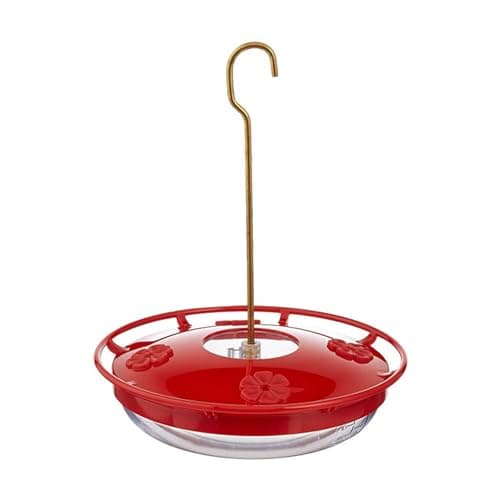
A four-port saucer feeder with the ant moat built into the lid and a cover that lifts straight off — the shortest path from hanging it up to washing it out.
- Type
- Saucer (dish)
- Capacity
- 12 oz
- Feeding ports
- 4
- Material
- Polycarbonate, metal hanger
- Dimensions
- 7.75" x 7.75" x 1.75"
- Ant moat
- Built in
- Perch
- Raised wraparound perch
- Mounting
- Hang or post mount
Our score: 9.2/10 — an editorial rating, not a customer rating or a test result.
Cleaning access
Two parts. The cover lifts off the base with no tools and no threads to cross, and the whole dish is one open bowl — a two-minute wash with a brush and hot water, which is exactly the cadence a nectar feeder needs. The moat is part of the lid, so there is no separate accessory to lose or forget to refill.
What works
- Saucer design puts nectar below the ports, so it does not drip as the air inside warms
- Ant moat is integral to the lid rather than a separate hanging accessory
- Opens to a single shallow bowl — the easiest shape in the category to scrub
- Raised ports shed rain, which keeps the nectar from being diluted
What doesn’t
- 12 oz is small for a busy yard
- Polycarbonate clouds over several seasons in a way glass does not
- No bee-excluding port tips fitted — that is the Ultra's feature, not the HighView's
Specifications from Duncraft — Aspects High View HummZinger and Amazon — Aspects HummZinger HighView 12 oz. We have not handled this feeder — here is what we did instead.
2. The better value
First Nature 3051 16 oz
Ten ports, a wide-mouth reservoir and a base that twists into two pieces — the cheapest feeder in the category that is genuinely easy to clean, which is the only reason it is here.
photo yet
- Type
- Inverted bottle
- Capacity
- 16 oz
- Feeding ports
- 10
- Material
- Plastic
- Base
- Patented two-part base, twists apart
- Reservoir
- Wide-mouth
- Ant moat
- Built into the base
- Dishwasher
- Not dishwasher safe — warm soapy water
Our score: 8.6/10 — an editorial rating, not a customer rating or a test result.
Cleaning access
Better than the price suggests. The reservoir mouth is wide enough to take a bottle brush without contortions, and the base twists into two pieces so you can reach the underside of the ports — the spot that grows mold first on a cheap bottle feeder. First Nature specifies warm soapy water, not the dishwasher.
What works
- Wide-mouth reservoir takes a standard bottle brush, unlike most budget bottle feeders
- Two-part base opens up the port undersides, which is where mold starts
- Ten ports and an integrated ant moat at the bottom of the category's price range
What doesn’t
- It is an inverted bottle, so it can drip as trapped air warms and pushes nectar out
- Not dishwasher safe, and the thin plastic would not enjoy a hot wash anyway
- Fill all 16 oz in a quiet yard and you will pour most of it away
Specifications from Oak Ridge Stores — First Nature FN3051. We have not handled this feeder — here is what we did instead.
3. If you want both
Aspects HummZinger Excel 16 oz
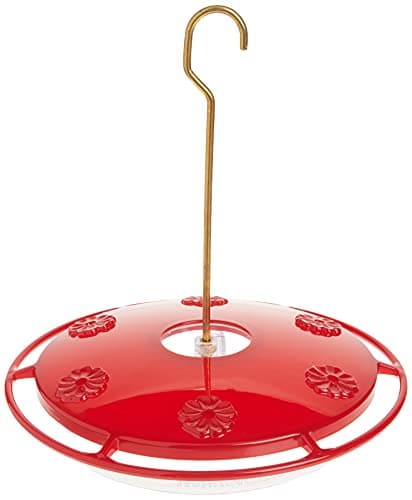
The saucer design scaled up to 16 oz and six ports, for the yard where a 12 oz feeder is empty by Tuesday and birds are queuing.
- Type
- Saucer (dish)
- Capacity
- 16 oz
- Feeding ports
- 6
- Material
- Polycarbonate
- Ant moat
- Built in
- Guarantee
- Lifetime guarantee (Aspects)
Our score: 8.7/10 — an editorial rating, not a customer rating or a test result.
Cleaning access
Identical two-part saucer routine to the rest of the HummZinger line — cover off, wash the bowl, done. The larger dish is if anything easier to get a brush around than the 12 oz.
What works
- Six ports genuinely reduces the fighting at a busy feeder
- Still a two-part saucer, so the extra capacity costs nothing in cleaning time
- Aspects' lifetime guarantee covers defects in material and workmanship
What doesn’t
- 16 oz of nectar spoils just as fast as 12 oz — capacity is not permission to clean less often
- Physically wider, which matters under a narrow eave
- No Nectar-Guard tips fitted as standard
Price as of October 17, 2026. #ad How we’re funded
Specifications from Greenhouse Megastore — Aspects HummZinger Excel and Amazon — Aspects HummZinger Excel. We have not handled this feeder — here is what we did instead.
Common questions
Frequently asked
Is the HummZinger HighView worth the extra money over the First Nature 3051?
If it is your main feeder and you will keep it for years, yes — the two-part saucer washes in about half the time and it cannot drip. If price is the binding constraint, or your yard is busy enough to need ten ports, the 3051 is a genuinely good feeder rather than a compromise.
Which one holds more nectar?
The First Nature 3051, at 16 oz against the HighView’s 12 oz. That is only an advantage in a busy yard — nectar spoils every three to five days regardless of how much you poured, so a large feeder in a quiet yard mostly gets emptied down the drain.
Which is easier to clean?
The HighView. It is two pieces — the cover lifts off and you wash one open bowl. The 3051 is a jar plus a two-piece base, and First Nature specifies warm soapy water with no dishwasher and no scalding water, because the parts can deform.
Does the First Nature 3051 come with an ant moat?
It depends on the bundle. Moats are called out on some 3051 listings and not others, and some multipacks ship them as separate loose parts. Check the listing you are buying. The HighView’s moat is built into the lid, so there is nothing to add or lose.
Should I just buy two First Nature feeders instead of one HummZinger?
It is a legitimate strategy — two feeders in different parts of the yard reduce territorial fighting. Just be clear about what it does not buy you: two feeders is twice the cleaning, on the same three-to-five-day schedule.
Sources
Where this came from
Read next
Related reading
By Scooter M.
an enthusiast who's genuinely into this. I read the manuals, compile the published specs, and do the math. No lab coat.
Published September 3, 2026