Reviews
Perky-Pet Pinch-Waist glass feeder review
Remarkable value in a shape that has one known weakness. There is also a parts difference between the two sizes that nobody tells you about before you buy.
We earn a commission on purchases made through our links, at no extra cost to you. We don’t accept free products or paid placements. Full disclosure.
Buy the 8 oz version, model 203CPBN. Both sizes give you a glass reservoir, four flower-shaped ports each with its own perch, a built-in ant moat and built-in bee guards — an unusual amount of included engineering at this price. The 8 oz is the capacity most yards should actually own, it costs less, and it is one of the four models Perky-Pet’s replacement bee guards fit. The 16 oz 210PB is not on that list.
What we recommend here
| # | Product | Best for | Score | Price |
|---|---|---|---|---|
| 1 |  Perky-Pet Pinch-Waist Glass 8 oz (203CPBN) 8 oz, same ports and defenses, takes replacement bee guards | Buy this size | 8.3 out of 10 | $7.97 on Amazon $9.36 15% off |
| 2 |  Perky-Pet Pinch-Waist Glass 16 oz (210PB) Same design, more capacity than most yards need | The 16 oz version | 8.0 out of 10 | |
| 3 |  Aspects HummZinger HighView 12 oz A saucer cannot push nectar out of its ports | If drips would bother you | 9.2 out of 10 |
Scores are our own editorial ratings from the criteria on our methodology page. They are not customer ratings and they are not test results.
What it is
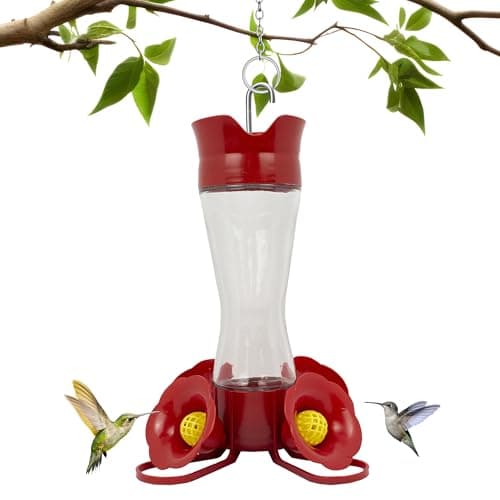
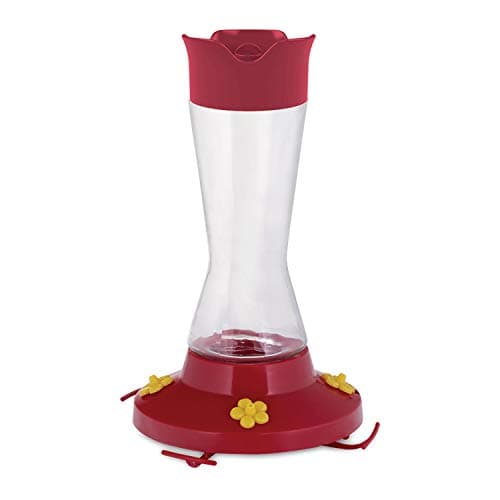
A glass bottle feeder with a pinched waist, sold in two sizes that share a design. The 16 oz 210PB stands 7.1 inches tall. The 8 oz 203CPBN is 8.38 x 7.25 x 7.25 inches and weighs 0.7 lb — wider, oddly, despite holding half as much.
Both have four flower-shaped feeding ports, each with its own perch, a built-in ant moat you fill with water at the top of the lid, and built-in flower-shaped bee guards. Both are hardened glass and plastic, and Perky-Pet states both disassemble completely for cleaning, including pulling the base apart to remove the feeding ports.
We have not handled either. Everything here is quoted from Perky-Pet’s own product pages and cited at the foot of this page — this is what we do instead of testing.
Why it is good value
At the budget end of this category you normally pick one thing you care about. Glass, or an ant moat, or bee guards. This feeder includes all three at a price below most bare plastic feeders.
Glass matters more than it sounds. Polycarbonate exposed to sugar water and sunlight develops a permanent haze after a couple of seasons — not dirt, and no amount of scrubbing removes it. Once a reservoir is hazed you cannot tell by looking whether the nectar has gone cloudy, and looking is how most people decide it is time to wash. The full argument is in glass vs plastic.
Both insect defenses are included, not sold as extras. Ants arrive down the hanging wire and are stopped only by water; bees fly to the ports and are stopped only by port geometry. They are unrelated problems with unrelated fixes, as set out in bee guards vs ant moats, and a feeder arriving with both handled has saved you two decisions and two purchases.
A perch at every port. Hummingbirds perch about three quarters of the day and hovering is the most expensive thing they do, so a perch at the port is a real feature rather than styling — see feeders with perches.
The leak question
It is one of the most common things people ask about this feeder, so let us be precise about what is and is not a fault.
This is an inverted bottle feeder. The reservoir sits above the ports and is held up by a pressure balance. Warm the trapped air in the bottle through the afternoon and it expands, pushing nectar out through the ports. That is not a defect, it is geometry, and no gasket or tighter assembly eliminates it — the physics are laid out in saucer vs bottle feeders.
What you can do about it: seat the base square and fully, keep the feeder out of direct afternoon sun, and do not overfill. Shade attacks the actual cause, because less thermal expansion means less expelled nectar — which is also why shade beats height in our placement guidance.
What you cannot do is make a bottle behave like a dish. If drips on your deck or railing would genuinely annoy you, buy a saucer instead; a saucer holds nectar below the ports and structurally cannot push it out. That is the reason the HummZinger is the third pick on this page.
There is a second reason to care beyond tidiness. Sugar water on the outside of a feeder is what bees actually feed on, so a dripping feeder undoes the work its own bee guards are doing. Wipe the glass down at every nectar change.
The parts trap: the two sizes are not equivalent
This is the most useful thing on this page and it is almost impossible to work out from the listings.
Perky-Pet sells replacement bee guards, model 205Y, as a four-pack for a couple of dollars. They snap open for cleaning, which is unusual and good. Perky-Pet publishes exactly which feeders they fit: 203CPBN, 203CPBR, 204CP-4 and 403CP — and states on its own site that if they are not fitting, your feeder is most likely not one of those models.
The 8 oz 203CPBN is on that list. The 16 oz 210PB is not.
Bee guards are a wear part. They are flexible plastic sitting in sun and sugar for seasons, and they go brittle. If you buy the 8 oz you can replace them for the price of a coffee; if you buy the 16 oz, as far as Perky-Pet publishes, you cannot, and a cracked guard means a port with no bee defense for the life of the feeder. The retrofit market will not save you either, because every add-on guard on sale is locked to one manufacturer’s models — the finding behind add-on bee guards.
That alone is enough to pick the smaller model, and it happens to be the size we would have recommended anyway.
Perky-Pet’s own cleaning advice is too slow on one model
Worth flagging because it comes from the manufacturer and it is wrong.
Perky-Pet’s page for the 16 oz 210PB says to clean the feeder at least once per week, and more often in very warm climates. That is sound. Its page for the 8 oz 203CPBN says to clean it at least every two weeks.
Follow the weekly figure, for both. Nectar needs changing every three to five days in moderate weather and daily in real heat, with a full break-down wash at least weekly — that is Cornell and Clemson guidance and it does not bend by model number, as set out in how often to clean a hummingbird feeder. Fermented nectar and mold in the ports are what actually harm hummingbirds. A two-week wash on a feeder that has been sitting in sun with sugar in it is not enough, and we would rather contradict Perky-Pet than repeat it.
Cleaning access in practice
Good for a bottle feeder, and the published detail is specific in the way we like: the base, bottle and lid separate, and the base itself pulls apart so the feeding ports come out.
Ports coming out is the spec that matters, because nectar ferments inside the port rather than in the middle of the reservoir, and a port you cannot remove is a port you are never really cleaning. The wide mouth takes a bottle brush for the reservoir.
It is still four or five components against a two-part saucer, and the moat is a shallow well in the lid rather than a deep cup, so it evaporates fast in exactly the hot still weather when ants are worst — the standing caveat on every built-in moat. Top it up whenever you change the nectar.
Who should buy it
Buy the 8 oz 203CPBN if you want glass with both insect defenses included at the lowest price we have found, and you are willing to wipe the outside down and keep it in shade.
Buy the 16 oz 210PB only if your yard genuinely drinks 8 oz in under three days, and accept the replacement-guard limitation. It is compared directly against the More Birds Ruby in Ruby vs Pinch-Waist.
Buy neither if drips are what brought you here, or if you want the fastest possible wash. A two-part saucer like the HummZinger HighView costs more and solves both, and it is our overall top pick for a reason.
The verdict
Genuinely good value, with one shape-related weakness and one parts asymmetry you should know before choosing a size. For a first feeder on a budget, or a second feeder to place out of sight of your first, the 8 oz Pinch-Waist does more than its price suggests. Ignore Perky-Pet’s two-week cleaning line and wash it weekly.
Recommended for this
What we’d buy
1. Buy this size
Perky-Pet Pinch-Waist Glass 8 oz (203CPBN)
The 8 oz Pinch-Waist: same glass, same four perched ports, same built-in moat and bee guards as its 16 oz sibling, at half the capacity and a lower price.
- Type
- Glass bottle
- Capacity
- 8 oz
- Feeding ports
- 4, flower-shaped, each with a perch
- Ant moat
- Built in
- Bee guards
- Built in
- Dimensions
- 8.38"H x 7.25"W x 7.25"D
- Weight
- 0.7 lb
- Material
- Glass, plastic
- Model
- 203CPBN
Our score: 8.3/10 — an editorial rating, not a customer rating or a test result.
Cleaning access
Perky-Pet states it "disassembles completely for effortless cleaning." Note the cleaning cadence on Perky-Pet's own page for this model: it says clean at least every two weeks. That is slacker than the evidence supports and slacker than Perky-Pet's own advice on the 16 oz version, which says at least weekly. Follow the weekly figure.
What works
- 8 oz is the capacity most yards should be buying, not 16
- Ant moat and bee guards both built in at the cheapest price of any glass feeder we cover
- A perch at each of the four ports
- Completely disassembles, per Perky-Pet
- One of the four models Perky-Pet's 205Y replacement bee guards actually fit
What doesn’t
- Perky-Pet's own page for this model advises cleaning only every two weeks — too slow; wash it weekly
- Inverted bottle, so it can drip as trapped air warms
- The moat is a shallow lid well and evaporates fast in heat
- Wider footprint (7.25 in) than the 16 oz model despite holding less
Specifications from Perky-Pet — 8 oz Pinch Waist Glass Hummingbird Feeder (203CPBN). We have not handled this feeder — here is what we did instead.
2. The 16 oz version
Perky-Pet Pinch-Waist Glass 16 oz (210PB)
Sixteen ounces of glass with both defenses already fitted — a moat in the lid and a flower-shaped bee guard at every port — for the price of a bare feeder.
- Type
- Glass bottle
- Capacity
- 16 oz
- Feeding ports
- 4, each with a perch
- Ant moat
- Built in — fill the top of the lid with water
- Bee guards
- Built in, flower-shaped, one per port
- Material
- Hardened glass, plastic
- Dimensions
- 7.1"H
- Model
- 210PB
Our score: 8.0/10 — an editorial rating, not a customer rating or a test result.
Cleaning access
Perky-Pet states the feeder disassembles so the base, bottle and lid separate, and that the base pulls apart so the feeding ports come out. The wide mouth is the other half of it — a bottle brush reaches the whole reservoir. Perky-Pet's own instruction is to clean at least weekly, and more often in hot weather.
What works
- Ant moat and bee guards both built in, not sold separately
- Ports come out of the base, so they can genuinely be cleaned
- Glass reservoir at a budget-feeder price
- A perch at each of the four ports
What doesn’t
- The moat is a shallow well in the lid — it evaporates fast and needs topping up
- Bottle feeder, so the reservoir sits above the ports and can drip
- 16 oz is more than a quiet yard will finish in three days
- The bright red plastic top and base will fade over seasons outdoors
Specifications from Perky-Pet — 16 oz Pinch Waist Glass Hummingbird Feeder (210PB). We have not handled this feeder — here is what we did instead.
3. If drips would bother you
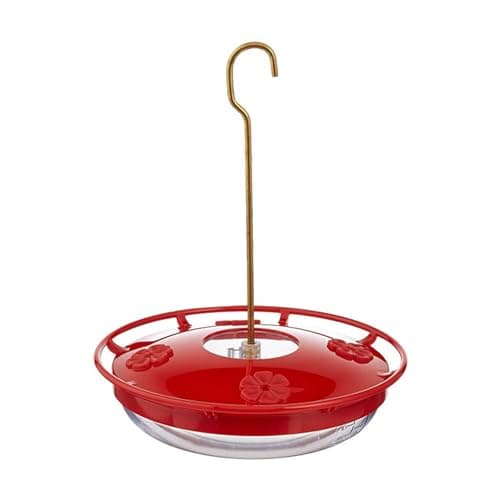
Aspects HummZinger HighView 12 oz
A four-port saucer feeder with the ant moat built into the lid and a cover that lifts straight off — the shortest path from hanging it up to washing it out.
- Type
- Saucer (dish)
- Capacity
- 12 oz
- Feeding ports
- 4
- Material
- Polycarbonate, metal hanger
- Dimensions
- 7.75" x 7.75" x 1.75"
- Ant moat
- Built in
- Perch
- Raised wraparound perch
- Mounting
- Hang or post mount
Our score: 9.2/10 — an editorial rating, not a customer rating or a test result.
Cleaning access
Two parts. The cover lifts off the base with no tools and no threads to cross, and the whole dish is one open bowl — a two-minute wash with a brush and hot water, which is exactly the cadence a nectar feeder needs. The moat is part of the lid, so there is no separate accessory to lose or forget to refill.
What works
- Saucer design puts nectar below the ports, so it does not drip as the air inside warms
- Ant moat is integral to the lid rather than a separate hanging accessory
- Opens to a single shallow bowl — the easiest shape in the category to scrub
- Raised ports shed rain, which keeps the nectar from being diluted
What doesn’t
- 12 oz is small for a busy yard
- Polycarbonate clouds over several seasons in a way glass does not
- No bee-excluding port tips fitted — that is the Ultra's feature, not the HighView's
Specifications from Duncraft — Aspects High View HummZinger and Amazon — Aspects HummZinger HighView 12 oz. We have not handled this feeder — here is what we did instead.
Common questions
Frequently asked
Why does my Perky-Pet Pinch-Waist leak?
Because it is an inverted bottle feeder. The reservoir sits above the ports and trapped air expands as it warms, pushing nectar out. That is geometry rather than a fault. Seat the base square, do not overfill, and keep it out of afternoon sun — shade attacks the cause. Only a saucer design avoids it entirely.
Which size should I buy, 8 oz or 16 oz?
The 8 oz 203CPBN. It is the capacity most yards should own, it costs less, and it is one of the four models Perky-Pet’s 205Y replacement bee guards fit — the 16 oz 210PB is not on that list, so a cracked guard cannot be replaced.
Can you get replacement parts for the Pinch-Waist?
Replacement bee guards (205Y) fit the 203CPBN, 203CPBR, 204CP-4 and 403CP. Perky-Pet publishes that list and says that if they do not fit, your feeder is not one of those models. Check the model number molded into or printed on the base before ordering — see add-on bee guards.
How often should I clean it?
Weekly, with nectar changed every three to five days and daily in real heat. Perky-Pet’s own page for the 8 oz model says every two weeks; that is slower than the evidence supports and slower than Perky-Pet’s own advice for the 16 oz. Use the weekly figure.
Does it have an ant moat and bee guards?
Both, built in on both sizes. The moat is a shallow well in the top of the lid that you fill with water, so it needs topping up every time you change the nectar and it dries out fastest in hot still weather. The bee guards are flower-shaped and fitted one per port.
Sources
Where this came from
- Perky-Pet - 8 oz Pinch Waist Glass Hummingbird Feeder (203CPBN): 8 oz, 4 ports with perches, built-in bee guards and ant moat, 8.38 x 7.25 x 7.25 in, 0.7 lb, disassembles completely, clean at least every 2 weeks
- Perky-Pet - 16 oz Pinch Waist Glass Hummingbird Feeder (210PB): 16 oz, 4 ports with perches, built-in ant moat and bee guards, 7.1 in H, clean at least once per week
- Perky-Pet - Yellow Replacement Bee Guards (205Y): fits models 203CPBN, 203CPBR, 204CP-4 and 403CP
Read next
Related reading
By Scooter M.
an enthusiast who's genuinely into this. I read the manuals, compile the published specs, and do the math. No lab coat.
Published October 3, 2026