Reviews
More Birds Ruby vs Perky-Pet Pinch-Waist
Two glass bottles at the same price, both with the moat and the bee guards already fitted. The specs are close enough that one number settles it.
We earn a commission on purchases made through our links, at no extra cost to you. We don’t accept free products or paid placements. Full disclosure.
The More Birds Ruby, on capacity. Both are glass bottle feeders at a budget price, both include an ant moat and bee guards, and both come apart for cleaning — genuinely close on paper. The Ruby holds 10 oz against the Pinch-Waist’s 16 oz, and on a feeder whose contents must be thrown out every three to five days regardless, smaller is the better specification. Buy the Pinch-Waist instead if your yard is busy enough to empty it.

What we recommend here
| # | Product | Best for | Score | Price |
|---|---|---|---|---|
| 1 |  More Birds Ruby 10 oz Glass 10 oz, four bee-guard ports, moat on top | Winner - better size, five perches | 8.3 out of 10 | $16.99 on Amazon $22.48 24% off |
| 2 |  Perky-Pet Pinch-Waist Glass 16 oz (210PB) 16 oz, four ports each with a perch | Buy this if your yard is busy | 8.0 out of 10 |
Scores are our own editorial ratings from the criteria on our methodology page. They are not customer ratings and they are not test results.
Why this is a close call
These two feeders sit in the same place on the shelf and answer the same question: what is the most feeder you can get for a budget price without giving up either insect defense?
Both are glass bottle feeders. Both have four feeding ports. Both include bee guards at the ports. Both have an ant moat built into the top rather than sold separately. Both have a detachable base and a wide mouth so a brush reaches the reservoir. At the price, having both defenses included is unusual — most feeders at this level give you one, or neither.
So the comparison comes down to a small number of real differences, and one of them matters much more than the rest.
Where they are effectively identical
Insect defense. Four bee-guard ports each, and an ant moat on the top of each. If you were choosing on that basis alone there is nothing between them. The moats are the same kind of shallow well in both cases, meaning both need topping up with water regularly and both will dry out in hot, still weather — the standing caveat on every built-in moat.
Material. Glass reservoirs on both. This is the actual reason to buy either over a plastic feeder at the same price: glass does not develop the cloudy film polycarbonate takes on after a few seasons of sugar water, so “clean” and “looks clean” stay the same thing. The trade-offs are in glass vs plastic feeders.
Cleaning access. Both have a detachable base and a wide bottle mouth. Perky-Pet goes further in print, stating that the base pulls apart so the feeding ports come out; More Birds is less explicit about the ports. That is a point to Perky-Pet on documentation, though in practice both are ordinary bottle feeders to clean and neither approaches a two-part saucer.
Drips. Both are inverted bottle feeders and both can drip for the same structural reason: the reservoir sits above the ports, and air trapped inside expands as it warms and pushes nectar out. Neither wins here; if this is your main concern, neither of these is your feeder.
The difference that decides it: capacity
The Ruby holds 10 oz. The Pinch-Waist holds 16 oz.
Sixty percent more capacity reads like the Pinch-Waist winning. On this site it is the Ruby winning, and the reasoning is the same as everywhere else: nectar has to be changed every three to five days in moderate weather and daily in real heat, and that clock does not care how full the feeder is. Capacity you do not drink is not stored, it is discarded.
In an average yard the 16 oz feeder is not lasting longer than the 10 oz one. It is being emptied half full, twice a week, which costs a little more sugar every time and makes the wash marginally bigger for no benefit.
The exception is real and worth stating: if your yard genuinely gets through 10 oz in under three days, the extra capacity stops being waste and starts being useful, and the Pinch-Waist is the better buy. The sizing question in general is in what size feeder should you get.
The perches: five against four
The Ruby has five integrated perches to the Pinch-Waist’s four, one at each of its four ports. That is a smaller point than the capacity, but it goes the same way.
Perches matter more than most buyers expect. Hummingbirds spend the majority of the day perched, and hovering to feed is expensive; a bird that can sit and drink is getting more out of the visit. Five perches on a 10 oz feeder is generous provision. The wider argument is in feeders with perches.
Size and siting
The Pinch-Waist is the more compact object despite holding more: 7.1 inches tall against the Ruby’s 8.75 inches, and narrower at the waist, which is where the name comes from. If you are hanging under a low eave or working with tight clearance on a deck hook, that is a genuine point in its favor.
The Ruby is wider at 6.5 inches across, which is worth knowing if you plan to add a weather dome — the dome has to be wider than the feeder’s widest point, so the Ruby wants a 12 inch dome where the Pinch-Waist would be covered by a 10.5 inch one.
Documentation, and why we mention it
Perky-Pet publishes more about this feeder than More Birds does about the Ruby: the model number 210PB, the height, the disassembly detail down to the ports, and a plain instruction to clean at least weekly and more often in hot weather.
That is worth a little on its own. A manufacturer that prints a cleaning cadence is a manufacturer taking the actual failure mode of its product seriously, and Perky-Pet is unusually good at this kind of documentation across its range — we go into it in who makes the best hummingbird feeders. It is not enough to overturn the capacity argument, but if the two were level on everything else it would be the tiebreaker.
Setting either of them up properly
Whichever you pick, three things turn a cheap glass feeder into a good one, and all three are free.
Put water in the moat on day one. A built-in moat that nobody fills is decoration. Top it up whenever you change the nectar, and check that nothing — a leaf, a twig, a second chain — gives ants a dry bridge around it.
Hang it in afternoon shade. Both of these are bottle feeders, and bottle feeders drip because trapped air expands as it warms. Shade attacks the cause rather than the symptom, and it slows spoilage at the same time, which is why shade beats height in our placement guidance.
Wipe the outside, not just the inside. Sugar water on the outside of the glass is what actually recruits bees, and on a bottle feeder there will be some. Thirty seconds with a cloth at every nectar change does more for a bee problem than either feeder’s bee guards do.
Which will last longer?
One size note before the materials: the Pinch-Waist also comes as an 8 oz model, which is the size we would actually buy, and only that smaller version takes Perky-Pet’s replacement bee guards. Both points are in our Pinch-Waist review.
Neither has a meaningful edge in materials — both are glass reservoirs on plastic bases with metal hardware, and the plastic is what will go first on either.
The difference is what happens next. Perky-Pet publishes model numbers and sells replacement parts across its range, and prints the compatibility lists for them, so a cracked component on a 210PB is a part number rather than a dead feeder. More Birds is sold through the same website and parts do exist, but the Ruby is documented less precisely. On a feeder at this price, that is worth more than any spec on the box, and it is the reasoning behind who makes the best hummingbird feeders.
Which should you buy?
Most people: the More Birds Ruby. Ten ounces is the better size for a typical yard, five perches beats four, and you give up nothing on insect defense or material. It is reviewed in full in our More Birds Ruby review.
Buy the Perky-Pet Pinch-Waist if your yard empties a 10 oz feeder in under three days, or if you need the shorter, narrower shape for a tight hanging spot.
Buy neither if drips are what brought you here. Both are inverted bottle feeders and both will push nectar out of the ports on a hot afternoon. A saucer feeder cannot do that, cleans in two parts rather than four, and is the recommendation we make more often than any other on this site — see saucer vs bottle and the main roundup.
Recommended for this
What we’d buy
1. Winner - better size, five perches
More Birds Ruby 10 oz Glass
A 10 oz glass bottle with four bee-guard ports, five perches and the ant moat built into the top — the cheapest way to get glass without giving up either insect defense.
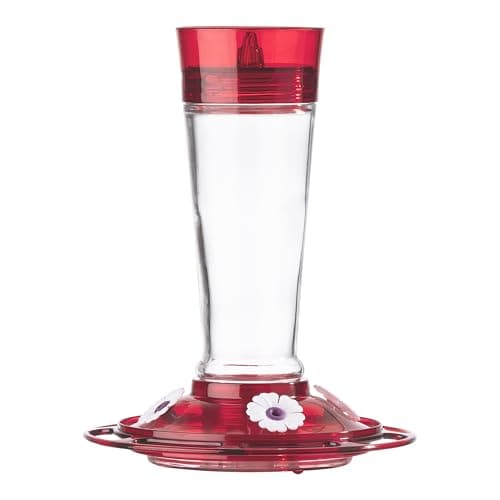
- Type
- Glass bottle
- Capacity
- 10 oz
- Feeding ports
- 4, bee-guard style
- Perches
- 5 integrated
- Material
- Glass, plastic and metal
- Dimensions
- 8.75"H x 6.5"W x 6.5"D
- Ant moat
- Built in, on top
- Base
- Detachable flat base
Our score: 8.3/10 — an editorial rating, not a customer rating or a test result.
Cleaning access
The flat base detaches and the bottle opening is wide, so you can reach every surface. Glass is the real advantage: it does not hold the cloudy film polycarbonate develops after a couple of seasons of sugar water, so 'clean' and 'looks clean' stay the same thing.
What works
- Glass reservoir does not stain or cloud the way polycarbonate does
- Four bee-guard ports and a built-in ant moat, both included rather than sold as extras
- Five perches on a 10 oz feeder is generous — perched birds drink longer and fight less
What doesn’t
- Glass breaks; a pole-mounted feeder in a windy spot is a bad match
- 10 oz is modest, so this is a second feeder in a busy yard rather than the only one
- Still an inverted bottle, so it shares the bottle-design drip risk
Specifications from Perky-Pet — More Birds Bird Health+ Ruby Hummingbird Feeder and Amazon — More Birds Bird Health+ Ruby Hummingbird Feeder. We have not handled this feeder — here is what we did instead.
2. Buy this if your yard is busy
Perky-Pet Pinch-Waist Glass 16 oz (210PB)
Sixteen ounces of glass with both defenses already fitted — a moat in the lid and a flower-shaped bee guard at every port — for the price of a bare feeder.
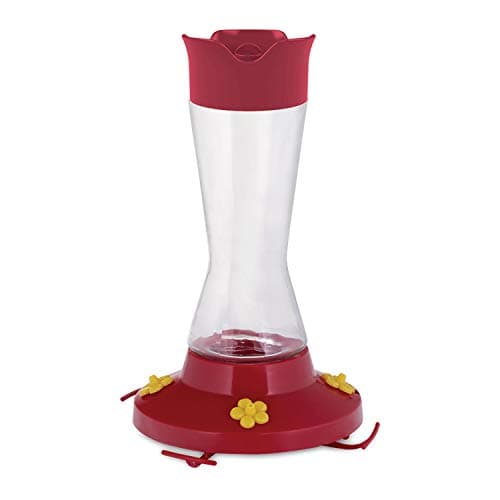
- Type
- Glass bottle
- Capacity
- 16 oz
- Feeding ports
- 4, each with a perch
- Ant moat
- Built in — fill the top of the lid with water
- Bee guards
- Built in, flower-shaped, one per port
- Material
- Hardened glass, plastic
- Dimensions
- 7.1"H
- Model
- 210PB
Our score: 8.0/10 — an editorial rating, not a customer rating or a test result.
Cleaning access
Perky-Pet states the feeder disassembles so the base, bottle and lid separate, and that the base pulls apart so the feeding ports come out. The wide mouth is the other half of it — a bottle brush reaches the whole reservoir. Perky-Pet's own instruction is to clean at least weekly, and more often in hot weather.
What works
- Ant moat and bee guards both built in, not sold separately
- Ports come out of the base, so they can genuinely be cleaned
- Glass reservoir at a budget-feeder price
- A perch at each of the four ports
What doesn’t
- The moat is a shallow well in the lid — it evaporates fast and needs topping up
- Bottle feeder, so the reservoir sits above the ports and can drip
- 16 oz is more than a quiet yard will finish in three days
- The bright red plastic top and base will fade over seasons outdoors
Specifications from Perky-Pet — 16 oz Pinch Waist Glass Hummingbird Feeder (210PB). We have not handled this feeder — here is what we did instead.
Common questions
Frequently asked
Do both the Ruby and the Pinch-Waist have ant moats?
Yes, both have one built into the top rather than sold separately. Both are shallow wells, so both need topping up with water regularly and both dry out fastest in the hot, still weather when ants are worst.
Which one holds more nectar?
The Perky-Pet Pinch-Waist, at 16 oz against the Ruby’s 10 oz. On this site that counts against it for most yards, because nectar has to be discarded every few days regardless of how much is left.
Which is easier to clean?
Close, and neither is in the class of a two-part saucer. Both have a detachable base and a wide mouth. Perky-Pet documents it better, stating that the base pulls apart so the feeding ports come out, which is the detail that matters most.
Are More Birds and Perky-Pet the same company?
Perky-Pet sells More Birds products on its own website, which is the clearest public link between the two lines. We have not characterized the corporate structure beyond that.
Will either of them drip?
Both can. They are inverted bottle feeders, so the reservoir sits above the ports and trapped air pushes nectar out as it warms through the day. That is geometry rather than a fault, and only a saucer design avoids it.
Sources
Where this came from
Read next
Related reading
By Scooter M.
an enthusiast who's genuinely into this. I read the manuals, compile the published specs, and do the math. No lab coat.
Published September 21, 2026