Reviews
Roamwild Window Hummingbird Feeder review
It answers the exact criticism we make of every other built-in ant moat. Then it makes a freshness claim we have to push back on.
We earn a commission on purchases made through our links, at no extra cost to you. We don’t accept free products or paid placements. Full disclosure.
The best-engineered window feeder we have found, at a capacity we would argue you down from. Roamwild gives it two independent ant moats rather than one, so the protection does not end the first hot afternoon a moat dries out; bee exclusion is built into the port geometry rather than sold as an add-on; and a tulip-shaped UV canopy shades the nectar. The catch is 20 fluid ounces on a window, which is a lot of sugar water to throw away every three to five days.

What we recommend here
| # | Product | Best for | Score | Price |
|---|---|---|---|---|
| 1 |  Roamwild Window Hummingbird Feeder Two moats, engineered ports, UV canopy, twist-off base | Most engineering on a window feeder | 8.2 out of 10 | |
| 2 |  Aspects Gem Window Feeder 4 oz 4 oz on the glass, and the bracket stays put when you wash it | The small alternative | 8.1 out of 10 | $23.35 on Amazon $25.43 8% off |
| 3 |  Aspects HummZinger HighView 12 oz 12 oz, two parts, washes in a minute | If it does not have to be a window | 9.2 out of 10 |
Scores are our own editorial ratings from the criteria on our methodology page. They are not customer ratings and they are not test results.
What it is
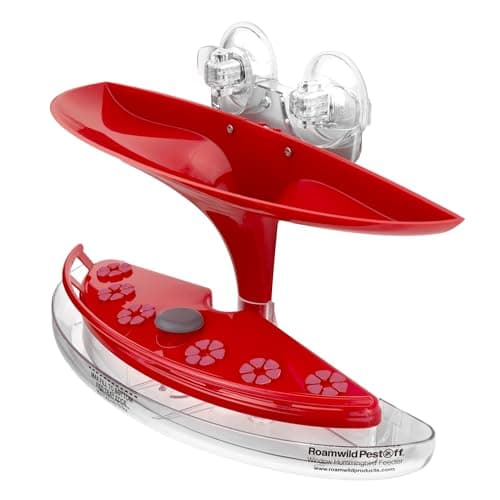
A 20 fl oz window-mounted feeder with five feeding ports, held on by what Roamwild describes as ultra-strong dual suction cups with built-in vacuum clips that “lock it securely and hold in all temperatures, hot or cold.” The body is UV-resistant unbreakable polycarbonate with a stainless steel, rust-proof hook, and it measures 8.7 inches high by 8.6 inches in diameter at 0.8 lb.
Three features do the actual work, and all three are unusual on a window feeder: two independent ant moats, feeding ports engineered to exclude bees, and an integrated tulip-shaped UV canopy over the nectar.
We have not tested this feeder. Every figure here is quoted from Roamwild’s own product pages and cited at the foot of this page, and where the company publishes nothing we say so instead of guessing. Our method is in how we choose picks.
One note on which Roamwild this is
Roamwild makes two hummingbird feeders: this window model and a hanging version with the same double-moat and port design. When we checked availability for this review, the hanging model came back currently unavailable with no price, so it is not a pick here and we have not given it a buy link — a link to an unavailable listing is a link to a dead page.
If you came looking for the hanging one, that is the position as of this writing. The window model below is the Roamwild hummingbird feeder you can actually buy.
The double moat is a real answer to a real objection
This is the part worth paying attention to, because it addresses a criticism we make on practically every page where a moat comes up.
An ant moat is not a repellent. It is a gap filled with water that ants will not cross, and it works right up until the water is gone. The built-in moats on most feeders are shallow wells molded into a lid, and a shallow well in hot, dry, still weather can empty in a day or two — which is precisely the weather in which ant pressure peaks. That is the standing caveat in feeders with a built-in ant moat and the reason capacity is the specification that matters on a standalone moat.
Roamwild’s answer is redundancy rather than volume: two independent water-filled moats, so in the company’s words, even if one runs dry in the heat the second keeps protecting the nectar. That is a sensible piece of engineering and we have not seen it anywhere else in this category. Two shallow moats that fail at different times are genuinely better than one shallow moat, and it costs the buyer nothing extra to maintain — you are topping up both at the same moment anyway.
The honest limit. A moat can only block a path that runs through it. On a hanging feeder that is easy, because there is exactly one route: down the wire. A suction-cup window mount is a different situation — ants can approach across the glass, along the window frame and over the bracket, and Roamwild’s published material does not show how the two moats sit relative to every one of those routes. So we would expect this to be a real improvement over a window feeder with no moat at all, and we are not going to promise it is airtight, because the geometry that makes a moat absolute on a hanging feeder does not transfer unchanged to a window.
Bee exclusion, built in rather than bolted on
Roamwild states the feeding ports are engineered so that only a hummingbird’s long tongue can reach the nectar, and that bees, wasps and yellow jackets physically cannot get to the sugar water.
That is the correct mechanism. A hummingbird has a bill plus a tongue that extends well beyond it; a honeybee has a proboscis measured in a few millimeters. Every genuine bee-proof design exploits that gap by putting the nectar somewhere a bird can reach and an insect cannot — the full argument is in the best bee-proof feeders.
Having it designed in matters more than it sounds, because retrofitting is mostly not possible. As we found in add-on bee guards, every retrofit guard on the market is locked to one manufacturer’s feeders, so “I will add bee guards later” is not a plan for most models. A feeder that arrives with the problem solved is worth a premium over one that does not.
The trade-off arrives at the sink, and we will come back to it: ports restrictive enough to stop a wasp are restrictive enough to be awkward to clean.
The freshness claim, and why we are pushing back
Roamwild says the integrated UV canopy shields the nectar from direct UV rays and delivers “2× longer nectar freshness.”
The first half is straightforwardly true and genuinely useful. Heat and sun are what drive spoilage fastest; shading a feeder is such a real effect that we recommend siting for afternoon shade above almost every other placement consideration, and it is the quiet second benefit of a weather dome. A canopy built into the feeder is a sound idea.
But do not read a freshness multiplier as permission to change the nectar less often, because that is not what it means. Two things set the change interval, and UV is only one of them. The other is contamination: nectar is compromised as soon as birds start drinking from it, and no amount of shade does anything about that. Which is why the schedule does not move — every three to five days in moderate weather, daily in real heat, as set out in how often to clean a feeder.
We have not seen the testing behind “2×” and Roamwild does not publish it, so we are reporting it as the manufacturer’s claim rather than as a finding. Treat the canopy as what it is: a good reason to expect the nectar to be in better condition at day three than it would be in full sun. Not a reason to leave it until day six.
Cleaning: good architecture, restrictive ports
Roamwild states the base twists off and the feeder is 100% dishwasher safe, with “no narrow necks, no hard-to-reach areas.”
The twist-off base is the right architecture and the single most important thing on the spec sheet after the moats. A feeder that opens into a wide bowl is a feeder that actually gets washed, which is the argument running through the easiest feeders to clean. No narrow neck means a brush is not fighting a bottle throat.
The dishwasher claim gets our standard caveat, and here it carries extra force. A machine will do a fine job on the reservoir, the base and the canopy. It will not scrub the inside of a feeding port — and on this feeder the ports are deliberately restrictive, because that restriction is the entire bee-proofing mechanism. The part most likely to harbor fermenting nectar is the part a dishwasher is least likely to reach. Do the five ports by hand with a port brush, every wash. The full routine is in how to clean a hummingbird feeder, and the dishwasher question in general is in can you put a feeder in the dishwasher.
Twenty ounces is the real problem
Everything above is positive. This is the part that keeps the score at 8.2 rather than higher.
Twenty fluid ounces is a large hummingbird feeder by our standards — we recommend 8 to 16 oz for most yards — and it is a very large window feeder. For comparison, the Aspects Gem holds 4 oz and the Perky-Pet 217 holds 8 oz.
Capacity is not storage. Nectar gets discarded on the weather’s schedule no matter how much is left, so a reservoir larger than your birds drink is not extra time, it is extra waste. And a window feeder is usually chosen for a close-up view from one specific room rather than to serve a crowd, which makes 20 oz an odd fit for the use case — the sizing arithmetic is in what size feeder should you get.
It is also weight on suction cups. Filled, 20 oz of nectar is over a pound of liquid on top of the feeder’s own 0.8 lb. Roamwild’s vacuum-clip cups are clearly built for it and the company is specific about holding in heat and cold, which is more than most suction mounts claim. Still, the practical advice is the same as the sizing advice: fill it part way. You get the same feeder, less weight on the glass, and less nectar down the drain.
What Roamwild does not publish
A warranty term. The window product page invites you to register a warranty but names no duration, and the hanging model’s page describes a “PestOff Promise” to make it right if insects reach the nectar, again without a stated period.
We are not treating that as disqualifying — it is a confident promise and an unusual one to make. But it is not the same as a number, and it is worth knowing that you are buying into a policy rather than a term. Compare Aspects, which prints a lifetime guarantee on its feeders and its domes alike; the comparison is drawn out in who makes the best hummingbird feeders.
Who should buy it
Buy it if you want a window feeder and insects are your actual problem. Nothing else on the window shelf arrives with two moats and engineered bee exclusion, and if you have fought ants or wasps at a window feeder before, this is the one designed against both. The UV canopy and the twist-off base are genuine additions rather than marketing.
Buy the Aspects Gem instead if you want the smallest sensible amount of nectar on the glass, or if the price gap matters — the Gem is a fraction of the cost and its suction cup holds a removable bracket so the seal is never disturbed when you wash it. Buy the Perky-Pet 217 if you want cheap and completely strippable.
And if it does not actually have to be a window: a hanging saucer like the HummZinger HighView will be easier to clean, cheaper, and easier to site well. The window format is a choice about the view, not about the feeding — which is the framing in the best window feeders.
The verdict
Recommended, with the capacity caveat stated plainly. Roamwild has done something genuinely uncommon here: it identified the two failure modes that actually ruin feeders — ants getting in and nectar cooking in the sun — and engineered against both rather than adding ports and colors. The double moat in particular is the first design we have seen that answers our own objection to built-in moats instead of repeating it.
Then it put all of that on a 20 oz reservoir and claimed a freshness multiplier, and those two things pull against the discipline that keeps hummingbirds safe. Fill it part way, change it on the normal schedule, brush the ports by hand, and it is a very good window feeder.
Recommended for this
What we’d buy
1. Most engineering on a window feeder
Roamwild Window Hummingbird Feeder
The only window feeder we have found with two independent ant moats, engineered bee-exclusion ports and a UV canopy — and the only one whose capacity we would argue you down from.
- Type
- Window mount (suction cup)
- Capacity
- 20 fl oz
- Feeding ports
- 5
- Ant moats
- 2, independent (double moat technology)
- Bee guards
- Port geometry — maker states only a hummingbird's tongue reaches the nectar
- Shade
- Integrated tulip-shaped UV canopy
- Mounting
- Dual suction cups with built-in vacuum clips
- Material
- UV-resistant unbreakable polycarbonate; stainless steel hook
- Dimensions
- 8.7"H x 8.6" diameter, 0.8 lb
Our score: 8.2/10 — an editorial rating, not a customer rating or a test result.
Cleaning access
Roamwild states the base twists off and the feeder is 100% dishwasher safe, with "no narrow necks, no hard-to-reach areas." The twist-off base is the part that matters and it is a genuinely good design. Treat the dishwasher claim the way we treat all of them: it will do the reservoir and the canopy, and it will not scrub the inside of a feeding port — and on this feeder the ports are deliberately restrictive in order to exclude bees, so they are exactly the part a machine is least likely to reach. Do those by hand.
What works
- Two independent ant moats, so one drying out does not end the protection
- Bee exclusion is built into the port geometry rather than sold as an add-on
- Integrated UV canopy shades the nectar, which genuinely slows spoilage
- Twist-off base with no narrow neck — the right cleaning architecture
- UV-resistant polycarbonate body and a stainless, rust-proof hook
What doesn’t
- 20 fl oz is a great deal of nectar to have stuck to a window on a 3-5 day discard cycle
- Roamwild's "2x longer nectar freshness" claim must not be read as license to change nectar less often
- Costs roughly double the cheaper window feeders we recommend
- No warranty duration published — the page asks you to register but names no term
- A moat only blocks a path that runs through it, and a suction-cup mount gives ants more than one route
Price as of October 16, 2026. #ad How we’re funded
Specifications from Roamwild - Window Mounted Bee Proof Hummingbird Feeder (capacity, 5 ports, double moat, UV canopy, dual suction cups, twist-off base, dimensions) and Roamwild - Hanging Bee Proof Hummingbird Feeder (same double-moat and port design, for comparison). We have not handled this feeder — here is what we did instead.
2. The small alternative
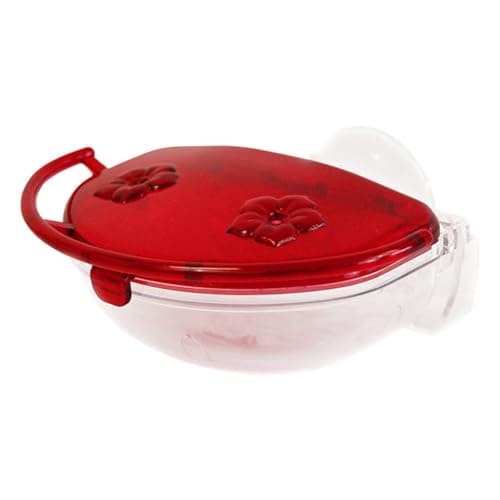
Aspects Gem Window Feeder 4 oz
A 4 oz, two-port window feeder whose suction cup holds a bracket rather than the feeder itself — so the feeder lifts off for washing and the cup stays seated on the glass.
- Type
- Window mount
- Capacity
- 4 oz
- Feeding ports
- 2, raised flowers
- Perch
- HighView perch
- Material
- Plastic, red lid with clear basin
- Dimensions
- About 5.25" x 3.25" x 1.75"
- Mounting
- Suction cup holding a removable bracket
- Insect defense
- Optional Nectar-Guard tips; Gem Anti-Insect kit sold separately
Our score: 8.1/10 — an editorial rating, not a customer rating or a test result.
Cleaning access
The feeder lifts off its window bracket, so you carry the feeder to the sink and leave the suction cup undisturbed on the glass — which matters, because re-seating a cup every few days is exactly what breaks the seal. The lid lifts for refilling and a locking tab holds it shut. Two ports is the easiest set to brush of anything on this site.
What works
- Feeder lifts off the bracket, so washing it never disturbs the suction cup
- 4 oz is emptied before it can spoil, even in heat
- Clear basin with an engraved nectar scale makes part-filling accurate
- Made in Rhode Island and covered by Aspects' lifetime guarantee
What doesn’t
- One suction cup — the mounting style we are wary of on larger feeders
- Only two ports, which one territorial bird can guard with no effort
- No bee defense in the box; Nectar-Guard tips and the Anti-Insect kit are extra
- 4 oz is too small to be anyone's only feeder
Specifications from Aspects - Gem Hummingbird Window Feeder (Item# 437) and Duncraft - Aspects Gem Window Hummingbird Feeder specifications. We have not handled this feeder — here is what we did instead.
3. If it does not have to be a window
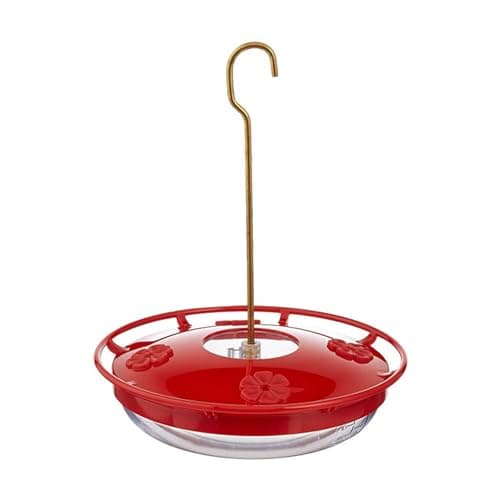
Aspects HummZinger HighView 12 oz
A four-port saucer feeder with the ant moat built into the lid and a cover that lifts straight off — the shortest path from hanging it up to washing it out.
- Type
- Saucer (dish)
- Capacity
- 12 oz
- Feeding ports
- 4
- Material
- Polycarbonate, metal hanger
- Dimensions
- 7.75" x 7.75" x 1.75"
- Ant moat
- Built in
- Perch
- Raised wraparound perch
- Mounting
- Hang or post mount
Our score: 9.2/10 — an editorial rating, not a customer rating or a test result.
Cleaning access
Two parts. The cover lifts off the base with no tools and no threads to cross, and the whole dish is one open bowl — a two-minute wash with a brush and hot water, which is exactly the cadence a nectar feeder needs. The moat is part of the lid, so there is no separate accessory to lose or forget to refill.
What works
- Saucer design puts nectar below the ports, so it does not drip as the air inside warms
- Ant moat is integral to the lid rather than a separate hanging accessory
- Opens to a single shallow bowl — the easiest shape in the category to scrub
- Raised ports shed rain, which keeps the nectar from being diluted
What doesn’t
- 12 oz is small for a busy yard
- Polycarbonate clouds over several seasons in a way glass does not
- No bee-excluding port tips fitted — that is the Ultra's feature, not the HighView's
Specifications from Duncraft — Aspects High View HummZinger and Amazon — Aspects HummZinger HighView 12 oz. We have not handled this feeder — here is what we did instead.
Common questions
Frequently asked
What is Roamwild's double moat, and does it work better than one?
Two independent water-filled moats instead of one. Roamwild’s reasoning is that if one runs dry in the heat the second still protects the nectar, which addresses the main weakness of every built-in moat — a shallow well evaporates fastest in exactly the weather ants are worst in. Two moats that fail at different times are genuinely better than one. The limit is that a moat only blocks a route that passes through it, and a window mount gives ants more than one route.
Does the UV canopy mean I can change the nectar less often?
No. Shade genuinely slows spoilage and the canopy is a good feature, but the change interval is also set by contamination from the birds themselves, which shade does nothing about. Keep to every three to five days in moderate weather and daily in real heat. We report Roamwild’s “2× longer freshness” as the maker’s claim — the supporting testing is not published.
Is the Roamwild hanging hummingbird feeder available?
Not when we checked for this review — the hanging Double Moat Guard model came back currently unavailable with no price, so we have not given it a buy link. The window model is the Roamwild hummingbird feeder you can buy, and it uses the same double-moat and port design.
Can you put the Roamwild feeder in the dishwasher?
Roamwild says yes, 100% dishwasher safe, with no narrow necks. The reservoir, base and canopy will come out fine. The five feeding ports will not — they are deliberately restrictive in order to exclude bees, which makes them the part a machine is least likely to clean. Brush those by hand.
Is 20 oz too big for a window feeder?
For most people, yes. Nectar is discarded every three to five days regardless of level, so a reservoir bigger than your birds drink is waste rather than convenience, and a window feeder is usually about a close-up view from one room rather than serving a crowd. Fill it part way — you also put less weight on the suction cups.
Sources
Where this came from
- Roamwild - Window Mounted Bee Proof Hummingbird Feeder: 20 fl oz, 5 ports, 2 independent moats, engineered bee-proof ports, tulip UV canopy, dual vacuum-clip suction cups, twist-off base, 100% dishwasher safe, 8.7in H x 8.6in dia, 0.8 lb
- Roamwild - Hanging Bee Proof Hummingbird Feeder: same double-moat and port design, UV-resistant polycarbonate, stainless hook, PestOff Promise
Read next
Related reading
By Scooter M.
an enthusiast who's genuinely into this. I read the manuals, compile the published specs, and do the math. No lab coat.
Published September 26, 2026